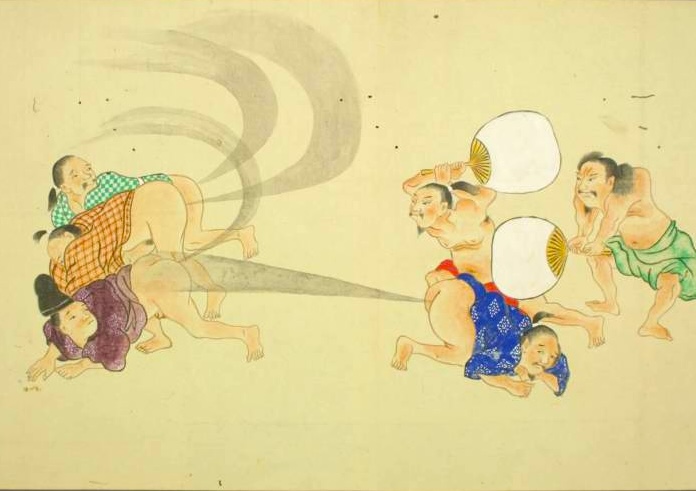
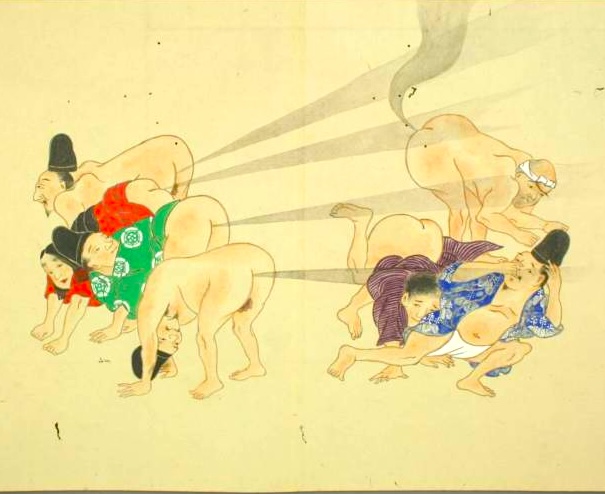
In the prestigious archives of the Waseda University Library in Tokyo, there exists a digitized artifact that consistently surprises historians and art enthusiasts alike. It is not a solemn religious text or a record of imperial decrees. It is a hand scroll, or emakimono, known as the He-gassen, which translates directly to “Fart Battle” or “Fart Competition.”
Created in 1846, this intricate work of ink and color on paper presents a vivid and uninterrupted narrative of men and women engaging in combat. However, their weapons are not swords or arrows. Instead, the figures on the scroll are depicted bending over and unleashing powerful gusts of flatulence to defeat their opponents in a chaotic skirmish.
Origins in the Waseda University Archives
The physical scroll measures approximately 29.6 centimeters (11.7 inches) in height and stretches an impressive 1003.1 centimeters (32.9 feet) in length. The work is dated to the third year of the Koka era, specifically 1846. While similar drawings appear in earlier periods of Japanese art history, this specific late-Edo period artifact remains the most widely referenced and verified example.
The artist used traditional techniques to render the scenes with high fidelity. The digitized version provided by the library allows viewers to scroll from right to left, observing the sequence of events as they were originally intended to be viewed. The scroll remains a tangible object that is carefully preserved within the library’s Special Collection.
Visualizing the Ballistics of Flatulence
The illustrations within the He-gassen follow a clear progression of events. The artist depicted groups of people consuming large quantities of food, likely taro roots or other gas-inducing ingredients, to prepare their bodies for the confrontation.
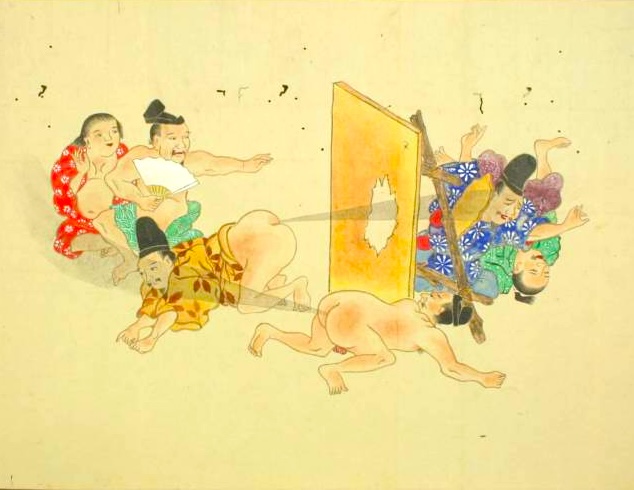
As the battle commences, the scroll visualizes the wind leaving the human body as distinct, forceful streams of grey and blue lines. These drawn lines represent the trajectory and power of the gas. The combatants are shown in various stages of undress, positioning themselves to aim directly at their targets. Some figures attempt to block the noxious attacks using fans or wooden boards, but the illustrations suggest the force is often too great to withstand.
The Destruction of Property and Animals
The narrative of the scroll escalates into total structural devastation. The artist drew scenes where the blasts of gas are strong enough to punch holes through wooden doors and paper screens. In one particularly detailed section, a horse is shown being blown completely off the ground by a collective attack. Another segment depicts a cat being hurled through the air by the wind.
The chaos extends beyond direct combat. Several figures are shown filling large bags with their gas, effectively creating biological weapons to be released later. The scroll concludes its visual story with the characters and their surroundings completely upended by the events. The He-gassen exists today as a preserved record of this specific artistic subject matter from 19th-century Japan.