
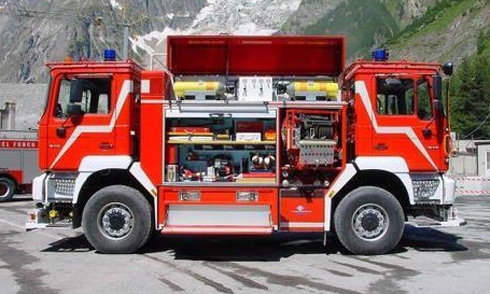
In 2015, the city of Nanjing, China, acquired a $1.5 million fire apparatus that appeared to be two vehicles fused together.
This truck featured a fully functional driver’s cabin at both ends, allowing it to change direction without ever needing to turn around. While this unusual design captured international attention as a modern engineering marvel, the mechanical concept originated from a catastrophic event deep beneath the Alps sixteen years earlier.
Disaster in the Mont Blanc Tunnel
On March 24, 1999, a Volvo refrigerator truck carrying flour and margarine entered the Mont Blanc tunnel connecting France and Italy. Halfway through the 7-mile passage, the vehicle caught fire. The narrow, two-lane tunnel quickly filled with toxic smoke, trapping dozens of cars and heavy goods vehicles.
Rescuers from both sides attempted to reach the blaze, but their standard fire engines were unable to navigate the congested, smoke-filled corridor. Abandoned cars blocked the path, and traditional trucks lacked the maneuverability to retreat or bypass obstacles. The fire burned for 53 hours, reaching temperatures of 1,830 °F (around 999 °C), and resulted in the deaths of 39 people.
Engineering a Specialized Response
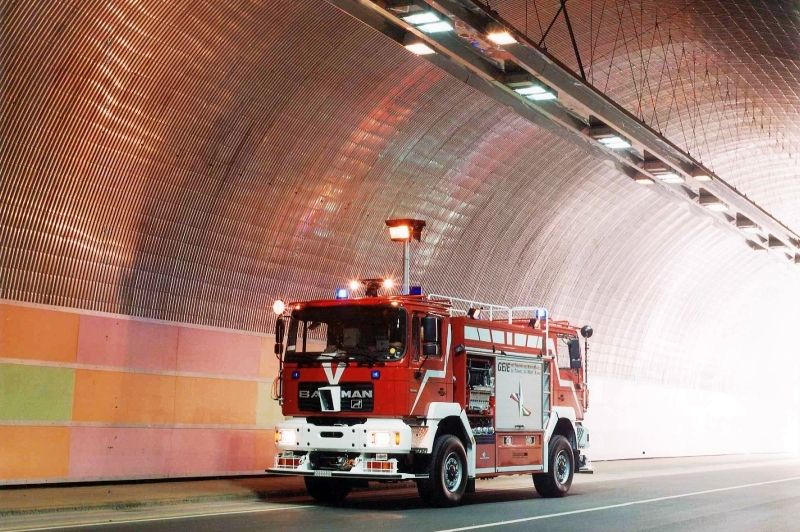
Following the disaster, authorities sought a vehicle that could navigate the unique constraints of a tunnel environment. The result was the MAN BAI Janus 4000 “Bifronte,” named after the two-faced Roman god. Unlike standard trucks, the Janus was built with two identical cabs and an advanced four-wheel steering system.
This allowed the vehicle to “crab-walk” sideways or pivot sharply around stalled cars. Most importantly, if the path ahead became too dangerous, the driver could simply switch to the opposite cabin and drive out in the other direction at speeds up to 75 mph (120 km/h) without needing to execute a three-point turn.
Advanced Protection for Extreme Heat
The Janus 4000 was designed to survive the exact conditions that paralyzed rescuers in 1999. It features a pressurized cabin to keep smoke out and an independent oxygen supply for the crew.
To combat zero-visibility conditions, the truck utilizes infrared cameras that display heat signatures on dashboard monitors, allowing operators to “see” through thick black smoke. The exterior is equipped with high-capacity water and foam turrets that can be operated via joysticks from inside the protected cab.
Global Adoption of Tunnel Safety
While the Janus 4000 was originally a site-specific solution for the Mont Blanc tunnel, its utility in dense urban environments led to further adoption. Nanjing’s decision to purchase a similar model highlighted the growing need for specialized equipment in cities with narrow streets and heavy traffic.
These vehicles represent a fundamental shift in emergency response, where the ability to move in any direction is a critical requirement for saving lives in confined spaces. Moving away from traditional designs, these trucks provide a technical answer to the logistical nightmares found in the world’s most difficult rescue environments.