

In the quiet, canal-lined streets of 17th-century Edam, a child was born who would literally overlook her entire generation. While the Dutch Golden Age was famous for its grand masters and global trade, the town of Edam produced a marvel of a different sort: Trijntje Cornelisdochter Keever.
Born in April 1616, she entered the world as the daughter of a local skipper, Cornelis Keever, and his wife, Anna Pouwels. Nothing in her modest beginnings suggested that she would eventually look down upon the tallest men of Europe, yet by the time she was a teenager, she had grown into a phenomenon that demanded the attention of kings.
A Growth Beyond Measure
Trijntje’s stature became apparent almost immediately. By the age of nine, she had already surged to a height of 2 meters (6 feet 7 inches), dwarfing her parents and neighbors. Her father, recognizing that his daughter’s extraordinary size was a unique curiosity, decided to capitalize on it. Instead of a typical childhood, Trijntje’s life became one of public exhibition.
Her parents took her on the road, traveling to various carnivals and fairs throughout the Netherlands. Spectators paid to witness the girl who could clean rain gutters without a ladder and whose shadow stretched longer than that of any grown man in the town square.
A Royal Audience
Her reputation spread far beyond the local fairgrounds. In June 1625, the exiled King of Bohemia, Frederick V, along with his wife Elizabeth Stuart and Princess Amalia of Solms-Braunfels, made a stop in Edam specifically to see the “nine-year-old girl taller than every man in Europe.”
The royal party was reportedly astounded by what they saw. The child stood before the monarchs, not as a subject looking up, but as a giant looking down. This royal visitation cemented her status as a documented historical figure rather than a mere folktale, providing verifiable witnesses to her immense scale during her short lifetime.
Life on the Road
Despite the royal interest, Trijntje’s daily reality involved the rigors of travel and constant display. She was known as De Groote Meid (The Big Girl) and spent her adolescence moving from town to town. Evidence suggests she suffered from acromegaly, a condition that causes unchecked growth. While this made her a spectacle, it also placed an immense strain on her body.
Her joints and bones bore the weight of a frame that refused to stop expanding. By her late teens, she had reached an astounding height of 9 Amsterdam feet. In modern measurements, this translates to approximately 2.54 meters (8 feet 4 inches), making her likely the tallest woman in recorded history.
The Final Measure
The traveling life came to an abrupt end in the summer of 1633. While in the town of Ter Veen, Trijntje passed away at the age of only 17. The cause was likely complications from her rapid growth or cancer, a common ailment for those with her condition.
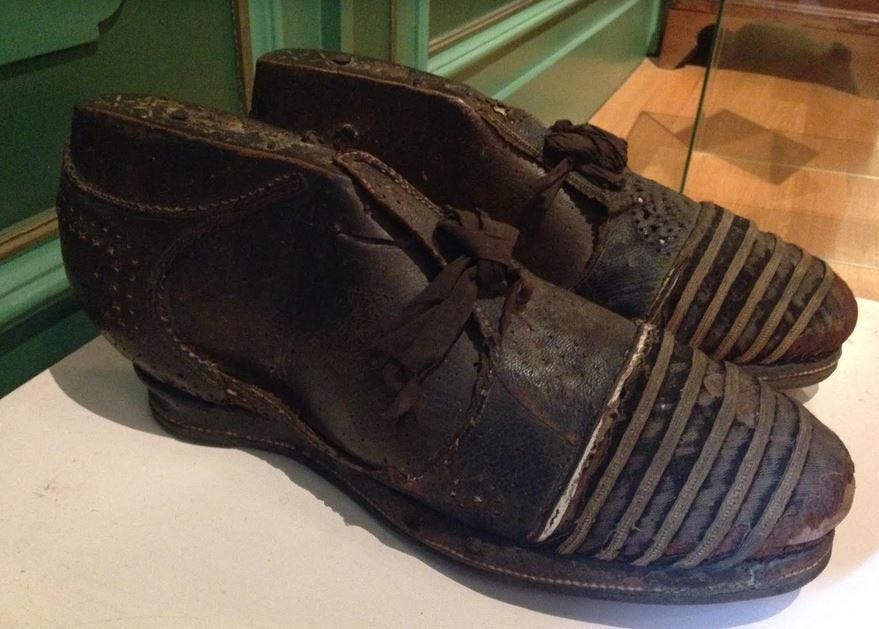
She was brought back to Edam and buried on July 7, 1633. Today, the Edam Museum holds the physical proof of her existence: a life-size painting commissioned shortly after her death and her original leather shoes. These shoes measure 36 centimeters (14 inches) in length, serving as a tangible record of the girl who once walked these streets, towering over a world that was too small for her.