
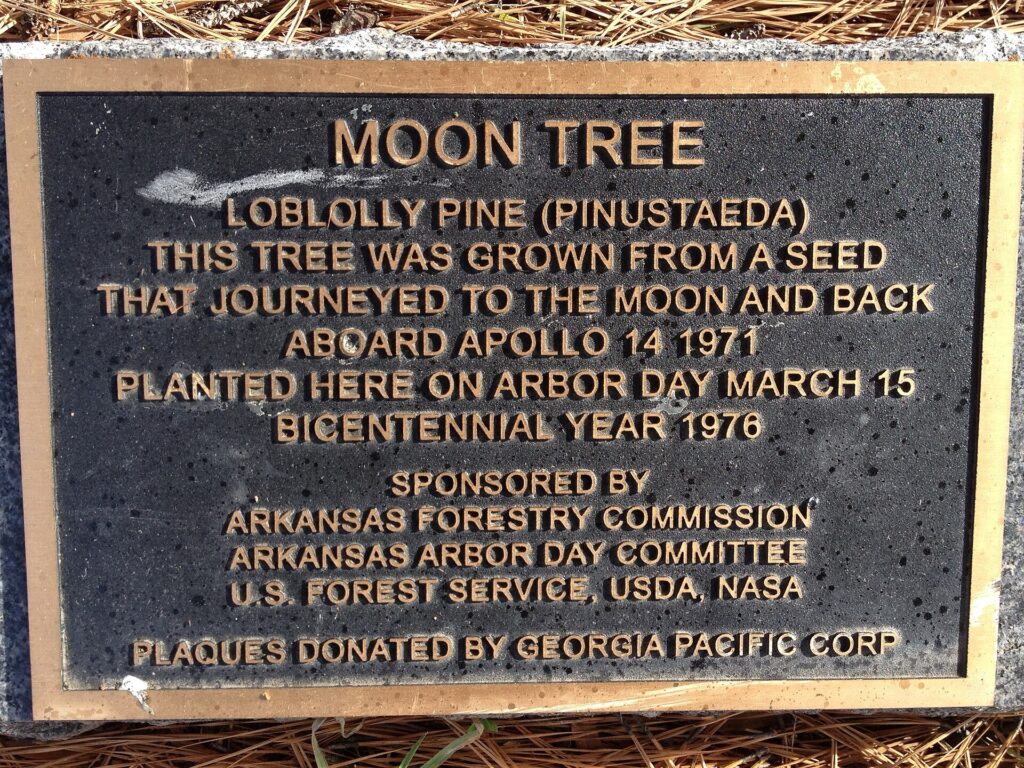
In 1971, while Astronaut Alan Shepard was famously hitting golf balls on the lunar surface, a different kind of life form was silently orbiting above him. Tucked away in the personal kit of Command Module Pilot Stuart Roosa were five hundred seeds.
These tiny travelers—future redwoods, pines, sycamores, and firs—circled the Moon thirty-four times, traveling farther into the universe than any plant in history. Today, their descendants are growing in parks, universities, and government buildings across the Earth, often completely unknown to the people walking past them. This is the fascinating history of the “Moon Trees.”
The Smokejumper’s Cargo
Before he was an astronaut, Stuart Roosa served as a smokejumper for the U.S. Forest Service, parachuting into wildfires to suppress flames. When he was selected for the Apollo 14 mission, the Forest Service contacted him with a unique scientific proposal.
They wanted to determine if the harsh radiation and microgravity of deep space would alter the genetics of plants. Roosa agreed to the experiment and packed a small metal canister containing seeds from five specific species: loblolly pine, sycamore, sweetgum, redwood, and Douglas fir. While his crewmates walked on the lunar dust below, Roosa and his canister remained in the Command Module Kitty Hawk, exposed to the depths of space.
Disaster in the Decontamination Chamber
When the crew splashed down in the Pacific Ocean, the experiment nearly ended in failure before it began. During the strict decontamination procedures designed to protect Earth from potential “moon germs,” the metal canister containing the seeds was exposed to a vacuum. It burst open, scattering the seeds inside the chamber and exposing them to the harsh sterilization chemicals. NASA scientists and Forest Service researchers feared the embryos were dead. The chaotic mix of seeds was gathered up and sent to Forest Service stations in Mississippi and California to see if anything could be salvaged. To everyone’s surprise, nearly all of them germinated successfully.
A Galaxy of Trees
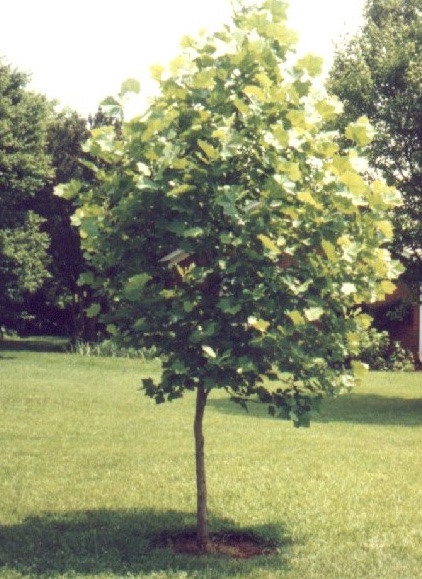
By 1975, the Forest Service had over 400 healthy seedlings ready for the soil. To celebrate the nation’s bicentennial in 1976, these “Moon Trees” were shipped out to state forestry organizations, universities, and foreign dignitaries. They were planted at the White House, in Brazil, in Switzerland, and in town squares across the United States.
However, in the rush of distribution, record-keeping was incredibly sloppy. No comprehensive list was kept of where every tree went. As the years passed, the plaques rotted away or were stolen, and the space travelers blended perfectly into the landscape.
The Hunt for the Lost Forest
For decades, the location of most Moon Trees was a complete mystery. Then, in 1996, a third-grade teacher named Joan Goble and her students found a tree with a plaque in Indiana. She emailed NASA, only to find that the agency had no idea the tree existed.
This sparked a worldwide scavenger hunt. NASA archivist Dave Williams began compiling a database, relying on tips from the public to locate the missing trees. Today, over eighty have been identified, still growing silently among us, biologically identical to their Earth-bound cousins but possessing a history that is literally out of this world.