
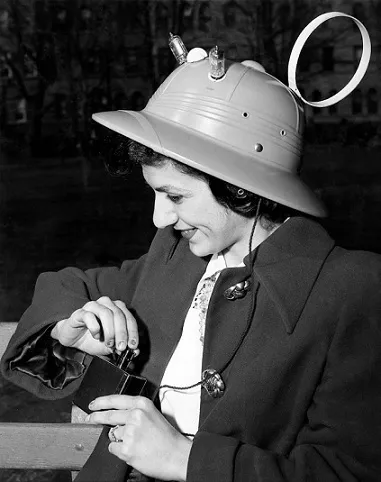
In early 1949, Americans walking down the street could tune into live broadcasts using nothing but their headwear. Long before pocket transistors and smartphones became the global standard, an eccentric Brooklyn novelty manufacturer introduced a fully functioning radio built directly into a standard pith helmet. It was officially marketed as the “Man-from-Mars Radio Hat” and retailed for $7.95.
The strange gadget promised to pull in AM broadcast stations from up to 20 miles (32 kilometers) away. The device sparked an immediate media frenzy, appearing in magazines from coast to coast and transforming teenagers into walking broadcast receivers.
The Vacuum Tube Design
Victor Hoeflich, the founder of the American Merri-Lei Corporation, conceptualized the device. His company was already highly profitable, shipping millions of paper Hawaiian leis and party noisemakers across the country. Because the modern transistor had only just been invented and remained an incredibly expensive laboratory curiosity, Hoeflich had to rely on existing vacuum tube technology.
Instead of hiding the bulky components, he made them the central visual feature of the hat. Two large vacuum tubes protruded directly from the front of the helmet, alongside a visible loop antenna and a prominent tuning knob. An internal battery pack provided 1.5 volts for the filaments and a 22.5-volt supply, which could power the portable radio for up to 20 hours of listening time.
A Nationwide Publicity Campaign
Hoeflich understood the visual appeal of his invention and immediately launched a massive press campaign. In March 1949, he held a press conference where local teenagers modeled the colorful hats for newspaper photographers and reporters.
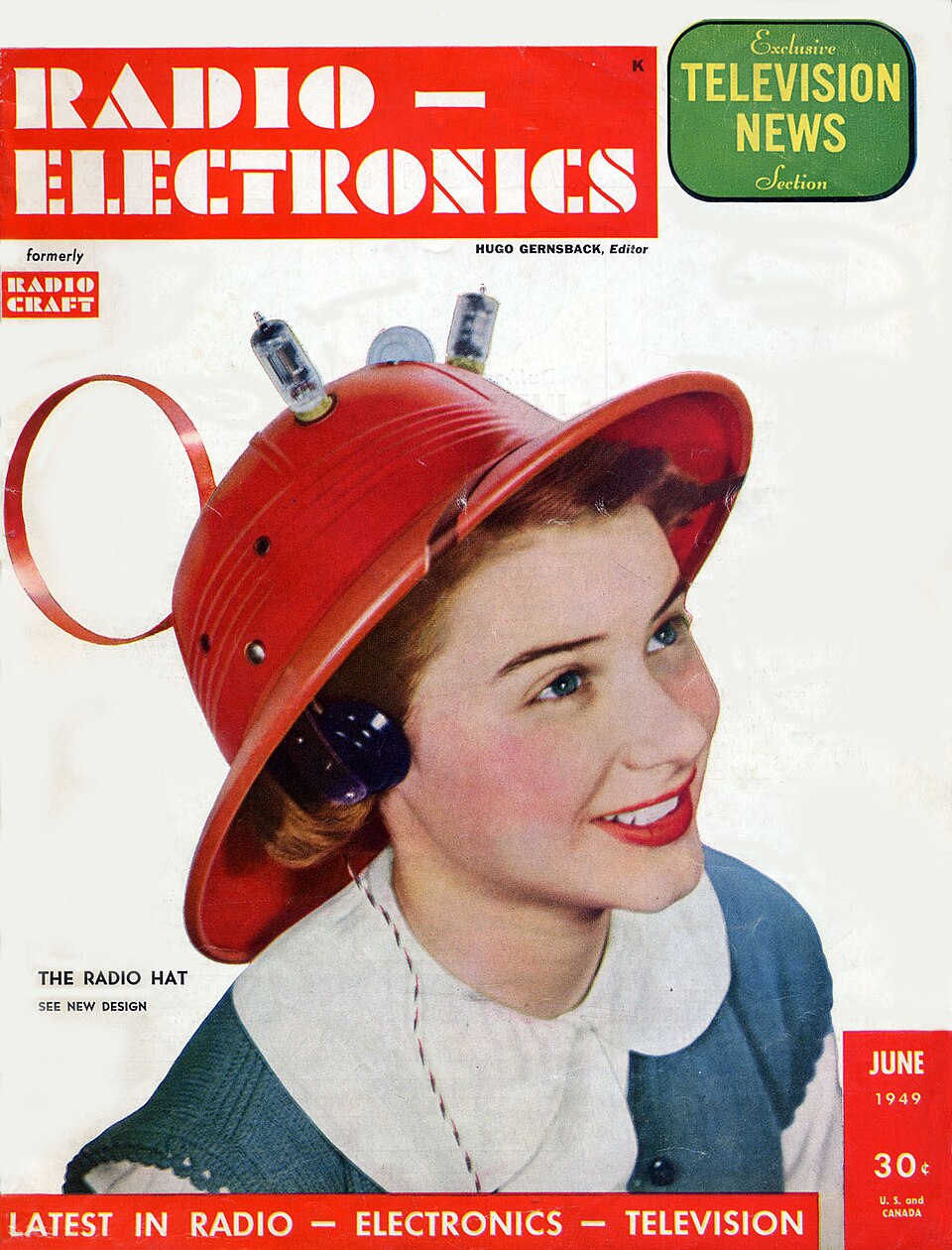
The strategy worked perfectly. Pictures of the hats were printed in major national publications, including Time, Newsweek, Life, and Popular Mechanics. The device was manufactured in eight distinct colors, ranging from Lipstick Red to Canary Yellow. Hugo Gernsback, the editor of Radio-Electronics, even featured a 15-year-old girl named Hope Lange modeling the hat on the cover of his June 1949 issue. Lange later went on to become an Academy Award-nominated Hollywood actress.
The Brief Commercial Run
Consumers could purchase the Radio Hat in major department stores or through direct mail-order catalogs. One service station chain in California even offered the wearable devices as promotional items for customers who purchased their gasoline. The device successfully functioned as a basic AM receiver, but it had distinct technological limitations.
The loop antenna was directional, meaning the audio signal could suddenly drop or squeal loudly if the person wearing the hat simply turned their head the wrong way. Despite the overwhelming media coverage and initial burst of consumer interest, the massive publicity did not translate into long-term commercial success. Advertisements for the Man-from-Mars Radio Hat completely ceased by early 1950, ending the brief production run of the wearable radio.