
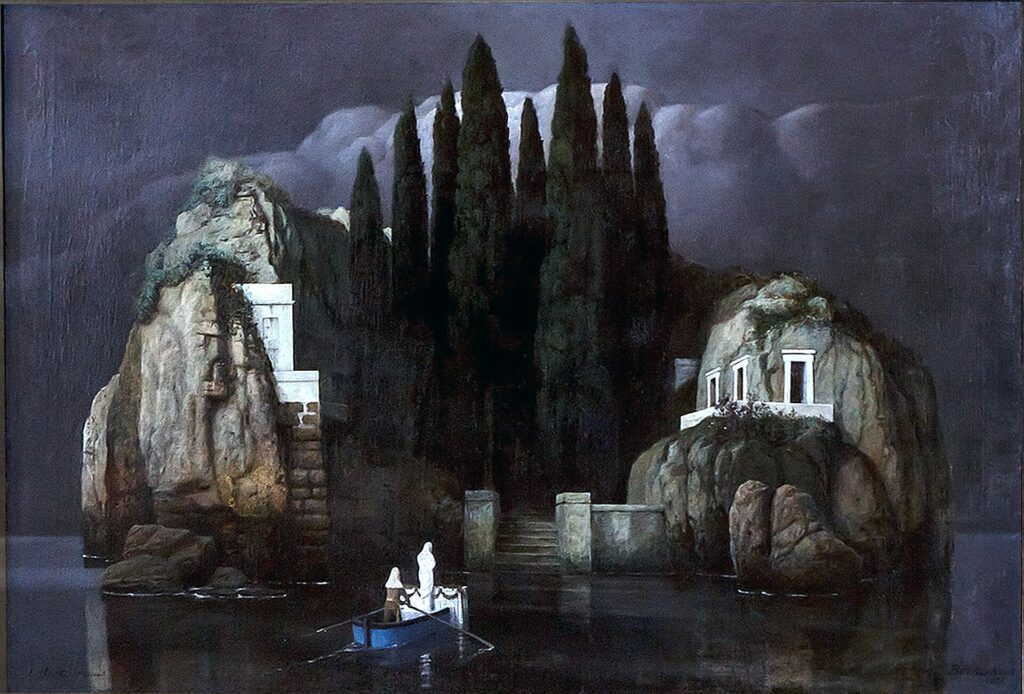
In 1880, a grieving widow visited a painter’s studio in Florence and requested a “picture to dream over.” The artist fulfilled her request by creating a haunting seascape featuring a dark, cypress-covered rock, a tiny boat, and a solitary white coffin. This single commission sparked an international obsession. The resulting artwork, known as the Isle of the Dead, mesmerized world leaders, famous composers, and historical figures, driving the artist to paint multiple versions of the exact same eerie scene.
A Widow’s Request for a Dreamlike Painting
Swiss painter Arnold Böcklin was working on a canvas in Florence when Marie Berna, mourning the loss of her husband, walked into his studio. She saw an unfinished landscape of a desolate rocky island and asked Böcklin to complete it for her. To fulfill her desire for a dreamlike image, Böcklin added a small rowboat carrying a standing figure in white and a draped coffin approaching the dark shores. He named the piece Die Toteninsel, or the Isle of the Dead.
Creating Five Distinct Versions of the Eerie Island
The painting generated massive public interest. Between 1880 and 1886, Böcklin produced five distinct versions of the Isle of the Dead. While the core elements remained identical—the water, the rocky tombs, the tall cypress trees, and the small boat—Böcklin changed the lighting, colors, and specific details of the rocks in each iteration. He painted the first three in Florence, the fourth in Zurich, and the fifth in Leipzig. He also authorized an art dealer to create prints, making the image famous across Europe.
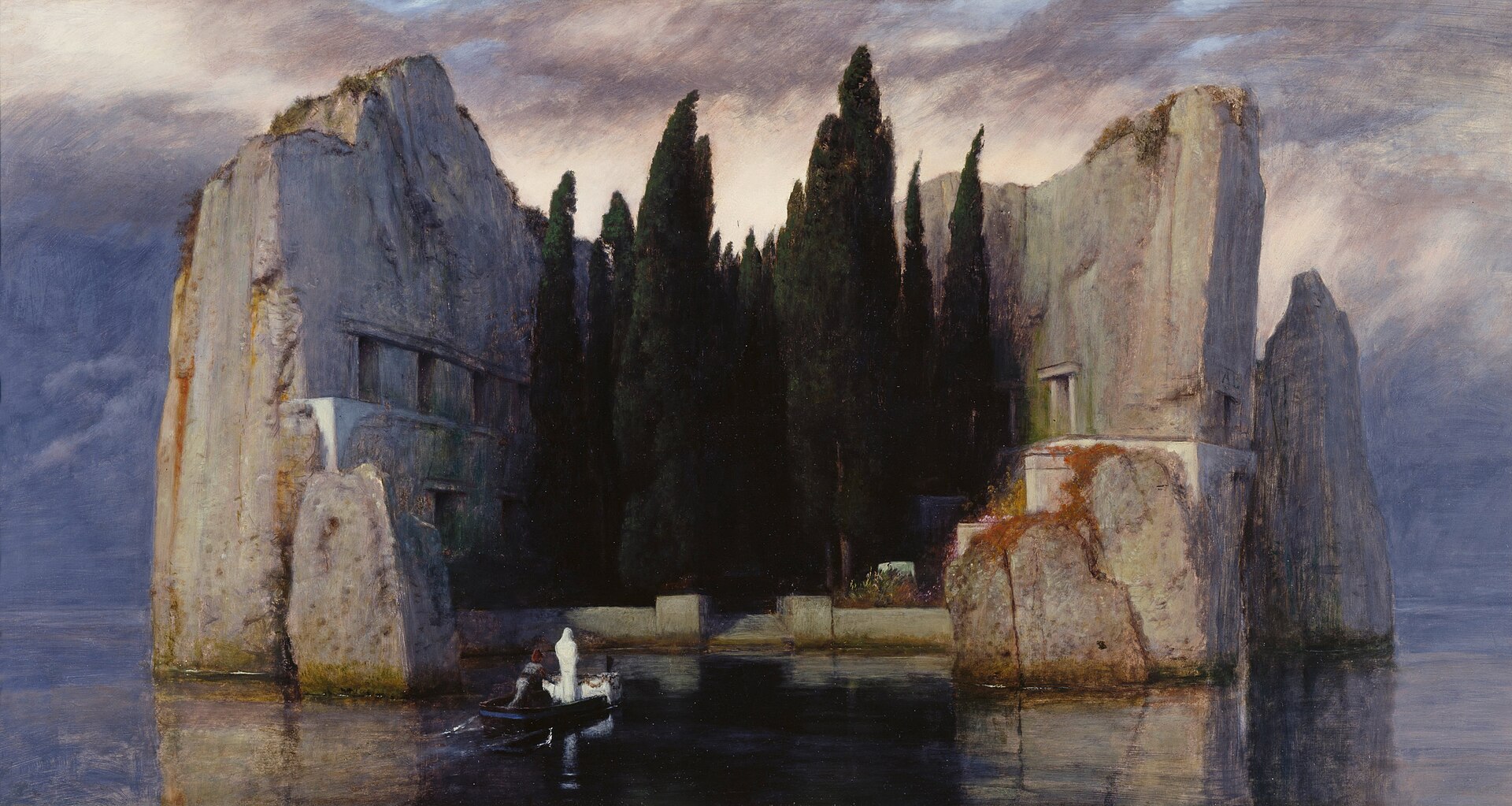
The Obsession of Historical Figures and Composers
The Isle of the Dead attracted high-profile admirers from entirely different political and cultural spheres. Russian revolutionary Vladimir Lenin hung a copy of it above his bed in Zurich. The founder of psychoanalysis, Sigmund Freud, kept a print in his Vienna office. The dark imagery also inspired Russian composer Sergei Rachmaninoff to write an entire symphonic poem based directly on the visual elements of the painting.
The Lost Canvas and the Painting’s Modern Status
In 1933, Adolf Hitler, an avid collector of Böcklin’s work, acquired the third version of the Isle of the Dead. He displayed it in his Berghof residence and later moved it to the New Reich Chancellery in Berlin. Today, four of the five original paintings survive in public museums in Basel, New York, Berlin, and Leipzig. The fourth version, completed in 1884, met a violent end. It was destroyed in Rotterdam during a bombing raid in the Second World War.