
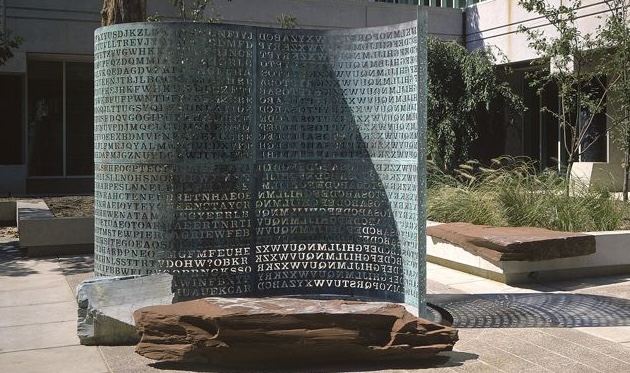
In 1990, an American artist named Jim Sanborn installed a copper, granite, and wood sculpture on the grounds of the Central Intelligence Agency in Langley, Virginia. This installation, named Kryptos, contains thousands of carved letters forming four distinct cryptographic puzzles.
More than three decades later, some of the most advanced cryptanalysts in the world have examined the text. While experts successfully decoded the first three sections, the fourth and final passage remains completely unsolved, creating an ongoing global cryptographic challenge.
A Copper Enigma in Langley
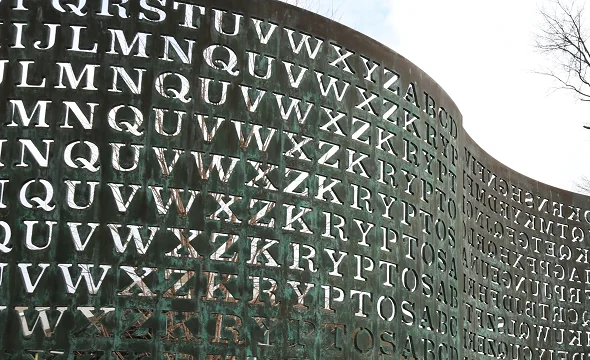
The CIA commissioned Sanborn to create the artwork in the late 1980s. The main section of Kryptos features a large, S-shaped copper screen measuring 12 feet (3.7 meters) in height and 20 feet (6.1 meters) in length. Sanborn cut approximately 1,800 alphabetical characters into the copper plate.
He worked alongside Edward Scheidt, a retiring CIA cryptographer, to design the cryptographic systems used in the installation. The sculpture was officially dedicated on November 3, 1990.
Cracking the First Three Codes
For several years, the text on the copper screen remained unread. In 1999, a computer scientist named Jim Gillogly publicly announced he had deciphered the first three sections using a custom computer program.
Following Gillogly’s announcement, the CIA revealed that one of their own analysts, David Stein, had actually solved the same three sections in 1998 using only pencil and paper. Additionally, the National Security Agency stated that a team of their cryptanalysts had also decoded those three sections as early as 1993.
The Secrets of the Decrypted Text
The decoded sections revealed distinct messages. The first passage contains a poetic phrase discussing the nuance of illusion, notably spelling the word with an intentional error as “iqlusion.”
The second passage provides exact latitude and longitude coordinates that point to a location within the CIA headquarters itself, followed by a question asking if Langley knows about what is buried there. The third section contains a modified excerpt from the diary of the archaeologist Howard Carter, describing the moment he opened the tomb of King Tutankhamun in 1922.
The Final Ninety-Seven Characters
The fourth section, known as K4, consists of exactly 97 characters. Despite the efforts of amateur codebreakers and professional intelligence agencies, no one has publicly revealed the decrypted text of this final passage. Over the years, Sanborn has released specific clues to assist cryptographers.
He confirmed that the letters translate to specific words, including “BERLIN,” “CLOCK,” and “NORTHEAST.” Even with these direct hints from the creator, the decryption method for the last 97 characters continues to elude everyone who has attempted to solve the puzzle.