
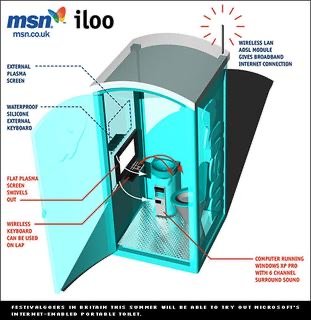
In the spring of 2003, Microsoft embarked on a project that would test the limits of corporate marketing and basic sanitation. Through its UK division, the tech giant announced the “iLoo,” a fully functioning, Wi-Fi-enabled portable toilet designed for British music festivals.
It featured an adjustable plasma screen, a wireless membrane keyboard, and a six-channel speaker system. The immediate, disastrous public response turned the project into one of the most embarrassing public relations debacles in Microsoft’s history.
Bringing Broadband to the Bog
On April 30, 2003, MSN UK released a statement declaring they were converting a standard portable toilet to create a “unique experience for surfers looking for an alternative to the bog-standard festival loo experience.” The iLoo was designed to feature an internal broadband connection via 802.11b wireless technology, a swivel plasma screen running Windows XP Professional, and a suction toilet.
Externally, the unit would display a prominent MSN logo and house a “Hotmail station” with an additional plasma screen and keyboard for those waiting in line. MSN UK even announced they were in talks with manufacturers to provide toilet paper embossed with popular web addresses. The division’s marketing manager explained the rationale simply: people read magazines in the bathroom, so surfing the internet was the natural next step.
A Fast and Furious Backlash
The announcement went viral immediately. It became the most-emailed story on Yahoo! News on May 1, being forwarded over 4,000 times. However, the response was overwhelmingly negative and mocking. Critics questioned the hygiene of a shared keyboard in a portable festival toilet and wondered aloud what would happen if the electronics were urinated upon. Others pointed out that festival-goers typically stay in a portable toilet only as long as absolutely necessary, making an internet browsing session highly unlikely.
The media unleashed a torrent of puns. Newspapers ran headlines like “Microsoft technology headed for toilet” and “Microsoft’s Gone Potty.” The situation worsened when an inventor named Andrew Cubitt stepped forward, claiming Microsoft had stolen the idea from his university project, which he had also named the “i-Loo.”
The Public Relations Panic
Faced with a rapidly deteriorating situation and global mockery, Microsoft panicked. On May 12, the company’s corporate headquarters officially declared the entire project was an elaborate “hoax” and an April Fools’ joke perpetrated by its British division.
This lie did not hold up. The Associated Press and the Seattle Post-Intelligencer immediately countered that they had previously received confirmation, and even schematic drawings, from two of Microsoft’s own PR firms. April Fools’ Day had passed nearly a month prior.
The following day, May 13, Microsoft was forced to retract its denial. The company admitted the iLoo was a legitimate demonstration project that was in the early stages of construction. Executives in Redmond, Washington, had abruptly terminated the initiative upon seeing the negative reaction. The company issued a final apology, blaming the confusion on employees moving too quickly and misspeaking before gathering all the facts.