
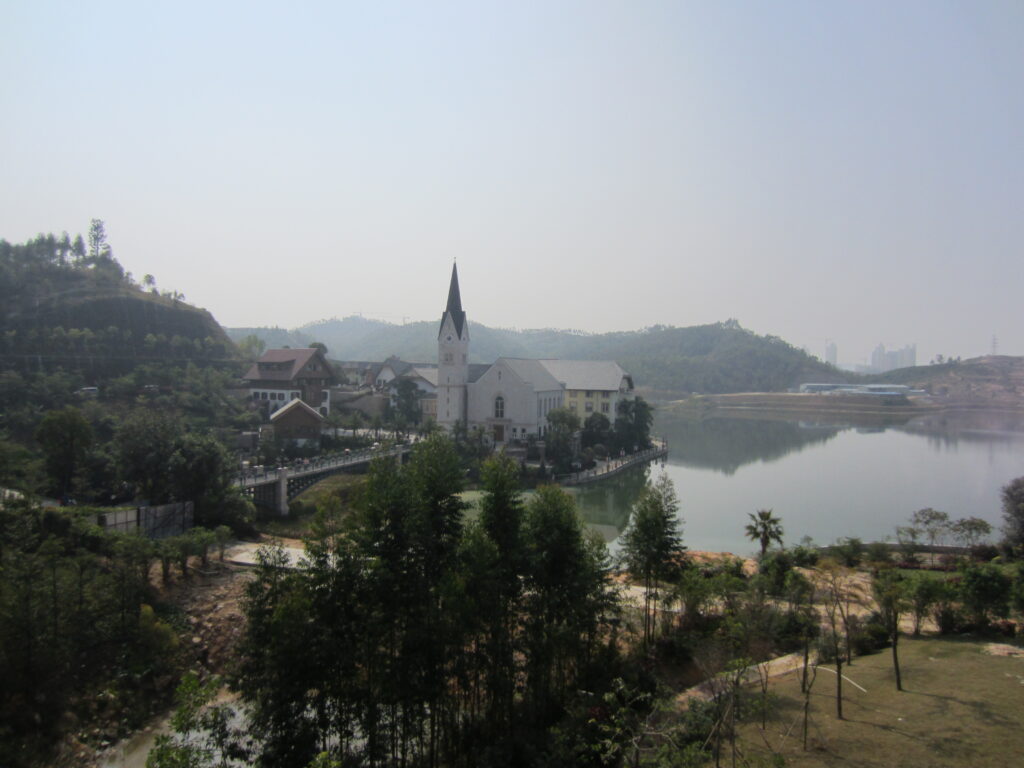
A forgotten stack of blueprints left in a hotel room in 2011 revealed a secret that stunned a tiny European community. The documents belonged to a team of architects who had quietly observed the Austrian village of Hallstatt for months. They were not there for a holiday.
Instead, they were gathering data to build a full-scale replica of the town in southern China. This discovery marked the beginning of one of the most unusual architectural projects in modern history, connecting two locations separated by over 5,500 miles (8,850 kilometers).
A Carbon Copy Worth Millions
Minmetals Land Ltd, a Chinese real estate developer, spearheaded the ambitious project in the Guangdong province. The company invested approximately $940 million to recreate the UNESCO World Heritage site on the other side of the globe. Construction crews reshaped the landscape to mimic the Austrian Alps. They excavated a man-made lake and built artificial hills to ensure the geography matched the original setting.
The developers spared no detail in their pursuit of accuracy. They cloned the town square, the church spire, and even the specific cobblestones of the streets. The copy included high-end residential villas intended for wealthy buyers rather than just tourists. The site covers over 1 million square yards (836,000 square meters) and sits just a short drive from the industrial city of Huizhou.
The Austrian Reaction
The residents of the original Hallstatt initially reacted with skepticism and surprise. The town has a population of fewer than 1,000 people and protects its privacy. Some locals felt the unauthorized copying of their homes was intrusive. However, the initial shock eventually turned into a diplomatic opportunity.
Alexander Scheutz, the mayor of Hallstatt, officially visited the Chinese replica for its grand opening in 2012. He signed documents to establish cultural ties between the two towns. The event featured traditional Austrian music and costumes, marking a formal acknowledgement of the twin cities.
An Unexpected Tourism Boom
The publicity surrounding the Chinese replica had a direct impact on the original Austrian village. Hallstatt was already historically significant due to its 7,000-year-old salt mines and ancient Celtic roots dating back to between 800 and 450 B.C. Yet, the cloning project introduced the town to a massive new audience in Asia.
Tourism numbers skyrocketed in the years following the reveal. In 2005, only about 50 Chinese tourists visited Hallstatt. By 2019, the town reported receiving up to 1 million overnight stays per year. The influx became so intense that local officials had to limit the number of tour buses entering the village to 50 per day to manage the crowds. The cloning project that began in secrecy ultimately transformed the quiet Austrian town into a global phenomenon.
In 2011, a forgotten set of blueprints in an Austrian hotel room exposed a covert operation.
Architects had been secretly studying the tiny village of Hallstatt to build a full-scale replica 5,500 miles (8,850 km) away in China.
The discovery stunned the locals…🧵👇 pic.twitter.com/LPOmrsLQFc
— Fascinating True Stories (@FascinatingTrue) February 16, 2026