

In December 1900, the French Académie des Sciences offered a massive reward of 100,000 francs to anyone who could successfully communicate with a celestial body.
There was only one strict rule attached to the money: talking to Martians was explicitly forbidden. This astronomical bounty remained unclaimed for decades, but a hidden contingency clause in the official documentation ended up financing a vast amount of actual scientific research on Earth.
A Wealthy Widow and the Martian Craze
Anne Émilie Clara Goguet Guzman established the Prix Pierre Guzman to honor the memory of her late son. Pierre was an amateur astronomer heavily influenced by Camille Flammarion, who published a wildly popular book in 1892 regarding the habitability of Mars.
During this specific cultural period, which also inspired the publication of H.G. Wells’ The War of the Worlds, the public largely believed the Red Planet was covered in canals and housed intelligent life. Clara Guzman felt that contacting Martians was entirely inevitable and far too easy. To claim the 100,000-franc prize, scientists had to receive an unequivocal reply from a distant planet, a moon, or a fixed star.
The Ingenious Contingency Clause
The initial ten-year deadline passed with absolutely no winners, and the subsequent decade yielded the exact same result. The technology required for interstellar communication simply did not exist. However, the official rules contained a highly practical contingency plan.
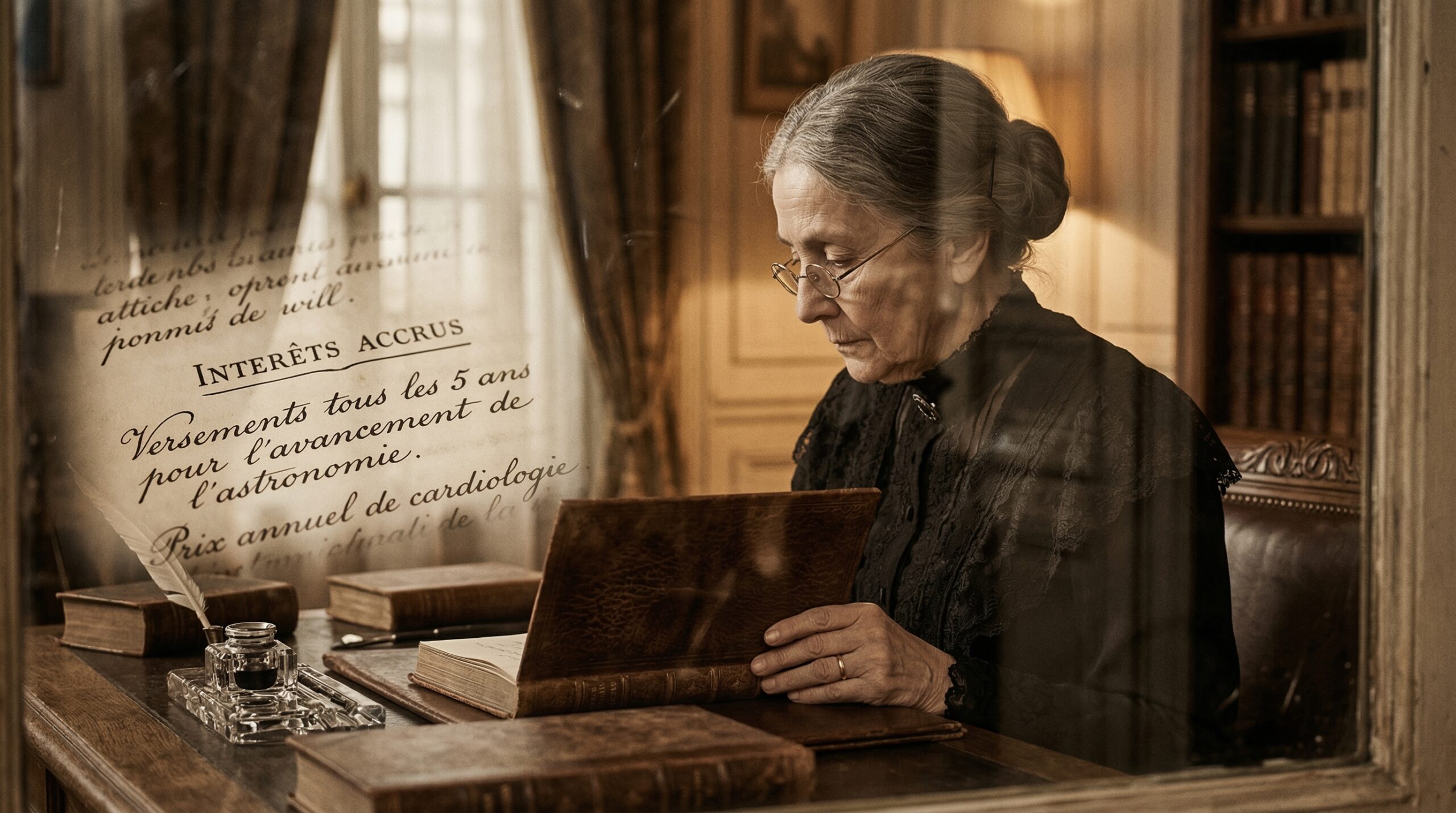
While the 100,000-franc principal sat untouched, the accrued interest from the endowment was mandated to be distributed. The funds provided an annual award for cardiac medicine and a five-year award for the most significant progress in astronomy, formally known as the Prix d’Astronomie de la Fondation Pierre Guzman.
Funding Real Discoveries on Earth
This interest-based funding mechanism operated for over 70 years. The money supported grounded, empirical research, ranging from monumental projects like mapping the Moon by Maurice Loewy to tracking minor planets. The very first astronomy award was distributed in December 1905.
It posthumously recognized Henri Joseph Anastase Perrotin, the first Director of the Nice Observatory, an institution founded in 1880. Perrotin successfully discovered six asteroids between 1874 and 1885, including the minor planets 138 Tolosa and 252 Clementina. He also developed complex calculations to track the orbit of the asteroid Vesta.
Measuring the Speed of Light
The 1905 prize also highlighted a major terrestrial physics experiment. In 1902, Perrotin and his colleague Prim successfully conducted an exceptionally accurate measurement of the speed of light using a mechanical revolving mirror. They measured the light across a physical path spanning 92 kilometers (57.17 miles).
The academy shared a portion of that initial interest payout with Louis Fabry, a mathematician and astronomer who developed rapid numerical methods for computing the exact coordinates of comets. The grand prize for extraterrestrial contact remained locked away indefinitely, while the interest payments steadily financed practical science.