
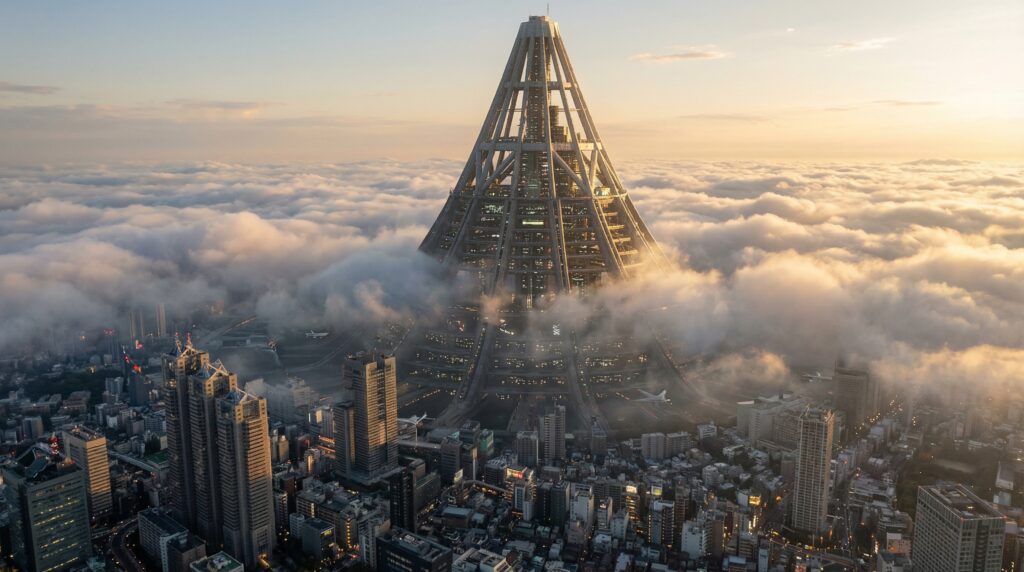
In 1995, engineers at the Taisei Corporation in Japan finalized plans for a structure so massive it defied the traditional definition of a building. Named the X-Seed 4000, this steel colossus was not merely a skyscraper. It was a blueprint for an entirely self-contained vertical environment capable of housing up to one million people. Standing at a staggering 4,000 meters (2.5 miles) high, the structure was designed to dwarf Japan’s most famous natural landmark, Mount Fuji, by more than 200 meters (656 feet).
A Man-Made Mountain
The X-Seed 4000 required dimensions that seem impossible by modern construction standards. The blueprints depicted a mountain-shaped cone with a 6-kilometer (3.7-mile) wide sea-base, sitting directly in the water of Tokyo Harbor. While the world’s current tallest building, the Burj Khalifa, pierces the sky at 828 meters (2,717 feet), the X-Seed was drafted to reach nearly five times that height. Its 800 floors were intended to accommodate residential zones, commercial districts, and green spaces, effectively functioning as a vertical city where residents would never need to leave.
Engineering Against the Elements
Building a structure 2.5 miles (4 kilometers) into the atmosphere presented unique physical challenges. At such extreme altitudes, the air pressure drops significantly, and weather conditions become volatile. To ensure survival, the design included active protection systems to regulate internal air pressure and temperature, protecting inhabitants from the harsh external environment.
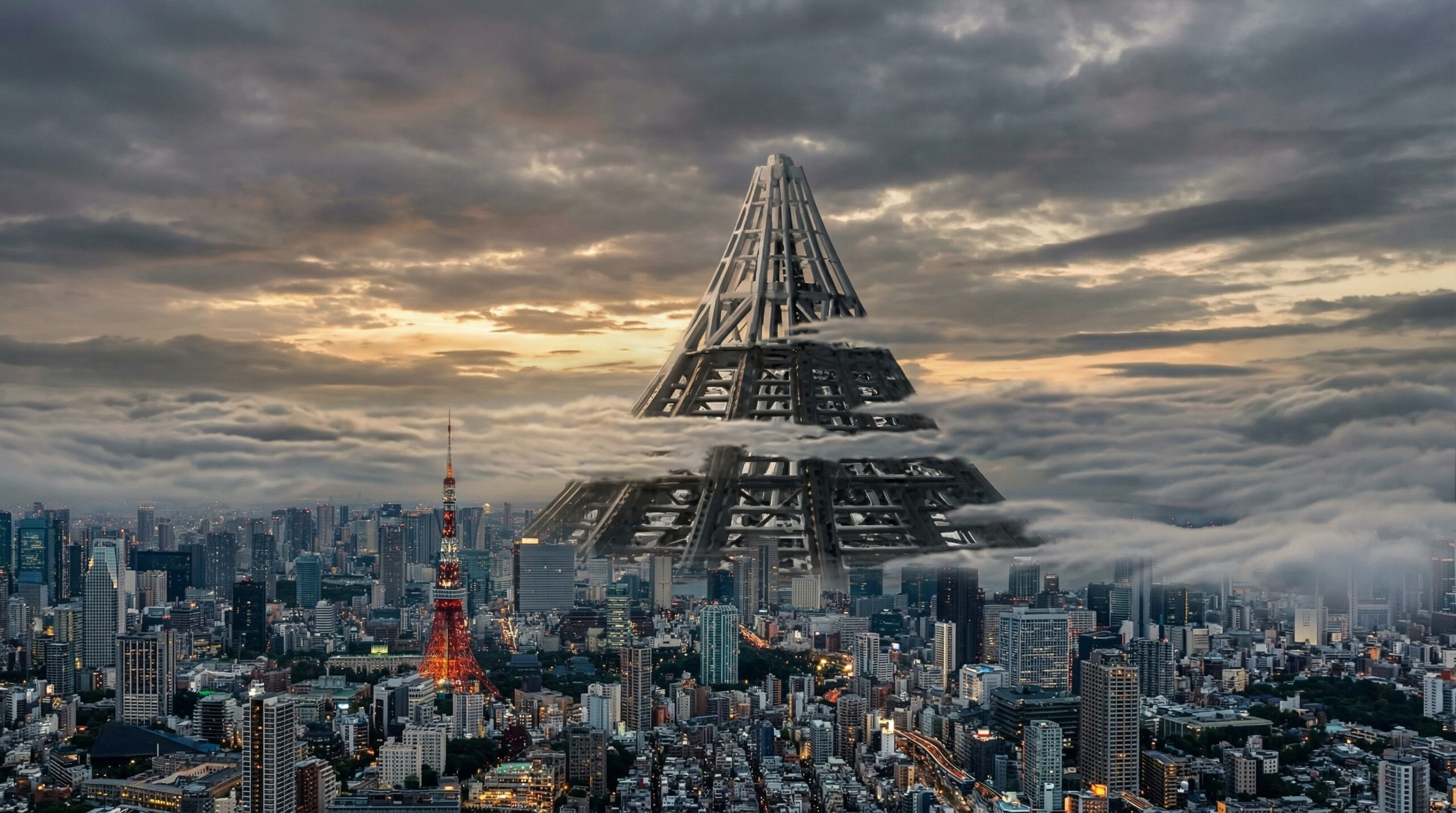
Designers rejected the standard vertical walls of typical skyscrapers. Instead, they opted for an open-frame, “teepee-like” structure. This sloping geometry was necessary to prevent the building from acting as a massive sail, allowing heavy winds to pass through the frame rather than crushing it. For internal transportation, traditional elevators were deemed too slow. The plan instead called for high-speed magnetic levitation (maglev) trains to shuttle residents vertically and diagonally across the structure’s vast interior.
The Cost of Ambition
The sheer scale of the X-Seed 4000 came with a price tag that made actual construction an economic impossibility. Estimates for the project ranged from $300 billion to $900 billion in 1995 currency—figures that exceeded the GDP of many nations. Aside from the financial barriers, the location in the Pacific Ring of Fire meant the structure required unprecedented seismic fortification to withstand earthquakes and tsunamis.
A Blueprint for Recognition
Despite the detailed schematics and technological solutions, the X-Seed 4000 was never intended for ground-breaking. Georges Binder, a building data expert, confirmed that the plan was never meant to be built. Instead, the Taisei Corporation created the concept to gain recognition and demonstrate their supreme technical capability during a time of intense economic optimism. The project remains the tallest fully envisioned building design in history, existing only on paper as a demonstration of what engineering could theoretically achieve.