
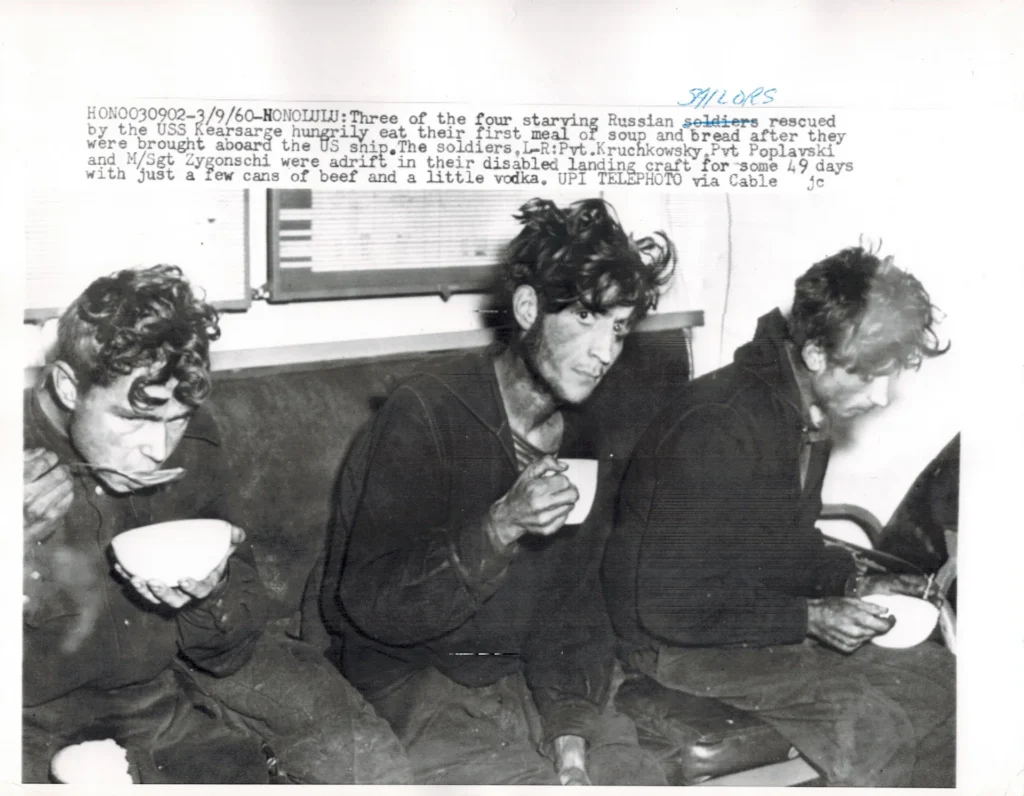
On a freezing night in January 1960, four young Soviet soldiers found themselves trapped on a small barge being dragged into the open Pacific Ocean by a severe hurricane.
With their engines completely dead, their radio communications severed, and only a three-day supply of food on board, the crew faced the freezing vastness of the sea. The sequence of events that followed was a 49-day drift across the ocean, involving boiling leather boots and drinking rusty engine water to stay alive.
A Severe Storm Hits Iturup Island in 1960
In December 1959, the Soviet garrison on Iturup Island beached its six barges for winter repairs. Standard ten-day emergency rations were removed. On January 15, 1960, anticipating a supply ship, barge T-36 was dragged back into the water. The vessel measured 17.3 meters (56.8 feet) in length and 3.6 meters (11.8 feet) in width. It was moored 152.4 meters (500 feet) offshore. The crew consisted of Askhat Ziganshin, Ivan Fedotov, Philip Poplavsky, and Anatoly Kryuchkovsky.
Shortly after midnight on January 17, a hurricane struck. The men repeatedly started the engines to avoid the rocks. By 10 p.m., the barge ran out of its 1.5 metric tonnes (1.65 US tons) of diesel fuel. The wind dragged the vessel into the open ocean.
Drifting Across the Sea: Rationing Food and Boiling Leather
The garrison found wreckage on the shore and assumed the crew had perished. Aboard the drifting T-36, the crew assessed their supplies. They had a loaf of bread, a can and a half of meat, 1.36 kilograms (3 pounds) of lard, some millet, dried peas, and potatoes ruined by spilled diesel fuel.
Ziganshin strictly rationed the food. The fresh water tank was destroyed, so the men drained 120 liters (31.7 US gallons) of rusty water from the engines cooling system. They collected rainwater by wringing out wet bedsheets. To stay warm, they burned crates, paper, and the rubber tires used as fenders. Once the food ran out, they boiled and ate their leather belts, wristlets, the leather parts of their garmon accordion, and their boots.
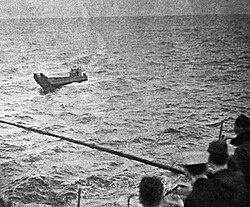
The Rescue of Barge T-36 by the USS Kearsarge
Around the 40th day, the crew spotted a passing ship, but it failed to see them. Two more ships passed in the following days. Finally, on March 7, 1960, after drifting for 49 days, two Grumman S-2 Trackers launched by the aircraft carrier USS Kearsarge spotted the vessel.
The T-36 was found in stormy waters 1,931 kilometers (1,200 miles) off the coast of Wake Island. The four soldiers were successfully rescued. Following medical advice against taking a transatlantic flight, the crew sailed to Paris on the RMS Queen Mary and then flew back to the USSR. The Soviet government officially expressed gratitude to the USS Kearsarge.