
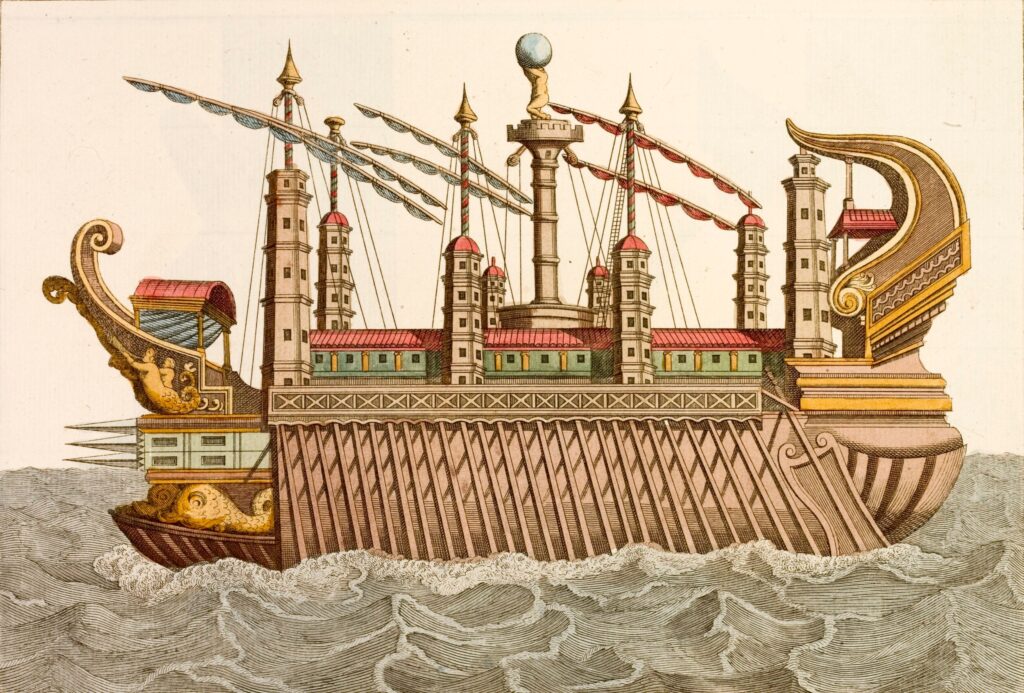
In the 3rd century BCE, Archimedes designed a vessel so massive it defied the naval standards of the ancient world. Commissioned by Hiero II of Syracuse, the Syracusia was built to be the largest ship ever to sail the Mediterranean, serving as both a luxurious palace and a formidable warship.
It was a structure of such immense scale that most harbors in the known world could not accommodate it. From its marble floors and onboard gymnasium to its defensive catapults, the ship was a factual demonstration of Hellenistic engineering and excess.
A Palace on the Waves
The construction required enough timber to build sixty standard triremes. The interior was divided into three levels, featuring thirty cabins decorated with mosaics depicting the entire story of the Iliad. The upper deck housed a gymnasium, a promenade lined with trees planted in leaden casks, and a library filled with scrolls.
For the comfort of its elite passengers, the ship included a temple dedicated to Aphrodite and a bathroom with three bronze tubs. To sustain life during long voyages, it carried a 75,000-liter (nearly 20,000-gallon) freshwater tank and a massive seawater tank filled with live fish for the cook.
Defensive Power and Armament
Despite its luxury, the Syracusia was a heavily fortified military asset. The top deck featured eight wooden towers, each manned by four fully armed soldiers and two archers. A massive catapult, designed by Archimedes himself, was mounted on the deck, capable of launching 77-kilogram (170-pound) stones or 3.7-meter (12-foot) poles at enemy vessels.
To prevent boarding, the ship was equipped with “iron hands” or grappling cranes that could lift and smash smaller boats. The hull was sheathed in lead plates to protect the timber from rot and provide a layer of defense against ramming.
The Problem of the Harbor
Once the ship was completed, Hiero II realized that Syracuse’s own harbor was barely deep enough to support the vessel. Furthermore, no other city in Sicily or Italy had a port large enough to receive it. The King eventually decided to send the ship as a diplomatic gift to King Ptolemy III of Egypt.
To ensure its arrival, the Syracusia was loaded with 60,000 measures of grain, 10,000 jars of Sicilian salt fish, and 20,000 talents of other cargo. Upon its arrival in Alexandria, the ship was renamed the Alexandria and eventually remained moored there as a permanent fixture.
Archimedes and the Launch
The sheer weight of the hull made a traditional launch impossible. Archimedes developed a system of pulleys and winches that allowed a single man to pull the massive structure into the water. This was a direct application of his research into levers and mechanical advantage.
To manage the inevitable leakage from such a large hull, he also installed his famous Archimedes’ screw, which allowed a single sailor to manually pump out all the bilge water.