

It sounds like a gag from a slapstick comedy, but for farmers in New Zealand during the early 1930s, the threat of spontaneously combusting clothing was a terrifying reality. In a bizarre collision of agricultural policy and volatile chemistry, laborers found themselves wearing garments that turned into ticking time bombs.
This strange phenomenon saw trousers igniting on clotheslines and detonating with a bang in living rooms, leading to a documented period of history where ordinary work clothes became deadly hazards.
A Chemical Solution to a Green Invader
The trouble began with the rapid expansion of the dairy industry in New Zealand. As pastures grew, so did an invasive weed known as ragwort. This plant was toxic to cattle, and because cows refused to eat it, the weed spread unchecked across the grazing lands.
Farmers faced a crisis as their meadows were overrun, prompting the government to recommend a powerful chemical solution: sodium chlorate. This herbicide was highly effective at killing ragwort, but it required the workers to mix the powder with water and spray it extensively over their fields to save their livelihoods.
The Invisible Trap in the Fabric
Farmers did not realize that the spray mist was soaking into their work clothes. Sodium chlorate is a potent oxidizing agent. When the liquid solution dried on the farmers’ cotton or wool trousers, the chemical crystals remained embedded in the organic fibers.
This process created a highly volatile combination that turned ordinary denim and wool into materials that behaved like solid rocket fuel. The treated fabric did not need a direct flame to ignite; simple friction from riding a horse or the radiant heat from a fireplace was often enough to trigger a violent reaction.
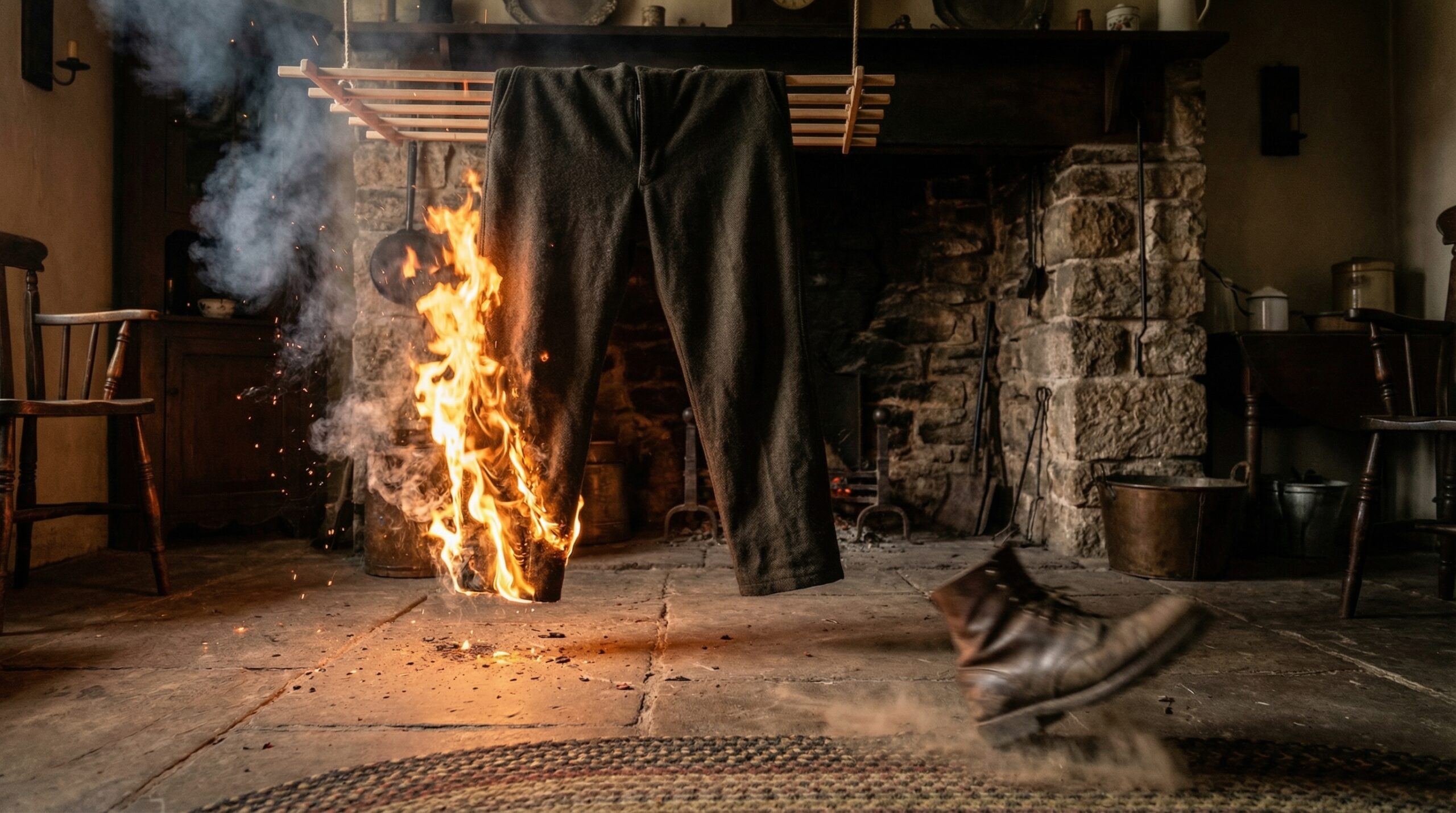
The Detonation of Richard Buckley’s Pants
The most famous case involved a farmer named Richard Buckley in 1931. After spending a day spraying ragwort, Buckley removed his damp trousers and hung them in front of his fireplace to dry. Without warning, the pants exploded with a loud bang.
A shocked Buckley managed to grab the smoldering garment and throw it onto the grass outside, where it continued to detonate in a series of small explosions for several minutes. He escaped unhurt, but the story spread quickly, confirming that the rumors of exploding clothing were true.
From Comedy to Tragedy
While Buckley’s incident ended without injury, others were not as fortunate. Reports surfaced of trousers smoking on washing lines and men suffering severe burns when their clothes ignited while horseback riding due to the friction against the saddle. In the worst cases, the phenomenon proved fatal.
One farmer died after striking a match in his home; the spark instantly ignited his chemical-soaked clothes, causing an explosion that killed him. The epidemic only subsided when the dangers of sodium chlorate became widely known and farming practices shifted.