
In 1865, the American Civil War concluded with the surrender of the South, but not every Confederate citizen accepted the outcome of the Reconstruction era. Rather than remain in the United States under the new federal laws, an estimated 10,000 to 20,000 Southerners packed their belongings and boarded steamships bound for a foreign empire.
They were not heading to the American West, but to the distinct tropical climate of Brazil. These emigrants, known historically as the Confederados, established a permanent colony that exists to this day, creating one of history’s most unusual cultural transplants in the Southern Hemisphere.
An Offer from the Emperor
Brazil was the only other major nation in the Americas that still practiced slavery during the late 1860s, though it would abolish the practice in 1888. Emperor Dom Pedro II actively recruited these Southern veterans, seeking their agricultural expertise to boost Brazil’s cotton production.
The Brazilian government offered significant incentives to the refugees, including subsidized transport, tax breaks, and land sold for as little as 22 cents per acre (approx. 54 cents per hectare). Colonel William Hutchinson Norris, a former Alabama senator, arrived first in late 1865. He purchased 500 acres (202 hectares) of land in the state of São Paulo and sent word back home that the soil was rich and fertile, prompting waves of families to follow him.
Ploughs, Pecans, and Watermelons
The settlers transported their specific agricultural methods to the Brazilian interior. Before their arrival, local farmers primarily used manual hoes for cultivation. The Americans introduced the modern moldboard plow to the region, significantly altering farming efficiency in the area. They also brought entirely new crops to the local agriculture, introducing pecans, Georgia rattlesnake watermelons, and various types of peaches.
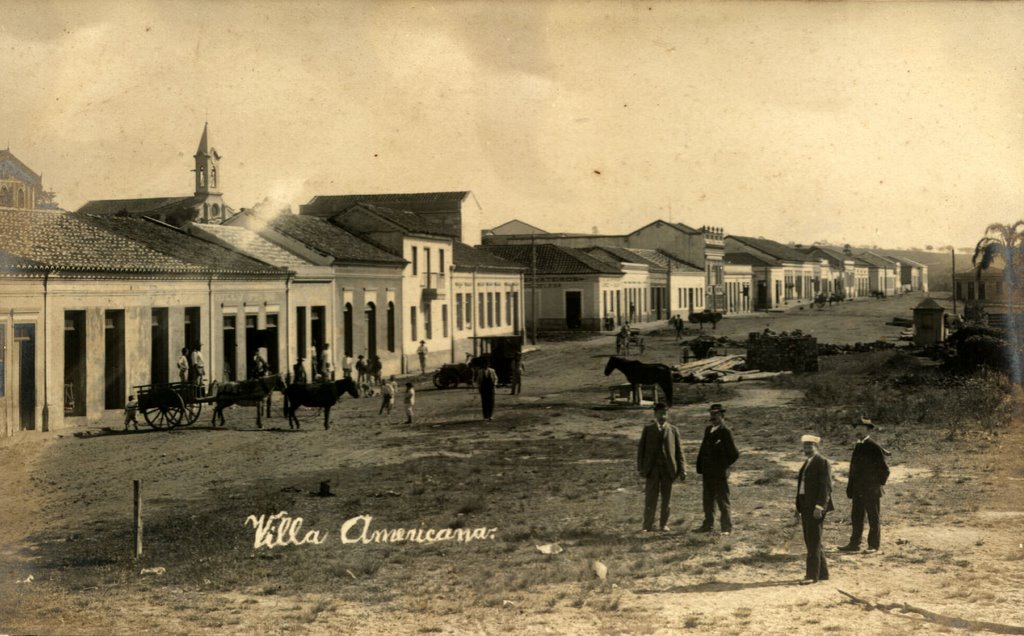
They established a village originally named Villa dos Americanos, which later evolved into the modern city of Americana, which now boasts a population of over 200,000 people. While many original immigrants eventually returned to the United States due to tropical diseases or homesickness, a core group remained, marrying into local families and eventually switching from English to Portuguese over subsequent generations.
The Annual Celebration
Today, the descendants of these settlers gather annually at the Cemitério dos Americanos (Cemetery of the Americans) in Santa Bárbara d’Oeste. This location serves as the final resting place for the original founding families, with headstones bearing surnames like Jones, Ferguson, and Norris. Once a year, thousands of attendees participate in the Festa Confederada.
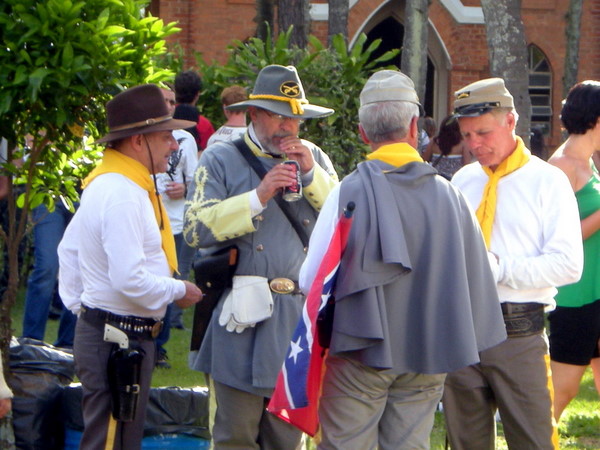
During this event, men dress in replica gray Confederate uniforms and women wear elaborate antebellum hoop skirts. The community serves traditional Southern food, including fried chicken, biscuits, and vinegar pie, which are otherwise rare in Brazilian cuisine. The event features the Confederate battle flag prominently, used by the descendants to mark their specific ancestral origins.