
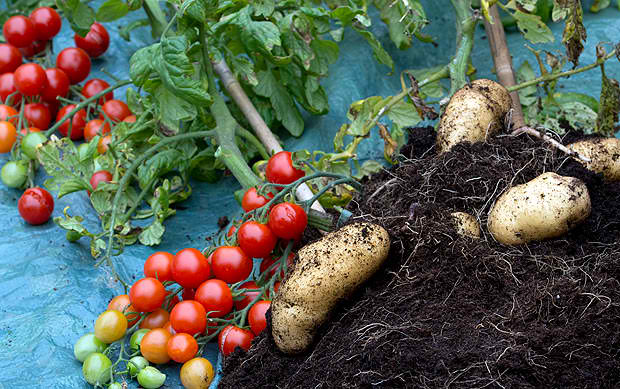
Pulling fresh potatoes from the dirt while picking ripe cherry tomatoes from the exact same plant sounds like a science fiction movie plot. However, agricultural science has made this a verifiable reality. The pomato is a botanical creation that yields two distinct crops from one single stem.
By physically fusing two common vegetables together, growers maximize limited growing space and double their harvest.
The Science Behind The Pomato Graft
Tomatoes and potatoes both belong to the Solanaceae, or nightshade, plant family. Because they are closely related botanically, their stems can be physically joined together through a horticultural process called grafting. A grower cuts the top off a potato plant and the bottom off a tomato plant.
They then bind the leafy tomato top, called the scion, to the established potato rootstock. As the wounded plant tissues heal, the vascular systems completely fuse. The leaves above ground use sunlight to produce energy. This energy fuels the growth of tomatoes in the air and potatoes in the earth.
Decades Of Agricultural Experimentation
The concept of joining these two specific crops is not a new idea. In 1977, researchers at the Max Planck Institute in Germany successfully fused the cellular structures of both plants to create a somatic hybrid. Later, commercial horticulturalists shifted their focus to manual grafting techniques to produce higher crop yields.
In 2013, a mail-order company based in the United Kingdom successfully commercialized the grafted plant. They released it to the general public under the trade name TomTato. It offered everyday gardeners a way to grow hundreds of cherry tomatoes alongside a late-summer harvest of potatoes.
Maximizing Yield In Tiny Spaces
The pomato offers distinct physical advantages for urban agriculture and small outdoor gardens. Because it grows vertically like a standard tomato vine, it requires only a fraction of the soil space normally needed to cultivate both crops.
A single grafted plant can grow comfortably in a standard container measuring 15 inches in diameter. Throughout the hot summer months, the upper portion produces up to 500 cherry tomatoes. Once the tomato vine naturally dies back in the autumn, the gardener digs directly into the soil to uncover up to four pounds of potatoes.
The Future Of Dual-Crop Farming
Agricultural researchers continue to refine the manual grafting process to improve disease resistance and overall crop efficiency. By utilizing a standard potato rootstock, the delicate tomato vines gain increased physical protection against common soil-borne pathogens.
Farmers and university scientists are actively applying this exact same grafting technique to other related crops within the nightshade family. The pomato functions as an agricultural tool that outputs two different food sources from a single physical footprint.