
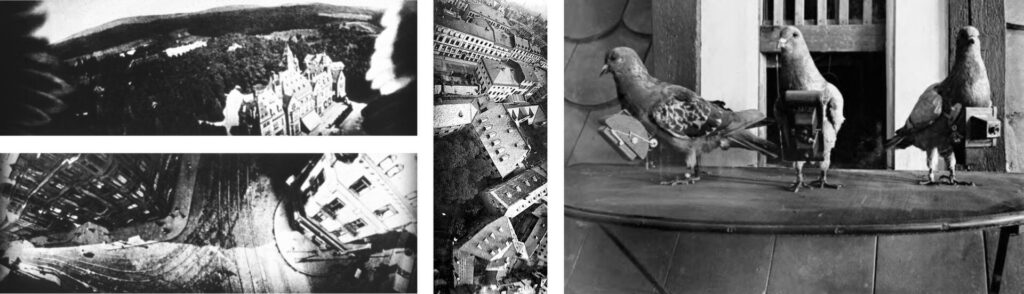
In 1907, a German apothecary named Julius Neubronner transformed the common homing pigeon into an advanced aerial surveillance tool. What started as a simple method for delivering emergency medical prescriptions quickly evolved into an unprecedented technique of aerial photography.
By equipping birds with miniature, time-delayed cameras, Neubronner captured images from the sky long before airplanes or modern drones existed. This fascinating innovation caught the attention of military officials and global intelligence agencies alike. The story moves from a hobbyist’s experiment to a classified tool of international espionage.
From Medical Deliveries to Accidental Discovery
Neubronner utilized pigeons to transport medications between his pharmacy in Kronberg and a nearby sanatorium. These daily deliveries weighed up to 75 grams (2.6 oz). The idea for taking pictures from the air emerged in 1903 when one of his trusted pigeons disappeared in thick fog, only to return four weeks later.
Curious about where the bird had traveled, Neubronner decided to track the flight paths using automatic cameras. He developed a lightweight aluminum harness and a breast-mounted camera that used a pneumatic system to trigger the shutter after a specific time delay.
Proving the Impossible to Patent Offices
When Neubronner first applied for a patent for his method of taking photographs of landscapes from above, the German patent office outright rejected the application. Officials firmly believed it was physically impossible for a pigeon to carry such a heavy load.
To prove them wrong, Neubronner produced a series of authenticated photographs taken directly by his birds. The patent was officially granted in December 1908. He soon showcased his invention at international exhibitions in Dresden and Frankfurt. Spectators watched pigeons arrive and saw their aerial shots turned into postcards for immediate sale.
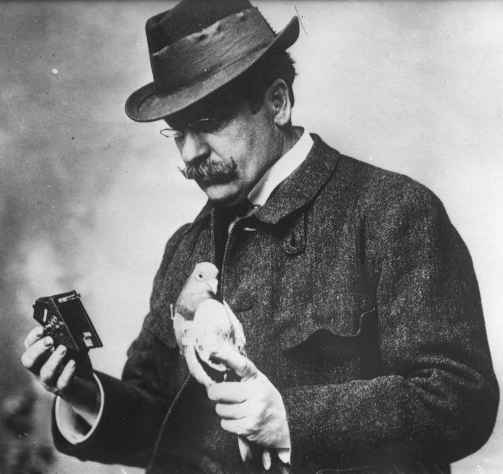
Military Interest and Mobile Dovecotes
The Prussian War Ministry took notice of the technology for its obvious potential in battlefield reconnaissance. While airplanes were still in their infancy, pigeons offered a unique way to take detailed photos from a lower altitude of 50 to 100 meters (164 to 328 ft).
Neubronner developed a mobile dovecote inside a horse-drawn carriage that included a darkroom and a home base for the birds. This allowed the pigeons to be relocated during a conflict while still knowing exactly where to return. These mobile units were actively utilized during major battles of the First World War.
The Feathered Cameras of Intelligence Agencies
During the Cold War, the United States Central Intelligence Agency developed its own battery-powered pigeon camera. While many specific details of these espionage missions remain classified, the agency museum currently displays a replica of the specialized equipment.
The panoramic cameras originally designed by Neubronner are preserved in the German Museum of Technology. Modern researchers continue to use similar animal-mounted camera techniques to study biology, employing the same principles established by a pharmacist and his birds over a century ago.