

In September 1986, Cleveland attempted to break a world record by releasing nearly 1.5 million helium balloons. Organized as a United Way fundraiser, the stunt was intended as a massive visual spectacle. Instead, an approaching storm turned the display into a severe hazard.
The balloons drifted back down to Earth, shutting down an airport runway, causing traffic collisions, and complicating a Coast Guard search for two missing boaters. What began as an ambitious public event quickly descended into multimillion-dollar lawsuits and a net financial loss.
Preparing the Massive Stunt
To surpass a record set by Disneyland, a Los Angeles company called Balloonart by Treb spent six months planning the logistics. On Cleveland’s Public Square, workers erected a massive rectangular holding structure measuring 250 by 150 feet (76 by 46 meters).
Covered in a woven mesh net, the three-story pen held 2,500 volunteers who worked relentlessly to fill the balloons with helium. Local children raised funds by selling sponsorships at one dollar for every two balloons.
The Early Launch
On September 27, organizers monitored an incoming rainstorm. To avoid the weather, they released the balloons early at 1:50 p.m. A crowd of over 100,000 people packed downtown Cleveland to watch.
Nearly 1.5 million balloons rose simultaneously, engulfing the Terminal Tower in a dense, multi-colored cloud and officially breaking the world record.
A Collision With the Weather
Typically, helium balloons float until they deflate. However, this massive cluster collided directly with a front of cool air and rain. The weather pushed hundreds of thousands of fully inflated balloons back toward the ground, blanketing Northeast Ohio.
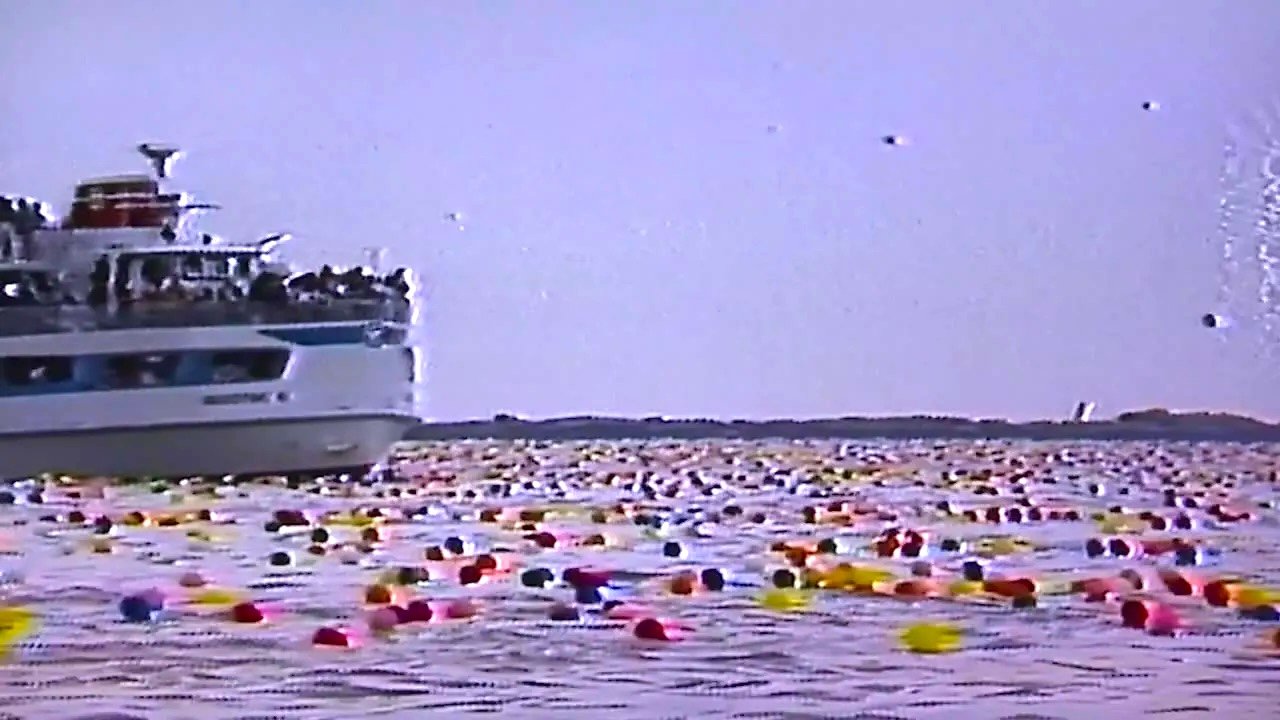
Drivers swerved to avoid the falling latex or stared at the sky, causing multiple traffic accidents. Nearby, Burke Lakefront Airport closed a runway for half an hour after balloons coated the tarmac.
Lawsuits and Emergency Disruptions
The descending balloons also interfered with serious emergency operations. Two fishermen, Raymond Broderick and Bernard Sulzer, had gone missing the previous day. A Coast Guard rescue helicopter struggled to navigate the airspace. On the water, boat crews found it impossible to spot the missing men because the lake’s surface was littered with bobbing balloons. The search was suspended on September 29, and the bodies later washed ashore.
One widow sued the organizers for $3.2 million. Another lawsuit came from a woman whose Arabian horses were allegedly spooked and permanently injured by the balloons. Both cases were settled for undisclosed terms. Ultimately, cost overruns forced the fundraiser to operate at a net loss.