
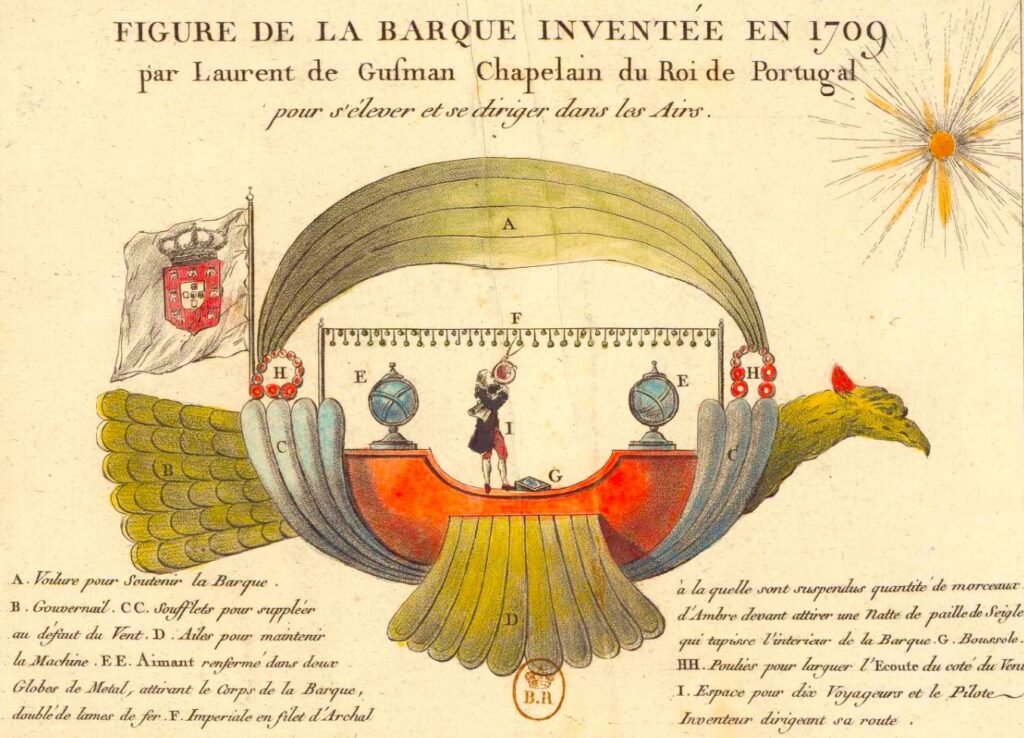
In 1709, King John V of Portugal granted a Brazilian-born priest sole rights to build a flying machine and stated that anyone who copied it would be put to death.
Months later, inside a Lisbon hall, that priest used a flame to send a small prototype rising to the roof before the royal court. What followed for Bartolomeu Lourenço de Gusmão involved bird-shaped airship blueprints, royal appointments, accusations before the Portuguese Inquisition, and a sudden escape to Spain.
From Colonial Brazil to the Portuguese Court
Born in December 1685 in Santos, in the Portuguese colony of Brazil, Gusmão began his novitiate with the Society of Jesus in Bahia around age fifteen before leaving the order in 1701. He moved to Portugal, found a patron in the Marquis of Abrantes in Lisbon, and studied philology and mathematics at the University of Coimbra, receiving the title of Doctor of Canon Law.
Accounts noted his strong memory and command of languages. In 1709, he petitioned King John V for royal favor for an airship concept reportedly conceived in Bahia, winning exclusive rights backed by the death penalty for imitators.
The Passarola Blueprints and a Canceled Test
Called the Passarola, Portuguese for bird, the preserved proposal depicted a boat-like hull fitted with wings, a head, a tail, and a steering rudder. Building on earlier concepts by Francesco Lana de Terzi, Gusmão planned to drape a massive sail over the hull to catch the wind, feed air into it through internal tubes and bellows when there was no wind, and house magnets inside two hollow metal globes. A public test scheduled for June 24, 1709, never took place.
Fire Under a Balloon in the Casa da Índia
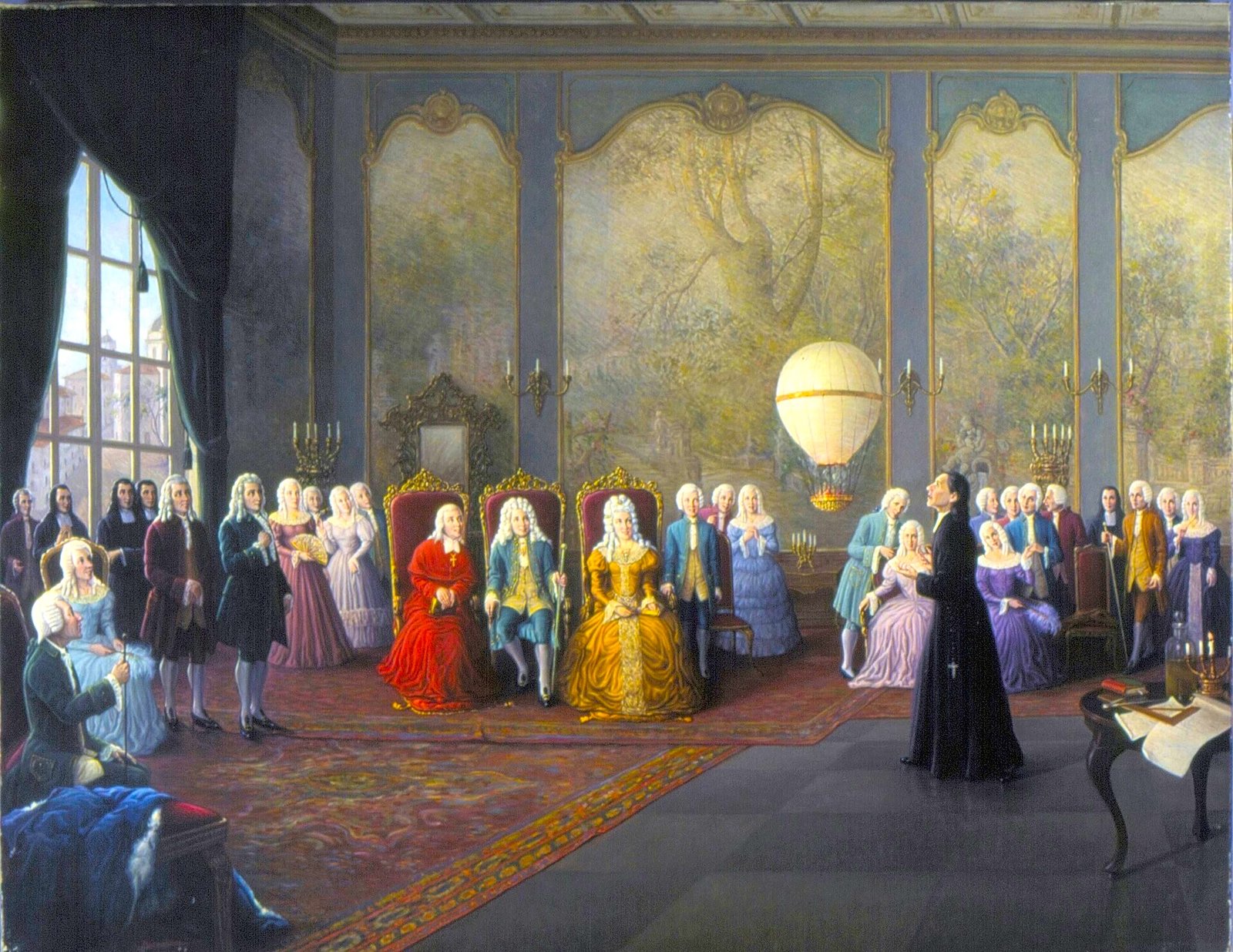
On August 8, 1709, Gusmão held a demonstration before the court inside the hall of the Casa da Índia in Lisbon. Using combustion from a flame, he propelled a small hot-air balloon up to the roof. King John V rewarded him with a professorship at Coimbra and made him a canon.
Gusmão became one of the fifty founding members of the Academia Real de História in 1720 and court chaplain in 1722. He published a 1709 manifesto on air travel and a 1710 work on draining leaking ships, while drafting an unfinished airship shaped like a triangular gas-filled pyramid.
The Inquisition and Flight to Spain
On October 20, 1786, London’s Daily Universal Register (later The Times) printed accounts from Lisbon claiming crowds had called Gusmão a wizard and that fear of the Inquisition over his flying experiments drove him to burn his manuscripts and flee.
Contemporary documents confirm that information was laid against him before the Inquisition, though on a different charge. Gusmão fled to Spain, contracted a fever, and died in Toledo on November 18, 1724.