
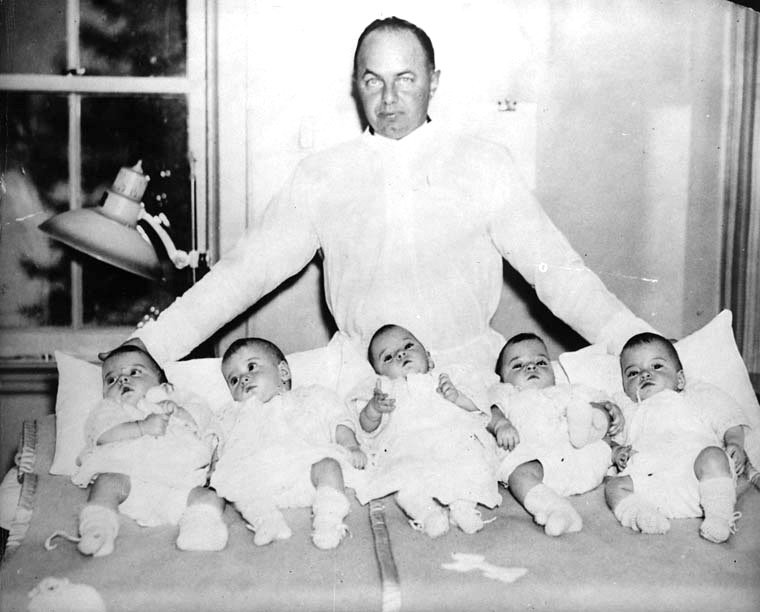
In May 1934, a rural farmhouse in Ontario, Canada, became the center of an unprecedented medical anomaly. A mother who believed she was carrying twins unexpectedly delivered five premature infants. They were so small they fit into the palms of adult hands.
Against severe medical odds, they all lived. However, their survival rapidly transformed from a biological rarity into a highly profitable government enterprise. The infants were removed from their parents, secured behind barbed wire, and showcased to millions of paying tourists. This is the factual sequence of events surrounding Annette, Émilie, Yvonne, Cécile, and Marie.
The Premature Birth of Five Sisters
On May 28, 1934, Elzire Dionne went into labor two months early. Dr. Allan Roy Dafoe arrived at the Corbeil farmhouse and delivered five premature girls weighing less than 14 pounds combined. The early survival strategies involved placing the newborns in a blanket-lined wicker basket near an open oven door for warmth. They were fed a homemade formula containing water, corn syrup, cow’s milk, and rum.
The Creation of the Quintland Compound
As news of the births spread, the girls’ father, Oliva, briefly signed then canceled a contract to exhibit them at the Chicago World’s Fair. Shortly after, the Ontario government, under Premier Mitchell Hepburn, intervened. Citing welfare concerns, officials assumed guardianship of the girls.
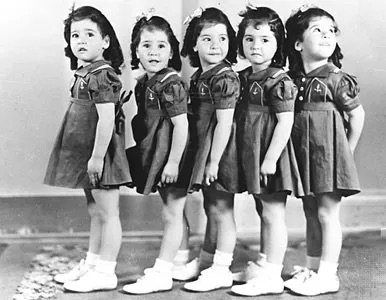
The state built a specialized hospital and nursery complex across the street from the family’s home. Surrounded by barbed-wire fences and monitored by police guards, the facility became known as Quintland.
Displayed for Three Million Tourists
Quintland quickly became Canada’s largest tourist destination, drawing larger crowds than Niagara Falls. Initially, nurses presented the infants on a balcony to onlookers. Later, the toddlers were placed in an outdoor play area enclosed by fine mesh glass. This allowed the public to observe them while the girls saw only shadows.
By 1943, approximately three million tourists had visited. The operation generated an estimated $500 million for the province. Concurrently, the girls’ likenesses were utilized in Hollywood films, advertisements, and product endorsements.
Returning to the Dionne Household
Following a nine-year custody dispute, the parents regained control of the girls in late 1943. The reunited family moved into a nearby mansion financed by the portion of earnings the state allowed the girls to keep. In their 1995 book, the surviving sisters disclosed that upon returning to this house, their father sexually abused them during car rides.
At age 18, the quintuplets departed the home and cut contact with their parents. Émilie died at age 20 from a seizure, and
Marie passed away at 36 from a blood clot. By the 1990s, Annette, Cécile, and Yvonne were living together on $525 a month. They petitioned the Ontario government regarding their mismanaged finances and received a one-time $2.8 million settlement.