

A sudden loud clap rings out across a pasture, and several goats lock their limbs completely rigid, toppling sideways onto the grass like wooden statues. Within seconds, the animals scramble back to their feet and casually resume grazing as if nothing occurred.
Known formally as the myotonic goat, this distinct American breed does not actually faint or lose consciousness. Instead, a peculiar genetic mutation turns a momentary startle into a total muscular freeze, triggering a century-long medical mystery that began on a rural nineteenth-century farm and eventually redefined neurology.
From Hidden Farmyards to the Scientific Record
In the 1880s, four unusual goats arrived in Marshall County, Tennessee. Local farmers noticed that unlike normal goats, these animals could not leap over ordinary field fences. Instead, they crawled through holes in the dirt like pigs, making them exceptionally easy to contain behind low stone walls.
Observers documented them across Marshall, Giles, Lawrence, Maury, and Coffee counties. One Texas farmer transported several goats from Giles County solely to convince skeptical neighbors that the stiff-legged creatures truly existed. By 1904, medical journals documented the phenomenon in print, and researchers formally classified the condition as congenital myotonia in 1939.
A Build Designed for Rigidity
The physical anatomy of the myotonic goat reflects its unusual muscular mechanics. These animals carry a broad, compact frame with dense muscle mass across the back and shoulders. Adult goats stand between 43 cm (17 in) and 64 cm (25 in) tall and weigh between 27 kg (60 lb) and 79 kg (174 lb), while large bucks can reach 90 kg (200 lb).
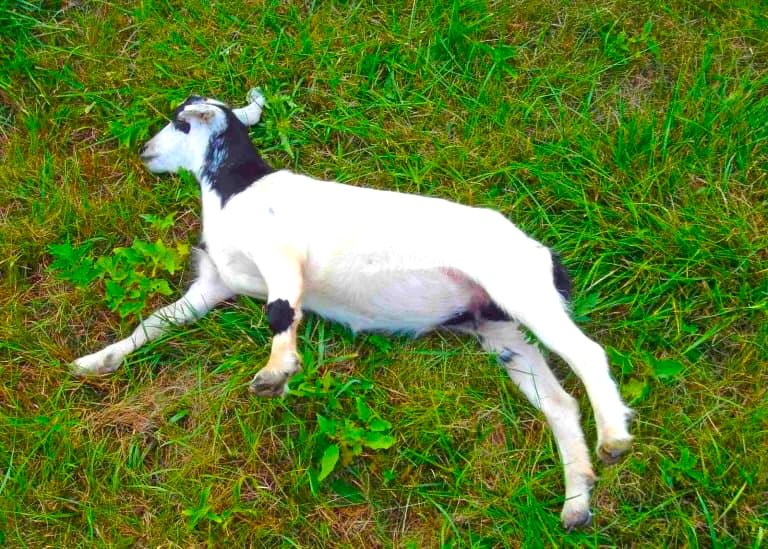
Their prominent, protruding eyes sit inside high sockets, earning them the nickname “bug-eyed.” Because they cannot jump obstacles higher than 0.5 m (1 ft 8 in), owners easily manage them behind modest enclosures. Newborn kids show no signs of muscle stiffness during their first 14 days of life, with physical rigidness only appearing between days 18 and 173.
The Microscopic Trigger Behind the Stiffening
The physical freeze traces back to a hereditary disorder within the skeletal muscle chloride channel, governed by the CLCN1 gene. In affected animals, a missense mutation swaps the amino acid alanine for a proline residue. This microscopic shift reduces the flow of chloride ions across muscle fibers, delaying relaxation after any sudden movement or excitement. When startled, their muscles fire repetitive electrical discharges rather than releasing tension.
How Farm Goats Reshaped Human Medicine
Landmark experiments by researchers Brown and Harvey in 1939 established how chloride conductance dictates muscle excitation. This work revealed direct parallels to human congenital myotonia, where individuals experience similar delays in muscle relaxation. In 1996, scientists pinpointed the exact goat gene mutation, decades after studying goat tissue to decode cellular electrical conductivity.