
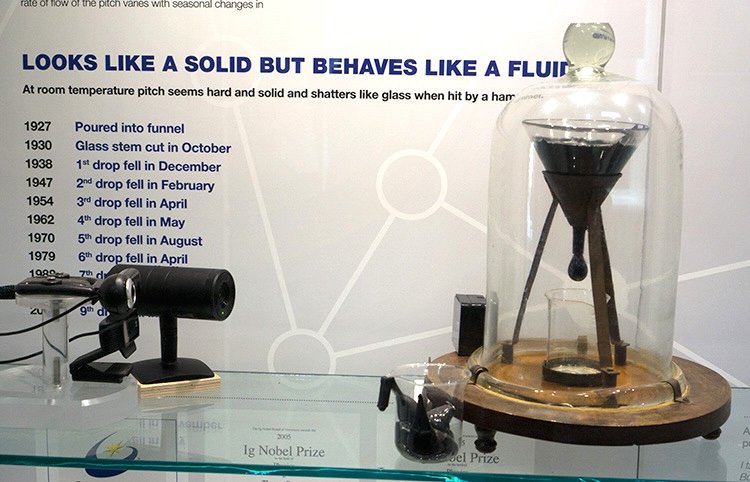
In 1927, physicist Thomas Parnell placed dark bitumen into a glass funnel at the University of Queensland in Brisbane, Australia. Pitch appears solid at room temperature and shatters under a hammer blow, yet it is a liquid flowing at an imperceptible speed.
Parnell set out to prove this to students, launching what Guinness World Records verifies as the world’s longest continuously running laboratory experiment. Nearly a century later, the funnel continues to drip, having outlasted the researchers who spent decades waiting to see a single drop fall.
A Solid Substance That Flows Like Water
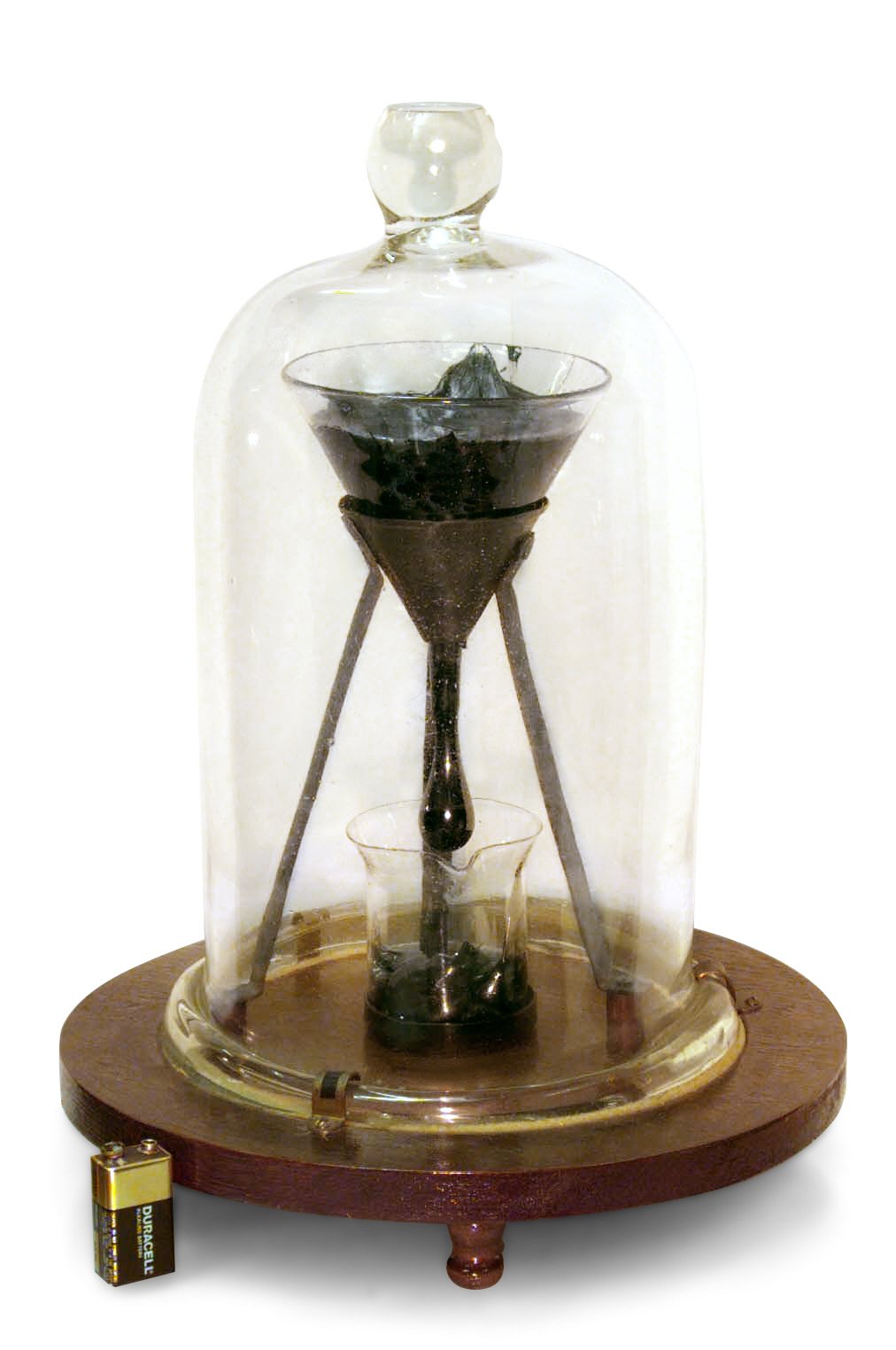
Parnell heated the pitch, poured it into the sealed funnel, and let it settle for three years. In October 1930, he cut the neck of the funnel to allow gravity to act on the material. The first drop took eight years to fall, detaching in December 1938. The material holds a viscosity approximately 230 billion times greater than water.
Kept under a glass dome outside a university lecture hall, subsequent drops required between seven and nine years each to form and drop into the beaker below.
Missed Drops and Camera Glitches
Professor John Mainstone oversaw the Queensland apparatus from 1961 until 2013 without ever witnessing a drop detach. The seventh drop fell on July 3, 1988, at 4:45 p.m. during Brisbane’s World Expo 88, occurring when Mainstone had stepped away to get a drink.
For the eighth drop in November 2000, researchers connected a live webcam to broadcast the moment, but a technical glitch knocked the feed offline during the detachment. Mainstone passed away in August 2013 at age 78 without seeing a fall occur.
Air Conditioning and a Snapped Stem
After the seventh drop, the university added air conditioning to the display area. The lower temperature raised the viscosity of the pitch, stretching the formation interval to roughly twelve to thirteen years. In April 2014, the ninth drop touched the eighth drop inside the beaker.
Professor Andrew White chose to replace the container before the drops fused. As the protective bell jar was lifted on April 24, 2014, the wooden base wobbled, causing the ninth drop to snap away from the funnel.
The First Drop Captured on Video
Another pitch experiment, started in October 1944 at Trinity College Dublin, sat unmonitored on a shelf for decades. In April 2013, Dublin physicists noticed a drip forming in the funnel. They placed the apparatus on a table and set up a webcam to monitor the movement.
At approximately 5:00 p.m. Irish Standard Time on July 11, 2013, the camera successfully recorded the pitch falling into the jar below, documenting the event on video for the first time in history.