
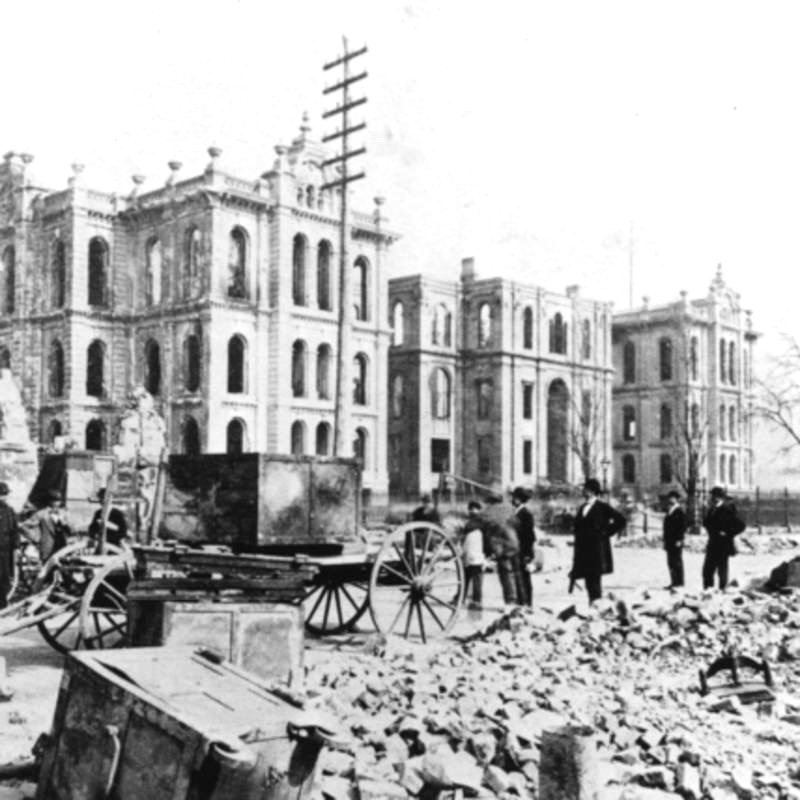
On the evening of Sunday, October 8, 1871, a small fire sparked in a barn on DeKoven Street. What began as a minor blaze in a localized shed rapidly escalated into one of the most catastrophic events in American history.
Within hours, flames devoured the wooden infrastructure of the city, driven by aggressive winds and months of severe drought. The fire leaped across the Chicago River, consuming the business district and leaving tens of thousands of residents homeless. This is the true story of the Great Chicago Fire.
A Perfect Storm for Destruction
In the autumn of 1871, Chicago was primed for disaster. The city had experienced just one inch of rain between July and October. More than two-thirds of the city’s buildings were constructed entirely of wood, utilizing a method called balloon framing.
Even the roads and sidewalks were made of highly combustible lumber. When the fire began near the O’Leary family barn, an initial error by a watchman sent the exhausted fire department to the wrong location. By the time firefighters reached DeKoven Street, the blaze was uncontrollable.
The River Failed as a Barrier
Firefighters hoped the South Branch of the Chicago River would act as a natural firebreak. However, the riverbanks were lined with lumber yards, coal stockpiles, and barges. As the temperature rose, the extreme heat generated a meteorological phenomenon known as a fire whirl.
These tornado-like funnels of hot air lifted flaming debris high into the night sky, throwing burning embers directly across the water. The fire jumped the river, igniting the South Side Gas Works. Shortly after, flaming debris struck the roof of the city’s waterworks building. Within minutes, the facility was completely destroyed, the city’s water mains ran dry, and the firefighters were left helpless.
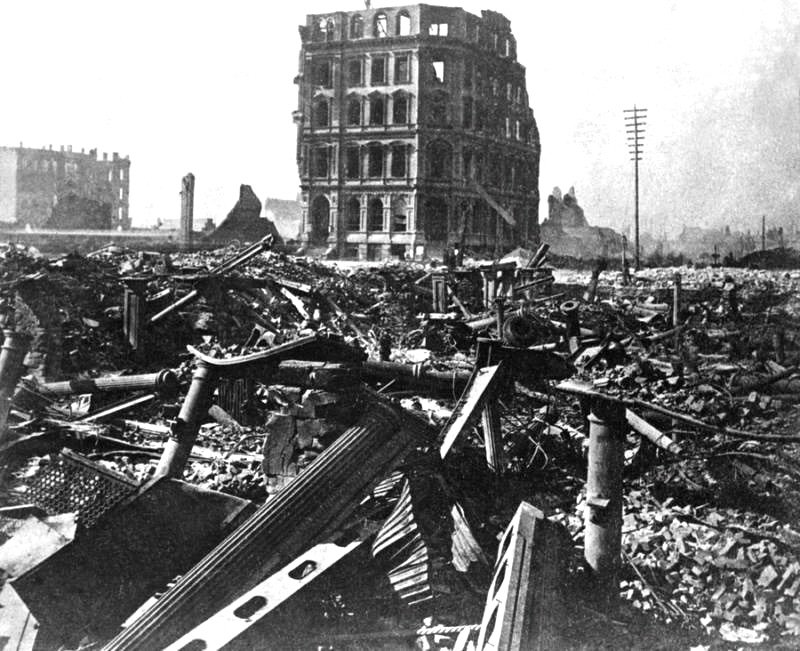
The Rain and the Ruin
Panic swept through the city as the courthouse collapsed, its massive bell crashing to the basement. The fire raged block by block, moving rapidly northward through densely populated neighborhoods. Finally, late on the evening of October 9, rain began to fall.
The fire, having exhausted its fuel in the heavily populated areas, finally died out on the morning of October 10. The damage was staggering. The blaze had leveled more than three square miles of the city, destroying 17,500 buildings and 73 miles of roads. The disaster left roughly 300 people dead and 100,000 residents without homes.
The Investigation and the Legend
Despite extensive investigations, the exact cause of the fire was never definitively proven. The most famous local rumor blamed Catherine O’Leary, an Irish immigrant, claiming her cow kicked over a lantern while she was milking it. In 1893, the reporter who popularized the story admitted he had fabricated it, and in 1997, the city council officially exonerated Mrs. O’Leary.
Other theories suggested a neighborhood boy knocked over a lamp during a craps game, or that a thief ignited hay while stealing milk. Regardless of its origin, the Great Chicago Fire forced the city to implement strict new building codes, fundamentally altering how American cities were constructed.