
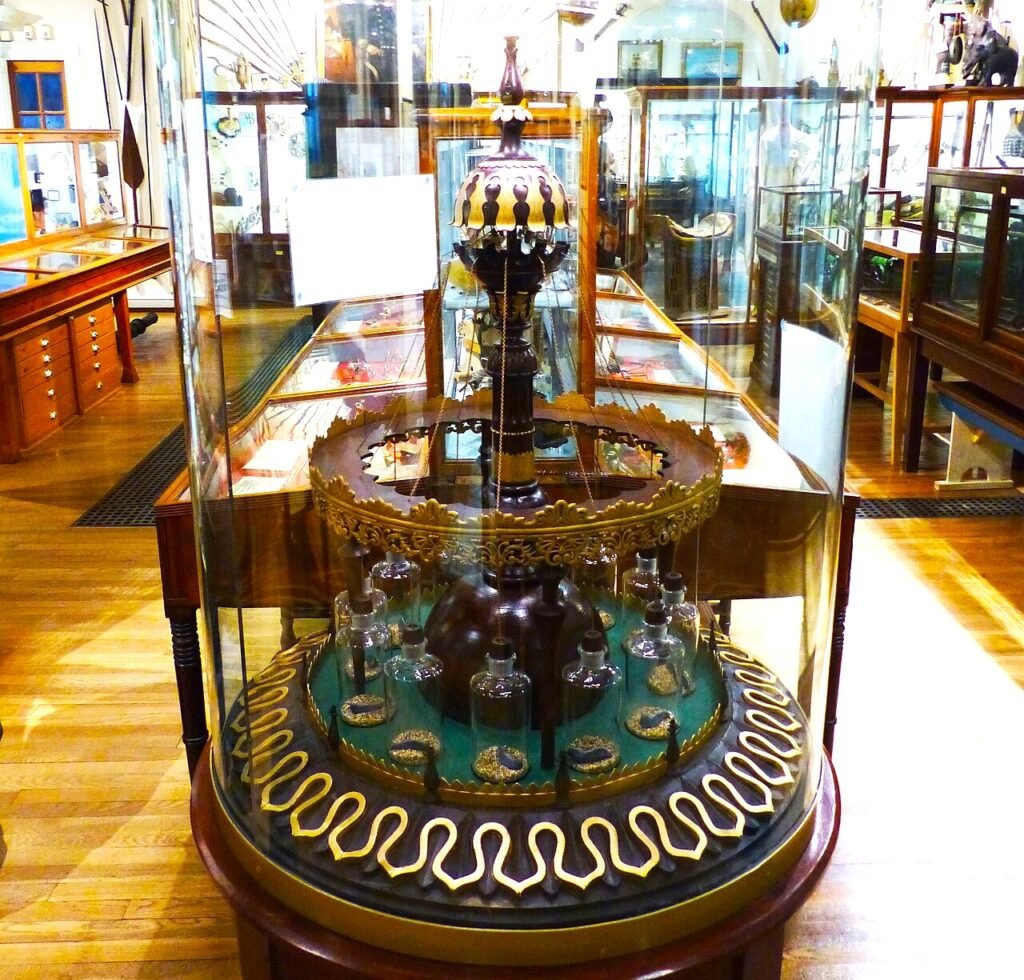
In 1851, visitors to London’s Great Exhibition encountered a weather prediction device unlike anything ever built. Instead of using mercury dials, this ornate machine used the instincts of twelve live leeches trapped inside glass bottles. When a storm approached, the agitated creatures climbed upward, triggering a mechanism that rang an alarm bell.
Created by a British doctor, the contraption successfully predicted violent storms before they hit the coast. The government rejected it, but the story of the leech barometer remains a highly unusual chapter in meteorological history.
A Jury of Weather Predictors
Dr. George Merryweather served as the honorary curator of the Whitby Literary and Philosophical Society’s Museum. He noticed that medicinal leeches reacted to electrical atmospheric changes. Inspired by an Edward Jenner poem about disturbed leeches rising to the summit of their prison, Merryweather spent 1850 designing his machine.
He placed twelve leeches into individual pint bottles, arranged in a circle so the creatures would not suffer the affliction of solitary confinement. He poured exactly one and a half inches (3.8 centimeters) of rainwater into each glass, creating a permanent residence for his jury of philosophical councilors.
Ringing the Storm Alarm
The mechanics of the tempest prognosticator were simple yet effective. Merryweather fitted small metal tubes at the top of every bottle. Inside each tube sat a piece of whalebone connected to a wire and a small hammer. When an approaching storm altered the air, the highly motivated leeches tried to escape.
They forced their way into the tubes, dislodging the whalebone and causing the hammers to strike a large central bell. If the bell rang repeatedly as multiple leeches ascended, a severe storm was imminent.
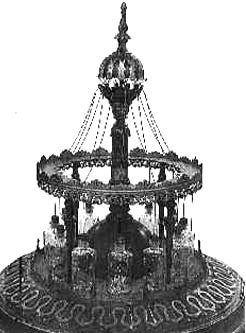
The Crystal Palace Exhibition
Merryweather spent a year thoroughly testing his invention. Whenever the bell rang, he dispatched a letter to Henry Belcher, the Philosophical Society president, warning him of an incoming tempest. The Whitby Museum library still holds 28 of these precise predictions.
Convinced of his success, Merryweather pitched a cheap version to the shipping industry. He also hired local craftsmen to build a lavish model inspired by Indian temples. On February 27, 1851, he presented a three-hour essay on his work before displaying the machine at the Great Exhibition inside London’s Crystal Palace.
Modern Replicas of a Lost Machine
Despite the documented accuracy of the tempest prognosticator, the British government decided against installing the machines along the coastline. They opted for Robert FitzRoy’s storm glass instead. The original Indian temple model was eventually lost.
One hundred years later, organizers of the 1951 Festival of Britain revived the concept by building a non-working replica based on Merryweather’s original copperplate drawings. The Whitby Museum acquired this model. Engineers later used its plans to construct fully functional versions, which currently sit on display at the United Kingdom National Meteorological Library and at a Christmas fair in San Francisco.