
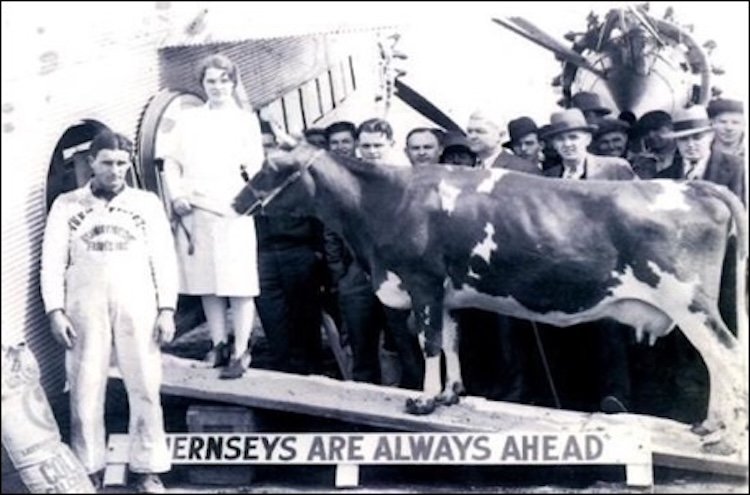
On February 18, 1930, onlookers in St. Louis watched paper cartons drift down from an airplane on parachutes. Inside those cartons was fresh milk, drawn midair from a passenger weighing over 1,000 pounds (454 kilograms).
That passenger was Elm Farm Ollie, a Guernsey cow whose flight during the Great Depression turned an aviation publicity stunt into a world first still celebrated every winter at a Wisconsin mustard museum.
Why the Aviation Industry Put a Cow on a Plane
The flight was part of the second International Aircraft Exposition at the newly built St. Louis Arena. Organized by the Aeronautical Chamber of Commerce, the event aimed to revive an aviation market hit by the Great Depression. Aircraft supply remained high while plane sales fell, the public worried about flight safety, and the industry wrestled with internal struggles over U.S. government air mail contracts.
Organizers promised over $2,500,000 in exhibits, an aviation musical, appearances by pilots Edward Stinson and Elinor Smith, and world-first flights. No cow was known to have flown before. Putting one aboard was meant to build buzz, show aircraft stability and safety, demonstrate air transport for livestock, and collect scientific data on her behavior and how high altitude affected a cow being milked.
Boarding a Ford Trimotor as “Sky Queen”
Before the flight, Elm Farm Ollie was known as “Nellie Jay.” She was an orange-red and white Guernsey cow from Sunnymeade Farms in Bismarck, Missouri. Organizers chose her for her docile, calm nature and her high daily milk yield, which required up to three milkings a day.
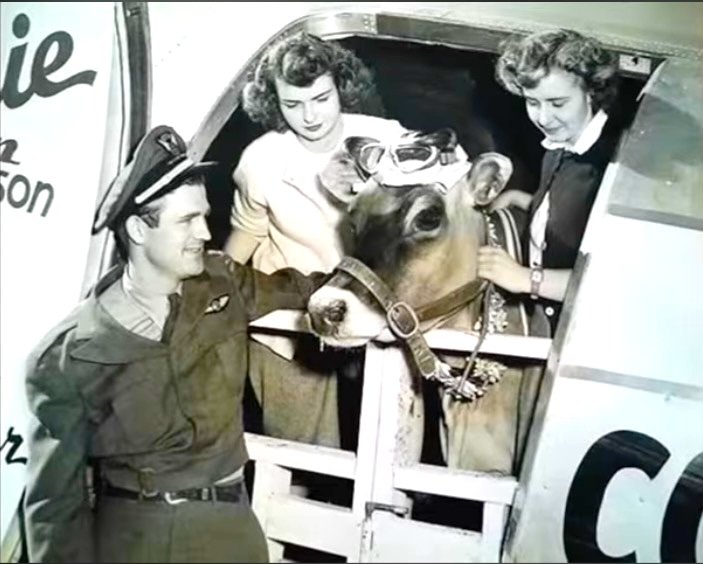
Pilot Claude Sterling of Parks Air College flew Ollie in a Ford Trimotor from Bismarck to St. Louis, a trip of 72 miles (116 kilometers). After completing the flight, she received the nickname “Sky Queen.”
Parachuting Fresh Milk Over St. Louis
During the flight, Elsworth W. Bunce of Wisconsin milked Ollie midair, making her the first cow milked in-flight and him the first man to do it. Accounts differ on whether Bunce milked her on the trip from Bismarck or on a second flight starting in St. Louis. Ollie produced 24 quarts (22.7 liters) of milk, which was sealed in paper cartons attached to parachutes and dropped to spectators below. Some milk was reserved for Charles Lindbergh, who had been announced as an attendee, though he never actually made it to St. Louis.
From Ripley’s to Elm Farm Ollie Day
Ollie lived to about 10 years old, and her story appeared over the decades in newspapers, trivia books, a painting by E.D. Thallenger, and the Ripley’s Believe It or Not! comic strip. In Wisconsin, former Assistant Attorney General Barry Levenson, founder of the National Mustard Museum, established February 18 as “Elm Farm Ollie Day” for a festival in Mount Horeb and wrote a cantata titled “Madamme Butterfat.” Today, the museum still marks the date each year.