
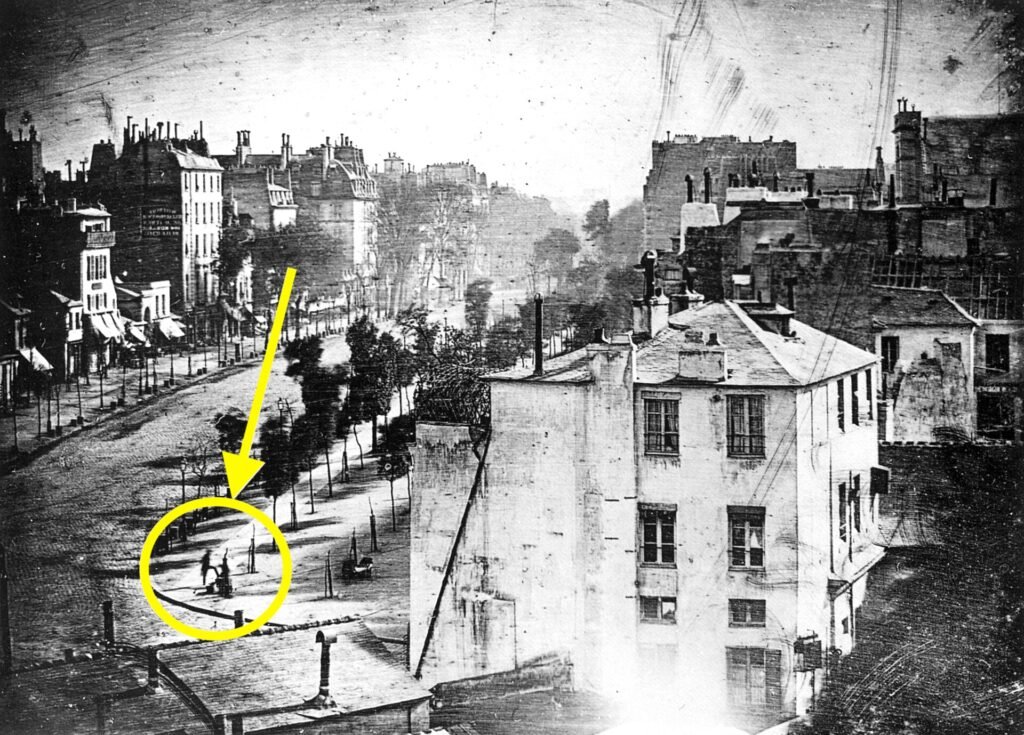
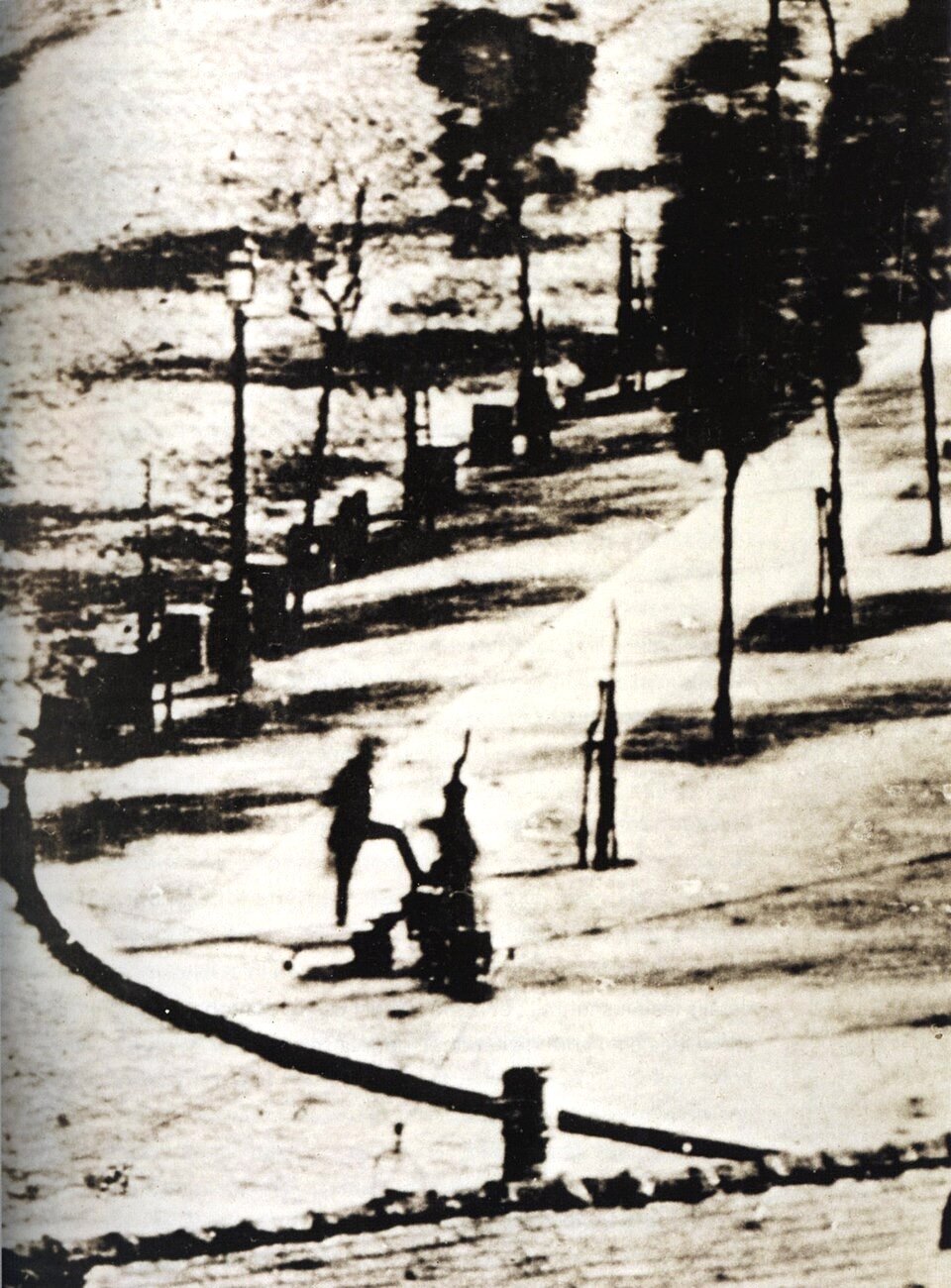
Look closely at an 1838 photograph of an empty Paris street and you might miss two tiny shadows in the bottom left corner. At 8:00 AM that morning, Boulevard du Temple was packed with pedestrians and horses. Every moving passerby vanished from the frame, leaving two anonymous figures in what is widely considered the earliest surviving photograph of a human. That silver plate survived a studio fire, deteriorated in royal storage, suffered a botched restoration, and had its exact street spot pinpointed nearly two centuries later.
Four Minutes That Erased a Busy Paris Street
French artist and inventor Louis Daguerre took Boulevard du Temple between April 24 and May 4, in 1838 or possibly 1837, from his studio window at 5 Rue des Marais. The silver-plated metal sheet measured about 13 by 16 centimeters (5 by 6 inches). Ten years earlier, the earliest known photograph, View from the Window at Le Gras, required multiple eight-hour exposures.
Daguerre cut the exposure to four or five minutes by polishing silver-plated metal, treating it with light-sensitive fumes, and developing the image with mercury vapor. Moving traffic vanished completely. Only a customer getting his shoes shined and the bootblack stayed still long enough to register, though some speculate the second shape is a water pump. Daguerre took two other plates that day, a surviving midday view and an evening shot now lost.
Fire, Rivalry, and a Royal Gift
Daguerre unveiled the daguerreotype to the French Academy of Sciences in January 1839. In early March, fire destroyed his studio, though firefighters saved his adjacent house and laboratory. Only 25 confirmed plates by Daguerre survive. Around the same time, Englishman Henry Fox Talbot developed a silver-chloride paper process and claimed priority. Daguerre patented his method in Britain, and France declared it free worldwide while requiring Great Britain to pay licensing fees.
In March 1839, Daguerre showed Boulevard du Temple to Samuel Morse, who described it in a letter published that April. That October, Daguerre gifted King Ludwig I of Bavaria a framed triptych featuring the 8:00 AM and midday views.
Lost, Rediscovered, and Ruined in Restoration
Stored at the royal palace and later the Bavarian National Museum archives, the plates deteriorated. In 1936 or 1937, American historian Beaumont Newhall rediscovered and reproduced them, publishing them in 1949. Kept poorly during World War II, the originals went to the Munich City Museum in 1970, where a failed restoration ruined them further. Modern facsimiles rely on Newhall’s copies.
Pinpointing the Exact Spot in 2026
On October 15, 2026, a plaque named “Un détail imprévu” (An unexpected detail) by the Brut de Fonte foundry was unveiled on Paris’s Place de la République. Swedish filmmakers Maximilien Van Aertryck, Axel Danielson, and Kalle Boman used perspective analysis, 3D models, and pre-Haussmann maps to locate where the two figures stood.