
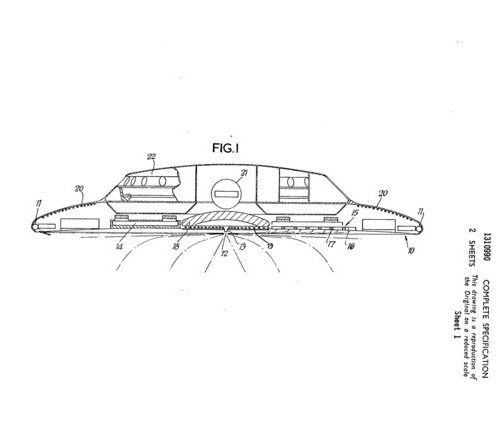
Back in 1973, the British Patent Office officially approved a highly unusual design for a nuclear-powered flying saucer. This revolutionary spacecraft was not submitted by an advanced aerospace agency or the military, but by British Rail.
The national railway operator successfully secured Patent No. 1,310,990 for a vehicle equipped with a laser-induced fusion engine, artificial gravity, and seating for dozens of commuters. The government quickly classified the blueprints as top secret, burying one of the strangest transportation projects of the Cold War.
A Fusion-Powered Commuter Craft
Engineer Charles Osmond Frederick originally drafted the spacecraft plans on his own time. Because of company policies regarding freelance inventions, he submitted his completed design through his employer. The craft’s propulsion mechanism relied on injecting minuscule amounts of hydrogen into a magnetic accelerator located beneath the hull.
High-energy lasers would then force these atoms to collide at a fraction of the speed of light. This would trigger nuclear fusion, creating microscopic hydrogen explosions at a rapid pace of 1,000 detonations per second. The resulting shock waves would propel the spinning disc upward to low-Earth orbit.
Heavy Radiation Shields and Glowing Force Fields
British Rail designed the flying saucer primarily for mass transit. Inside the circular upper compartment, up to sixty passengers would sit facing inward, much like riders on an amusement park centrifuge.
Because the continuous fusion engine generated massive amounts of deadly ionizing radiation, the ship required an eight-foot-thick solid lead deck weighing hundreds of tons just to keep the occupants alive. The blueprints also incorporated a highly theoretical magnetic deflection system to channel dangerous charged particles to the top of the ship. When active, this shield would glow brightly like the aurora borealis.
Defying Physics With Anti-Gravity Coils
To counter the crushing physical stress of extreme acceleration and deceleration, Frederick bypassed standard spacecraft physics and sketched out a complex graviton field generator. This proposed artificial gravity system relied on spinning ultra-high-energy electrons through elaborate overhead coils.
Building such a device would require an energy output millions of times greater than today’s Large Hadron Collider. Generating that specific particle physics reaction would theoretically require a power plant roughly the size of Neptune’s orbit just to manage the gravity inside the passenger cabin.
Top Secret Files and Expired Patents
Patent laws in the 1970s allowed inventors to file protections for highly theoretical and speculative designs. When the patent was officially granted in March 1973, British intelligence agencies noticed the word “nuclear” and immediately classified the entire file as “Hush, Most Secret.”
Maintaining exclusive rights required regular financial renewals, and by 1976, British Rail simply let the patent lapse. The national railway never constructed a prototype, and decades later, government officials confirmed they had no plans to introduce nuclear flying saucers to the public transportation network.