
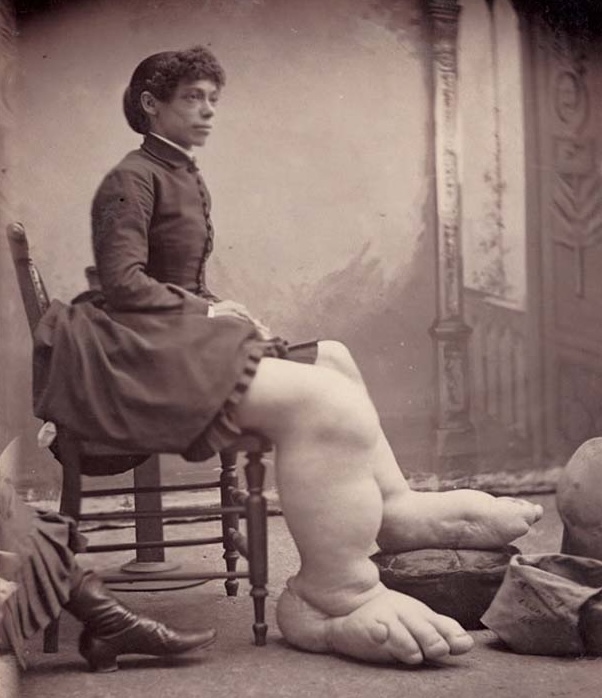
Born in England around 1860, Fanny Mills immigrated to Sandusky, Ohio, as a young child. While her two sisters developed typically, her parents soon noticed a distinct physical difference in her lower extremities. She began showing symptoms of Milroy’s Disease, a condition causing severe swelling in the lower limbs.
This medical anomaly transformed her into one of the most famous dime museum attractions of the 19th century, known nationwide as the “Ohio Big Foot Girl.”
The Early Life of Fanny Mills
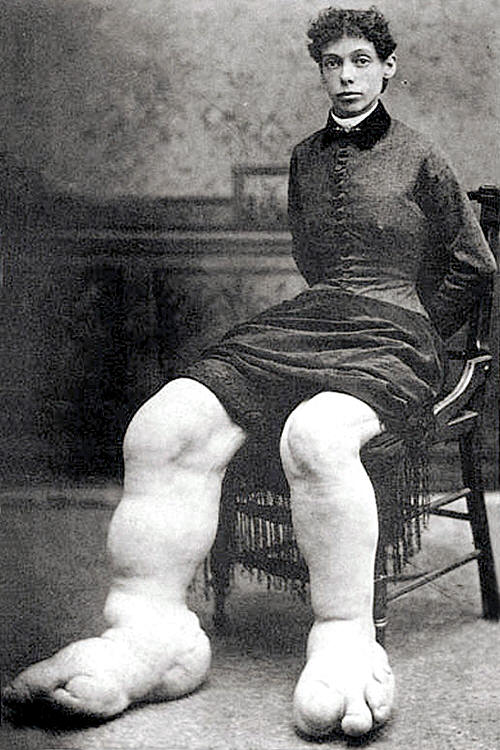
Despite weighing only 115 pounds (52 kilograms) from the waist up, her feet grew to an astonishing size. Medical reports from the era indicate her feet reached 19 inches (48 centimeters) in length and 7 inches (18 centimeters) in width.
Because standard footwear could not fit her, she reportedly wore shoes constructed from three goat skins and used ordinary pillowcases as socks. A visiting reporter described her feet as immense, noting the toes were irregular and the toenails were entirely missing, though the nail beds remained visible.
Finding Fame in Dime Museums
In 1885, Mills decided to capitalize on her condition by exhibiting herself. Accompanied by her friend Mary Brown, who assisted her with walking and removing her oversized shoes, she traveled to various dime museums along the East Coast. These establishments were incredibly popular at the time, charging visitors a single dime to view unusual human attractions.
Promoters eagerly advertised her appearances. To attract larger crowds, museum owners circulated a false promotional campaign claiming her father would pay $5,000 to any man willing to marry her. Posters boldly advertised this fabricated dowry. The advertisements deliberately omitted a crucial fact: she was already married. In 1886, she had wed William Brown, the brother of her assistant Mary.
The Final Years of the Ohio Big Foot Girl
Her career as a museum attraction proved highly lucrative. She frequently earned up to $150 per week, an amount roughly equivalent to $4,000 in modern currency. Audiences flocked to see the striking contrast between her typical upper body and her massive lower limbs.
Her time in the spotlight was brief. In 1887, she gave birth to a stillborn child. Her health declined significantly following the pregnancy, prompting her to retire from public exhibitions in 1892. She and her husband returned to their home in Ohio. She died there shortly after at the age of 39. As the 20th century approached, the dime museum industry faded as society gained a better understanding of medical conditions and audiences turned to new entertainment options like cinemas and carnivals.