
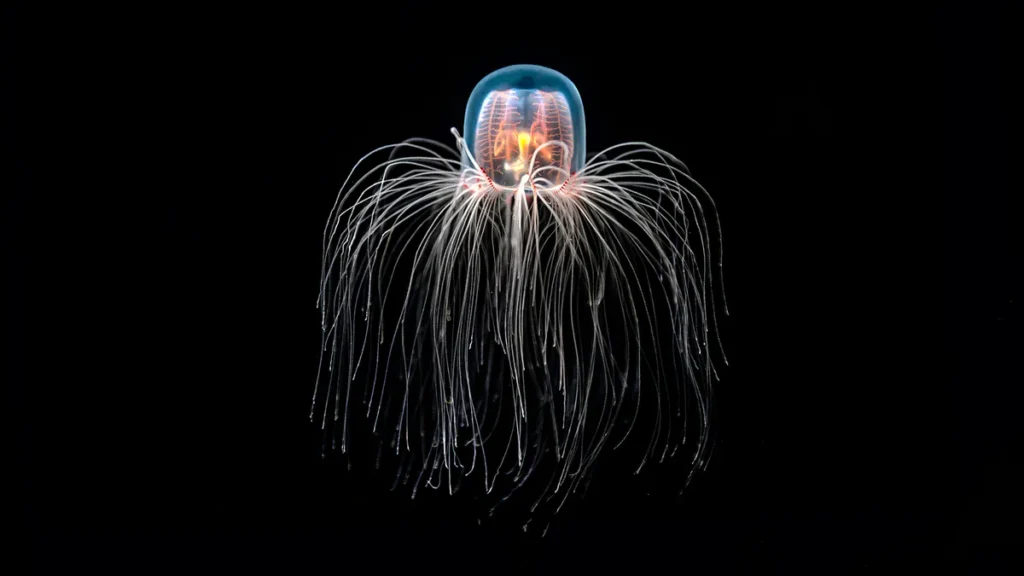
Deep in the oceans, a tiny organism possesses a biological ability that defies the natural aging process. The Turritopsis dohrnii, a bell-shaped marine animal, has the documented capability to reverse its life cycle completely. When faced with starvation, physical injury, or old age, this creature does not perish but instead transforms its mature adult body back into a juvenile state.
This continuous cycle of aging and reverting makes it biologically immune to a natural death. Researchers have studied this unique cycle for decades to understand how it functions.
From Larvae to Predator
The life of this marine animal begins as a free-swimming larva known as a planula. This larva eventually settles onto the ocean floor and develops into a branched polyp colony. Jellyfish, also called medusae, bud off from these polyps to become sexually mature adults. The adult is remarkably small, measuring a maximum of about 4.5 millimeters, or 0.18 inches, in diameter. It features a bright red stomach shaped like a cross and contains up to 90 tentacles along its edge. As a carnivore, it hunts zooplankton, fish eggs, and small mollusks. It uses its tentacles, which contain specialized stinging cells, to capture its prey.
The Biological Reset Button
If the adult animal faces environmental stress, sudden temperature changes, or physical damage, it triggers a rare cellular process called transdifferentiation. During this event, the bell and tentacles of the jellyfish deteriorate. The organism turns into a cyst-like mass, drops back down to the sea floor, and transforms directly into a new polyp colony. The entire process occurs rapidly. This newly formed polyp is an exact genetic clone of the adult and will subsequently release new young jellyfish. The animal effectively resets its biological clock.
Scientific Discoveries and Genetic Research
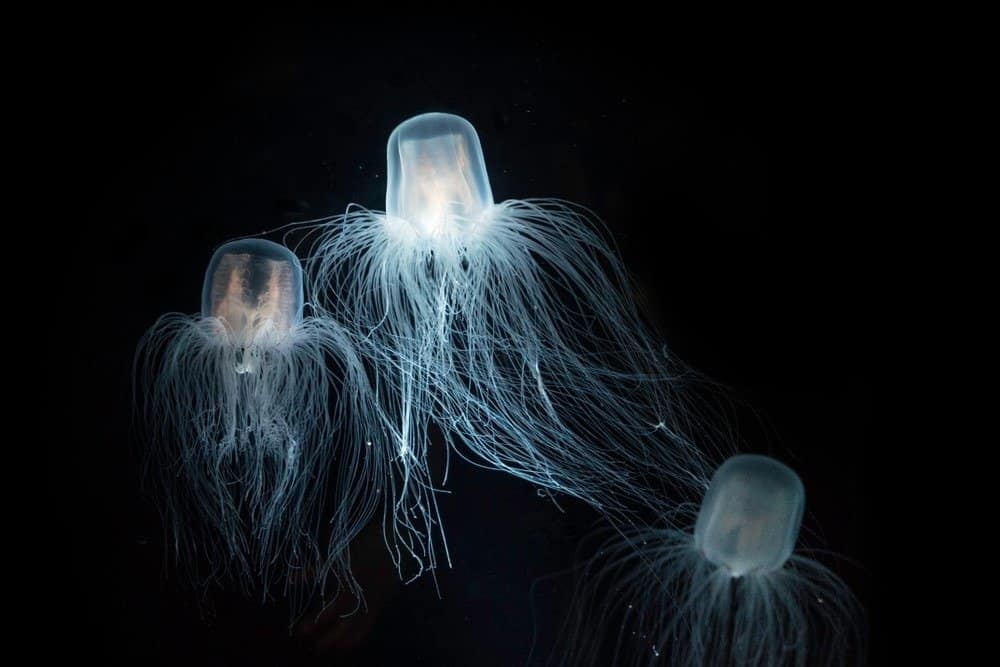
Researchers have closely monitored this process in laboratory settings. Keeping them in captivity is notoriously difficult, requiring daily inspections of their food sources. In one documented experiment, a captive colony rebirthed itself exactly eleven times over a two-year period. In 2022, scientists analyzed the genome of the species to understand the mechanics behind this rejuvenation. They discovered that the organism maintains its telomere length during the life cycle reversal, which prevents cellular aging.
A Silent Global Invasion
The species was first identified in the Mediterranean Sea and formally named in 1883. Today, marine biologists find these organisms in temperate and tropical ocean waters worldwide. Researchers believe the animals spread globally by traveling inside the ballast water of large cargo ships. Because the organisms are extremely small and can revert to a dormant state when starved during long voyages, they easily survive transoceanic trips. This widespread distribution remains largely unnoticed by the general public due to their tiny size and lack of harmful effects on local ecosystems.