
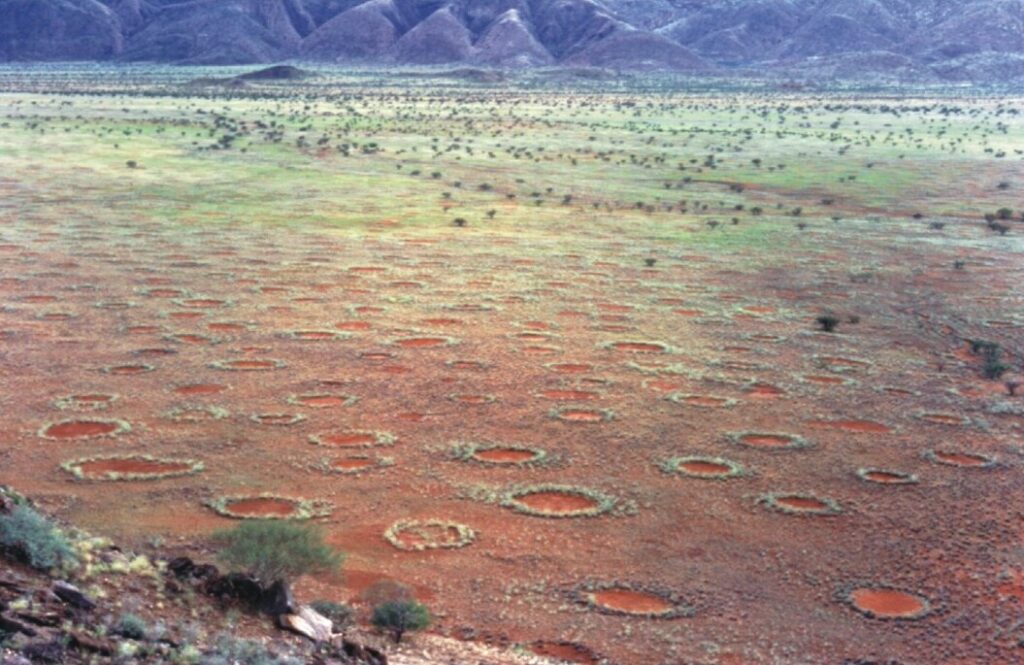
Across the dry expanse of the Namib Desert, millions of barren patches dot the landscape like perfectly drawn polka dots. These completely empty discs of red soil are surrounded by a distinct, vibrant ring of tall grass.
For decades, scientists have traveled to southern Africa to study this massive natural grid. The exact cause behind the formation of these rings has triggered one of the most intense and continuous debates in modern ecology, pitting entomologists against botanists.
Millions of Barren Discs in the Sand
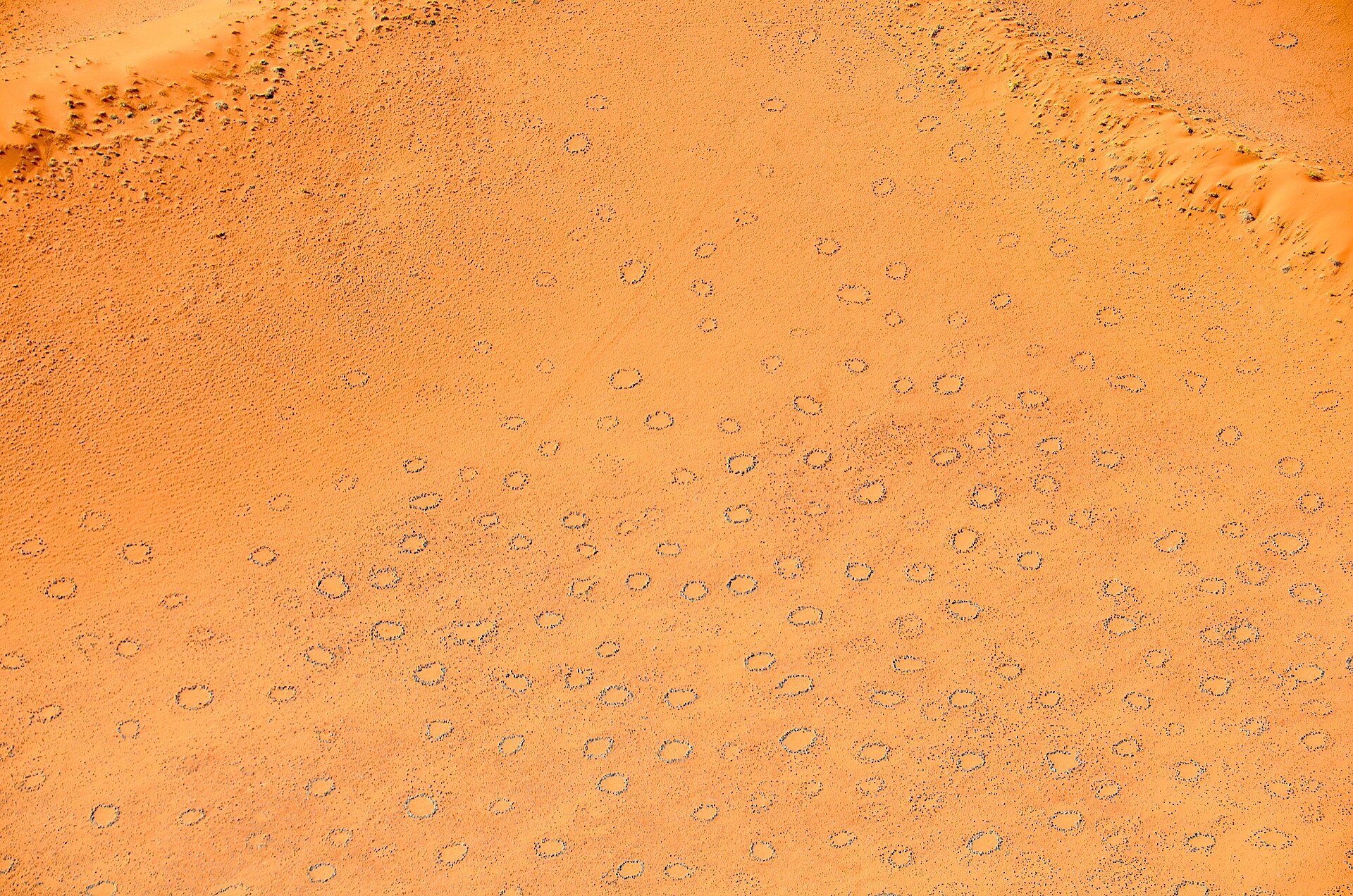
These formations appear in arid grasslands, stretching inland from the coast of the Atlantic Ocean in Namibia. The bare patches range in size from 2 to 15 meters, or 6.6 to 49.2 feet, in diameter. The rings are not static. They go through a measurable life cycle where they appear, expand, and eventually vanish as grass overtakes the center again.
An average formation maintains its structure for roughly 30 to 60 years. While originally thought to be unique to the African continent, researchers discovered identical formations in the remote Pilbara region of Western Australia in 2014.
The Termite Engineering Hypothesis
One prominent scientific explanation involves subterranean sand termites, specifically the species Psammotermes allocerus. Biologist Norbert Juergens proposed that termites actively create these circles to secure a permanent water supply.
By consuming the grassroots in a circular pattern, the insects prevent the plants from absorbing rainwater. The water then percolates deep into the porous sandy soil, creating an underground reservoir that allows the termites to survive extreme dry seasons. The ring of taller grass at the outer edge survives by tapping into the moisture trapped below the surface.
The Plant Competition Model
Other researchers argue that the phenomenon is driven entirely by the plants themselves. According to this theory, the extreme scarcity of water forces the vegetation to self-organize into specific spatial patterns. When rainfall is extraordinarily low, the plants establish an extensive root system that draws moisture from the surrounding bare soil.
The vegetation extracts the water it needs to survive, which leaves the adjacent central area completely devoid of moisture, physically preventing any new seeds from taking root in the middle.
A Combined Ecological Interaction
In recent years, ecological modeling has shown that both theories operate simultaneously. Scientists from Princeton University published data demonstrating a joint mechanism. The termites create the initial bare patches by clearing the vegetation to store moisture below the ground.
At the exact same time, the surrounding grass self-organizes its root structures to compete for the remaining surface water. This combined biological interaction ultimately creates the highly organized, large-scale geometric pattern of millions of circles that are clearly visible from satellites in space.