
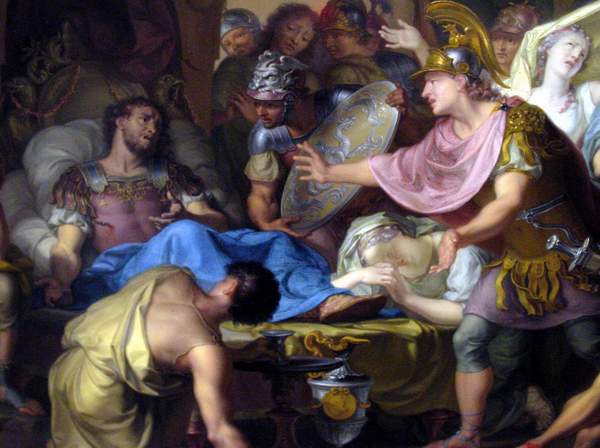
A military force of exactly 300 men, organized entirely as 150 pairs of male lovers, once became the most feared heavy infantry of the ancient world. In the fourth century BC, this unique unit completely shattered the longstanding myth of Spartan military invincibility.
Known as the Sacred Band of Thebes, these elite soldiers fought fiercely alongside their partners. For decades, they dominated ancient Greek battlefields before finally facing the rising military power of Macedonia. This is the documented history of how this extraordinary fighting force operated, conquered, and fell in combat.
Formation of an Elite Infantry
The Theban commander Gorgidas organized the Sacred Band in 378 BC. He selected 300 hand-picked men based strictly on military ability and merit. The unit consisted of 150 male couples, each pairing an older lover with a younger partner.
Trainees likely entered the force around the age of 20 and ended their service at age 30. The ancient historian Plutarch recorded that the soldiers exchanged sacred vows at the shrine of Iolaus. Stationed at the Cadmea citadel, they functioned as a standing defense force and received daily training in wrestling and dance.
Breaking the Spartan Army
In 375 BC, Pelopidas took command and utilized the soldiers as shock troops. At the Battle of Tegyra, Pelopidas ordered his 300 men into an abnormally dense formation to successfully rout a much larger Spartan force.
At the Battle of Leuctra in 371 BC, the armies pitched camps across a battleground measuring about 900 meters or 3,000 feet wide. Acting on his own initiative, Pelopidas led the Sacred Band to intercept a Spartan flanking maneuver, fixing the enemy in place until the main Theban infantry overwhelmed them.
The Fall at Chaeronea
The undefeated run of the Sacred Band ended at the Battle of Chaeronea in 338 BC. During this conflict, Greek city-states faced the invading army of Philip II of Macedon and his son, Alexander the Great. The traditional hoplite infantry could not overcome the long-speared Macedonian phalanx.
While the rest of the Theban army fled, the Sacred Band held their ground. Surrounded and outnumbered, all 300 men fell where they stood beside their commander, Theagenes. Viewing their heaped bodies after the battle, Philip II reportedly wept.
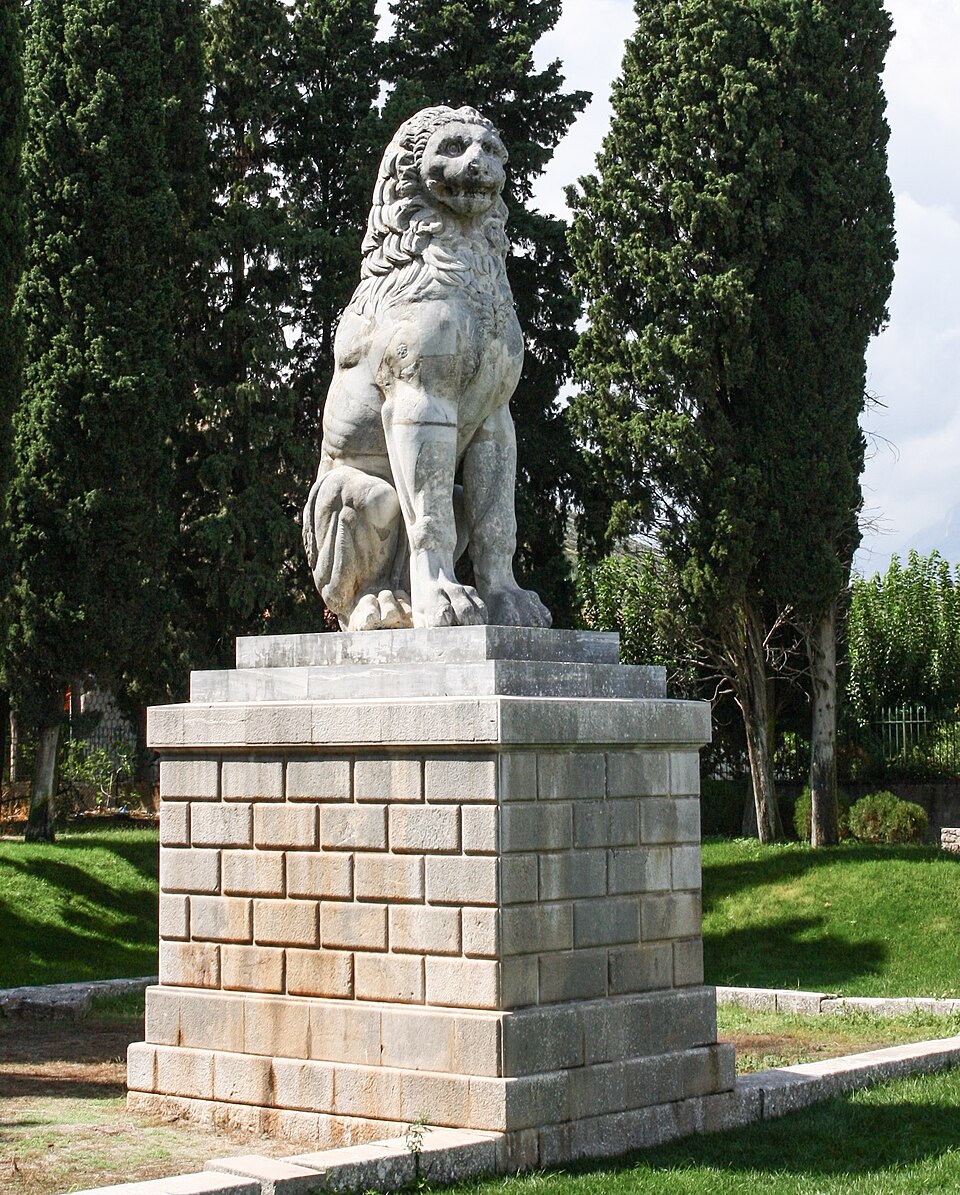
The Stone Lion Tomb
Following their annihilation, a gigantic stone statue of a lion standing 3.8 meters or 12.5 feet high was erected near the village of Chaeronea. The ancient Greek geographer Strabo recorded that this monument stood over the common tomb of the Thebans who died fighting Philip.
In the late nineteenth century, excavations at the site revealed a quadrangular enclosure directly beneath the lion. Inside the enclosure, archaeologists uncovered the skeletons of 254 men laid out in seven rows. Historians generally accept that these physical remains belong to the Sacred Band.