
Around 1809, a man named Sequoyah set out to create a written system for the Cherokee language. He was completely illiterate when he began this project.
Over twelve years, he developed a unique writing method that quickly spread. This achievement changed how the Cherokee language was recorded, leading to widespread literacy, bilingual newspapers, and modern digital fonts.
Deciphering the Talking Leaves
Sequoyah was initially impressed by the written languages of Europeans, which he referred to as talking leaves. He began by trying to assign a unique character to every single word. After realizing this method was far too difficult, he shifted his approach and designed characters to represent individual syllables.
He dropped or modified most of his original designs. By the early 1820s, he completed the Cherokee syllabary. The system contained 85 characters, though it originally had 86. Although the characters visually resemble letters from Latin, Greek, Cyrillic, and Glagolitic scripts, they represent entirely different sounds.
Printing the Cherokee Phoenix
The new orthography achieved almost instantaneous popularity. By 1825, a majority of Cherokees could successfully read and write using the new system. Albert Gallatin, a trained linguist, observed that Cherokee students could learn the 85 characters and begin reading in just a few weeks, a process that often took English students two years.
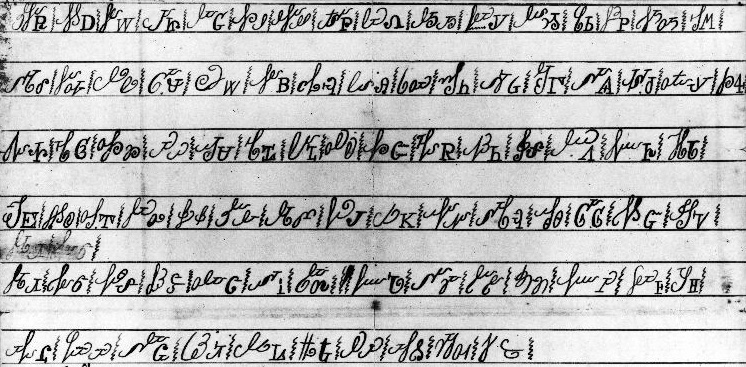
In 1828, author and editor Elias Boudinot modified the shapes and chart order of the characters to adapt them for printing presses, dropping the 86th character entirely. In 1834, Samuel Worcester inverted the character for the syllable do so it would not be confused with the character for go. Following these changes, the Cherokee Phoenix began printing as a bilingual newspaper.
Adapting to Digital Technology
The characters remained mostly unchanged until the arrival of new typesetting technologies. In the late 1970s, a Cherokee syllabary typewriter ball was created for the IBM Selectric. Computer fonts were later developed, allowing writers to easily publish in Cherokee. In 2010, Roy Boney, Jr. and Joseph Erb created a Cherokee keyboard cover.
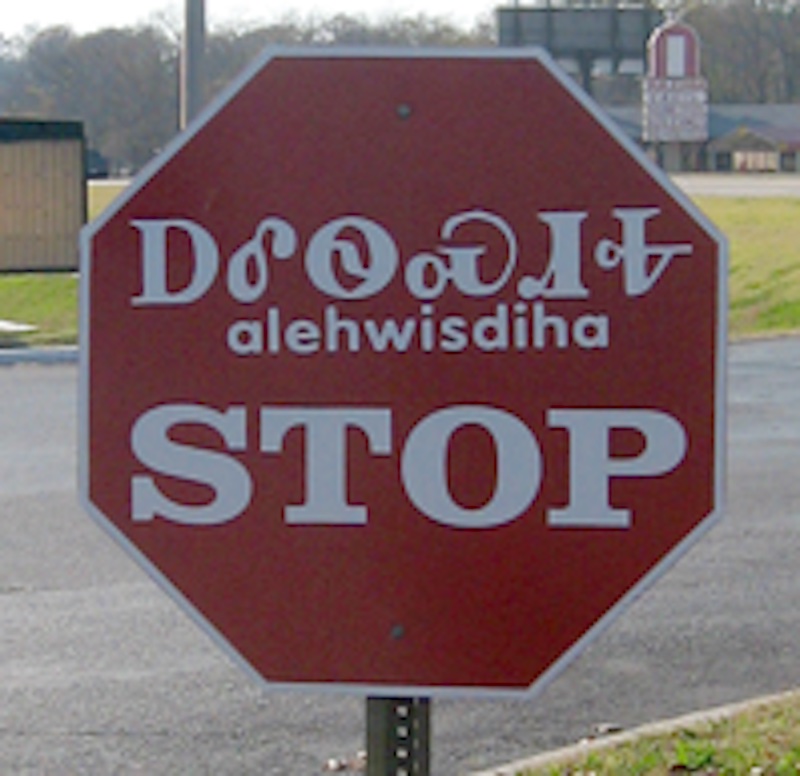
This cover is currently used by students at the Cherokee Nation Immersion School, where all coursework is completed in the syllabary. The syllabary was added to the Unicode standard in September 1999. Today, the characters appear on street signs in Tahlequah, Oklahoma, and Cherokee, North Carolina. The syllabary also appeared on a 2023 United States quarter dollar honoring Wilma Mankiller.