
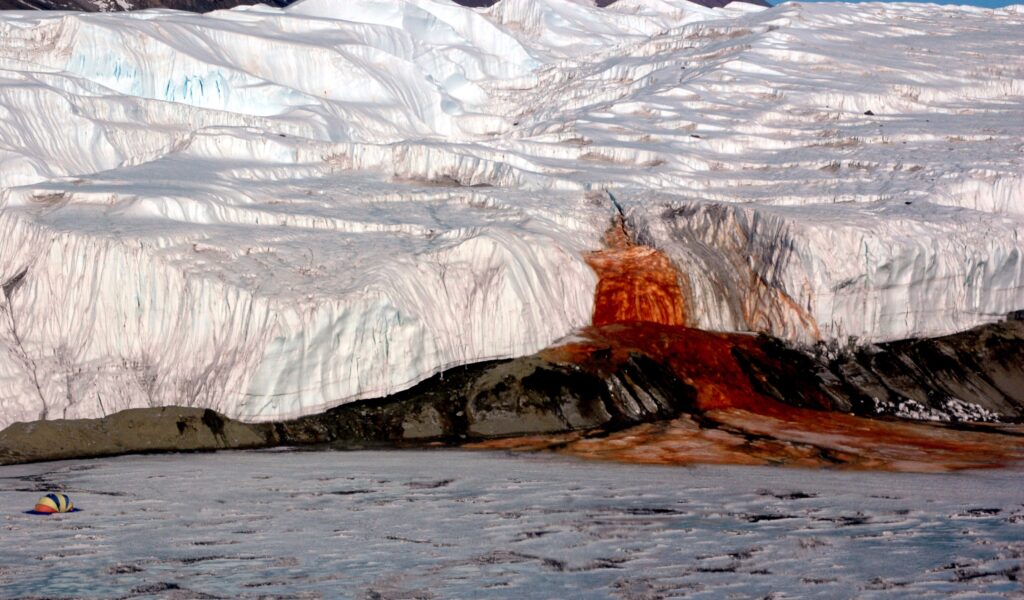
In the middle of the freezing, desolate expanse of the McMurdo Dry Valleys in Antarctica, a bright red waterfall bursts out of the stark white ice. Discovered in 1911 at the toe of the Taylor Glacier, this startling phenomenon looks exactly like a bleeding wound in the frozen landscape.
For decades, the source and composition of this crimson flow baffled explorers. Today, modern radar technology and intensive sampling have revealed a hidden world buried 400 meters (1,300 feet) beneath the ice. The true cause of Blood Falls is a trapped underground lake teeming with ancient, unexposed organisms that have survived in complete darkness for millions of years.
A Century-Old Scientific Mystery
When Australian geologist Thomas Griffith Taylor first explored the valley, pioneers attributed the red cascade to red algae. This assumption stood for years until geochemical analysis proved the color actually comes from iron oxides.
The liquid emerging from small fissures in the ice cascade is an iron-rich, hypersaline brine. As this oxygen-free water hits the surface and makes contact with atmospheric oxygen, the iron oxidizes. The liquid literally rusts, turning a deep red before freezing against the glacier.
The Hidden Subglacial River
The average temperature in this dry landscape hovers around -17 degrees Celsius (1.4 degrees Fahrenheit). At these temperatures, water should naturally freeze solid. However, the Taylor Glacier hides a complex network of subglacial rivers flowing from a pocket of ancient seawater trapped five million years ago. As pure ice crystallized, it expelled its dissolved salts, concentrating the captive water into a brine two to three times saltier than the ocean.
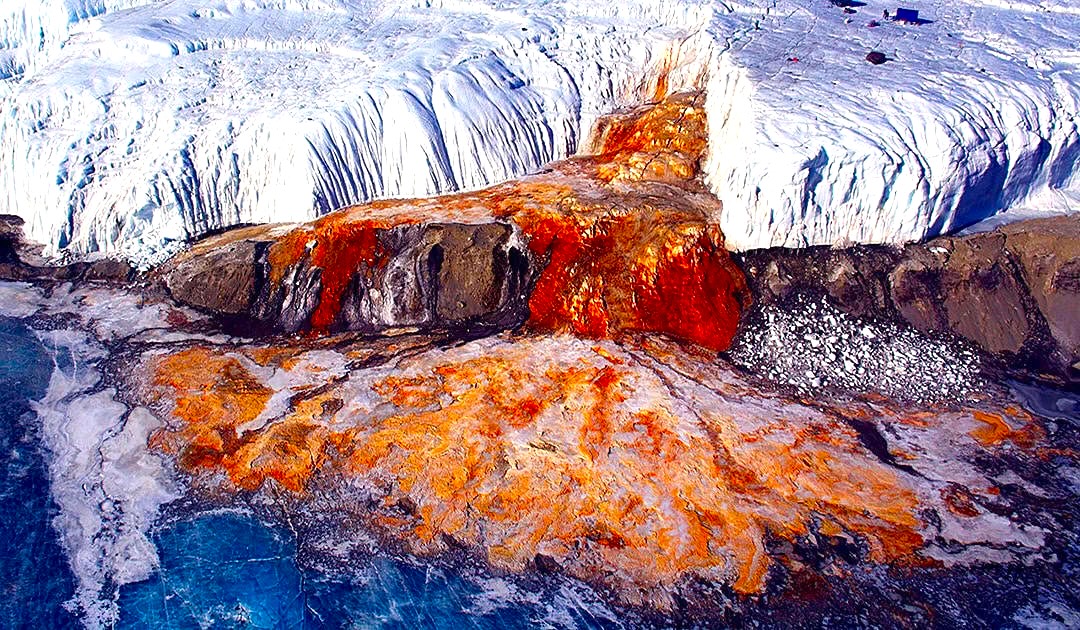
This extreme salt content drastically lowers the freezing point. Additionally, as the water begins to freeze, it releases latent heat. This heat partially melts the surrounding ice, allowing the -7 degrees Celsius (19 degrees Fahrenheit) brine to flow continuously through cracks in the coldest known glacier on Earth.
Life in the Dark
In 2014, scientists used a melting probe called the IceMole to sample the brine feeding Blood Falls directly. They extracted an 8 percent sodium chloride solution containing a rare ecosystem of autotrophic and heterotrophic bacteria, including the genus Marinobacter.
Sealed off 1.5 to 2 million years ago, this microbial population metabolizes sulfate and ferric ions to survive in a lightless, oxygen-free environment. Scientists study this extreme environment to understand how similar organisms might exist on frozen worlds like Mars or Jupiter’s ice-covered moon, Europa.