
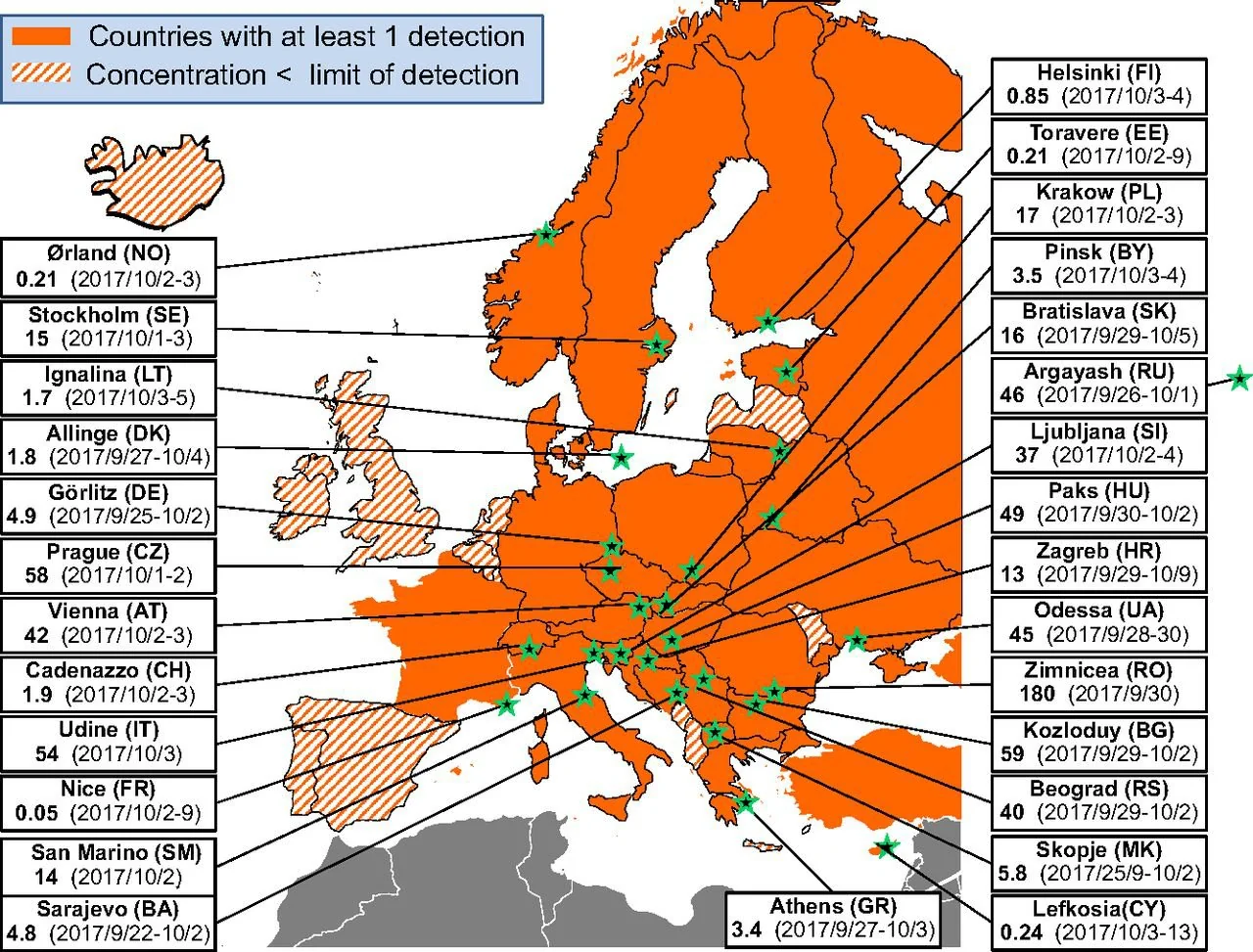
In late September 2017, an invisible, radioactive cloud swept across Europe. Monitoring stations in 28 countries suddenly detected an unusual spike in airborne Ruthenium-106. No nation claimed responsibility for the contamination.
The detection of this rare isotope triggered a massive international scientific investigation to trace the plume back to its exact origin. The forensic search revealed a secretive nuclear facility, an ambitious physics experiment, and a hidden accident that released a massive wave of radiation.
Detecting the Airborne Ruthenium-106 Spike
The first alarms sounded in early October 2017. The Swiss Federal Office of Public Health and an Italian laboratory in Milan recorded elevated levels of Ruthenium-106. Soon, 27 other European nations reported concentrations reaching up to 150 millibecquerels per cubic meter of air.
The French Institute of Radioprotection and Nuclear Safety estimated the total release at 100 to 300 terabecquerels. This immense quantity, roughly 1 to 3 grams (0.035 to 0.105 ounces) of the isotope, would have necessitated evacuations within several kilometers (miles) of the unknown source.
Narrowing the Search to the Southern Urals
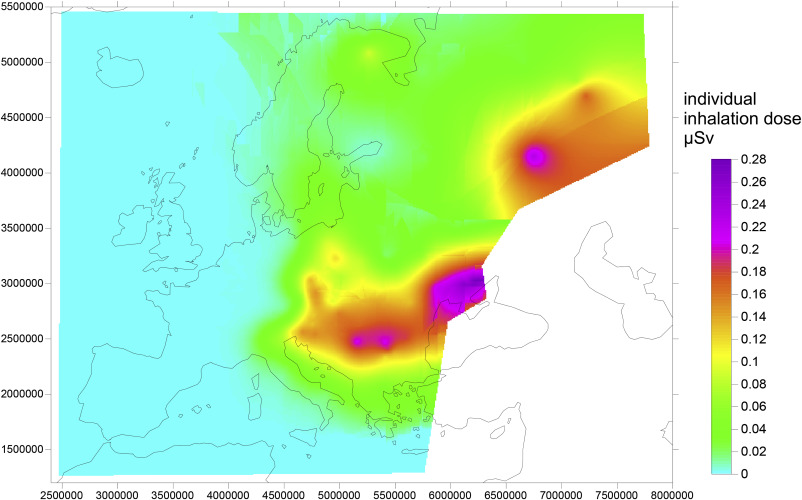
Ruthenium-106 forms exclusively through nuclear fission. Because no other radioactive species were present, scientists ruled out a standard reactor meltdown. Researchers used atmospheric dispersion models to trace the weather patterns and wind trajectories backward.
The data, heavily supported by high-frequency air-filter readings from Romania, pointed directly to the Volga and Ural regions in southwestern Russia. Further analysis of 200 soil and rainwater samples identified high concentrations of the isotope within 20 kilometers (12.4 miles) of the Mayak Production Association, a nuclear reprocessing plant near Chelyabinsk.
The Neutrino Experiment Connection
Scientists deduced the cause using forensic chemistry. The presence of both Ruthenium-106 and Ruthenium-103 indicated the source was spent nuclear fuel that had cooled for only about a year and a half, an unusually short timeframe. At that time, Mayak had agreed to extract Cerium-144 from fresh spent fuel for a particle-physics experiment in Italy.
To meet the strict radioactivity requirements, the facility had to process highly radioactive fuel prematurely. During this process, extreme heat or an explosion likely volatilized ruthenium compounds, releasing 250 terabecquerels of radiation. The experiment was subsequently canceled in 2018 when Mayak failed to deliver the required materials.
Denials Amidst Scientific Consensus
Despite the extensive forensic evidence published in the Proceedings of the National Academy of Sciences, Russian authorities and Rosatom consistently denied any mishap. They confirmed a radiation spike occurred within 100 kilometers (62.1 miles) of Mayak but maintained that facility inspections revealed no anomalies.
A Mayak executive later admitted routine releases of Ruthenium-106 but denied responsibility for the massive 2017 plume. European scientific groups stand by their findings, concluding the leak resulted from the dangerous reprocessing of fresh nuclear waste.