
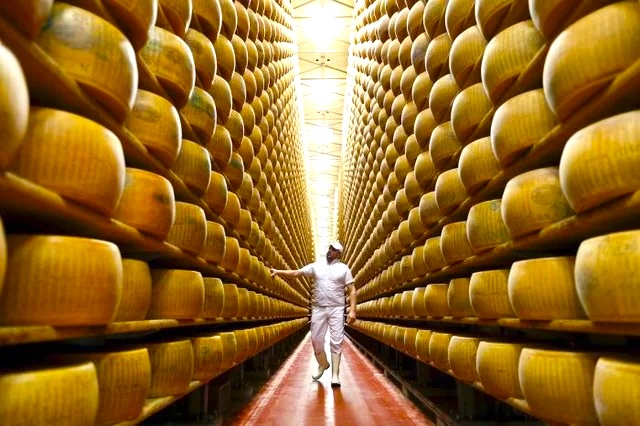
Inside the climate-controlled vaults of Emilia-Romagna, Italy, lies a staggering fortune of 325 million euros ($382 million) that is completely edible. Towering shelves hold hundreds of thousands of Parmigiano Reggiano wheels, slowly aging and increasing in value. For local dairy farmers, this aging process creates a massive financial hurdle.
The cheese takes years to mature, but the bills for milk, staff, and cow feed must be paid every 30 days. To bridge this gap, Credem Bank steps in with a highly unusual banking model, accepting massive 80-pound (36.3-kilogram) wheels of cheese as direct collateral for business loans.
The King of Cheeses Meets High Finance
Since 1953, Credito Emiliano, known locally as Credem, has operated this unique financial system. Parmigiano Reggiano is strictly regulated. It requires only milk, salt, and rennet. The cheese must mature for at least 12 months, though many wheels age for 24, 36, or even 40 months.
During this waiting period, producers face steep operating costs. Energy, transport, and logistics expenses continually rise. Credem offers a lifeline by extending credit lines to these farmers, holding the young cheese in secure bank-owned warehouses as a guarantee.
Climate-Controlled Vaults and Daily Inspections
When a wheel arrives at the bank’s subsidiary, Magazzini Generali delle Tagliate, it is immediately scanned and logged into a digital registry. This passport records the production date and the original dairy. The warehouse handles about 2.3 million wheels annually, keeping roughly 500,000 wheels at any given time.
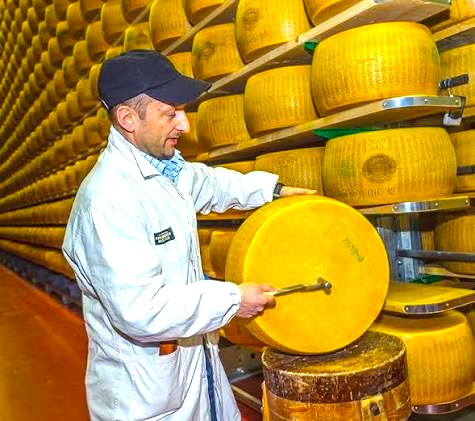
Staff members walk the aisles daily to inspect the inventory. They look for cracks, swelling, or moisture issues. At the 12-month mark, the Parmigiano Reggiano Consortium strikes each wheel with a hammer. They listen for a clean, uniform sound to confirm the cheese has no internal defects.
Minimizing Risk Through Expert Warehousing
Credem limits its financial exposure by offering a loan-to-value ratio of 70 to 80 percent, based on the current market price of mature cheese.
The bank actively manages the aging process using state-of-the-art climate controls. Through careful monitoring, the bank restricts degradation to just one percent, compared to the industry average of ten percent. If a producer defaults on their loan, the bank simply sells the matured cheese.
Sustaining a Traditional Supply Chain
This infrastructure supports a network of roughly 300 producers and more than 2,000 dairy farmers in Northern Italy. Most are small, family-owned cooperatives that refuse corporate consolidation. By holding and aging the cheese, the bank replaces an expensive part of the production operation for these farmers.
This allows the farmers to access working capital without sacrificing the long maturation time required to produce high-quality Parmigiano Reggiano.