
In 1997, a network of underwater microphones picked up an ultra-low frequency sound so loud it traveled more than 3,000 miles across the Pacific Ocean. The U.S. National Oceanic and Atmospheric Administration (NOAA) named the high-amplitude noise the Bloop.
It rose in frequency over the course of a minute and was recorded by multiple deep-sea sensors simultaneously. For over a decade, the public debated the origins of this massive acoustic event, questioning whether an undiscovered marine beast was lurking in the dark waters of the globe.
Listening to the Deep Ocean
NOAA pinpointed the source of the Bloop to a remote coordinate in the South Pacific Ocean, west of the southern tip of South America. The noise was captured by the Equatorial Pacific Ocean autonomous hydrophone array.
This equipment was designed to augment the U.S. Navy’s Sound Surveillance System, a deep-water network initially built to detect Soviet submarines. Researchers utilized these highly sensitive hydrophones to monitor underwater earthquakes, ice activity, and marine mammal migrations.
The Giant Animal Hypothesis
The immense volume of the Bloop immediately presented a scientific puzzle. In 2002, a science journalist interviewed NOAA researcher Christopher Fox, who noted that the audio profile of the Bloop closely resembled the rapid frequency variations made by living marine animals.
However, because the sensors detecting the sound were positioned up to 3,000 miles apart, the source had to be vastly more powerful than the call of any known whale on Earth. This observation fueled widespread speculation that an impossibly massive biological entity produced the noise.
Tracking an Antarctic Iceberg
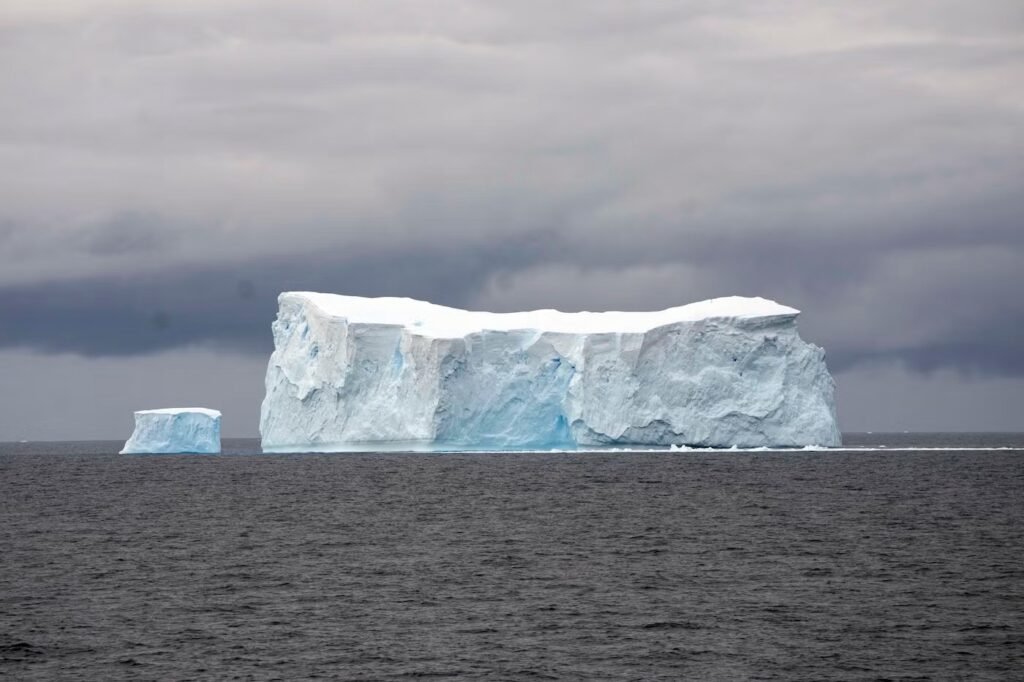
The acoustic mystery was definitively solved following the disintegration of iceberg A53a near South Georgia Island in early 2008. As researchers tracked the colossal ice mass, they recorded numerous ice quakes, which are also known as cryoseisms. These massive fractures produced spectrograms identical to the 1997 Bloop recording.
They also possessed the extreme amplitude necessary to be detected thousands of miles away. By 2012, NOAA officially confirmed that the Bloop was a non-tectonic cryoseism.
The Mechanics of Glacial Sounds
The acoustic event resulted from glacial movements, such as ice calving or the seabed being gouged by shifting ice. When compacted glacial ice floes are forced together, a process called rubbing induces shear deformation, triggering horizontally polarized waves.
Additionally, a process called ridging occurs when ice bends and crushes together, sealing air gaps and emitting acoustic signals similar to collapsing air bubbles. Because seawater functions as an excellent sound channel, these explosive glacial fractures easily propagate powerful, low-frequency noises across vast oceanic distances.