
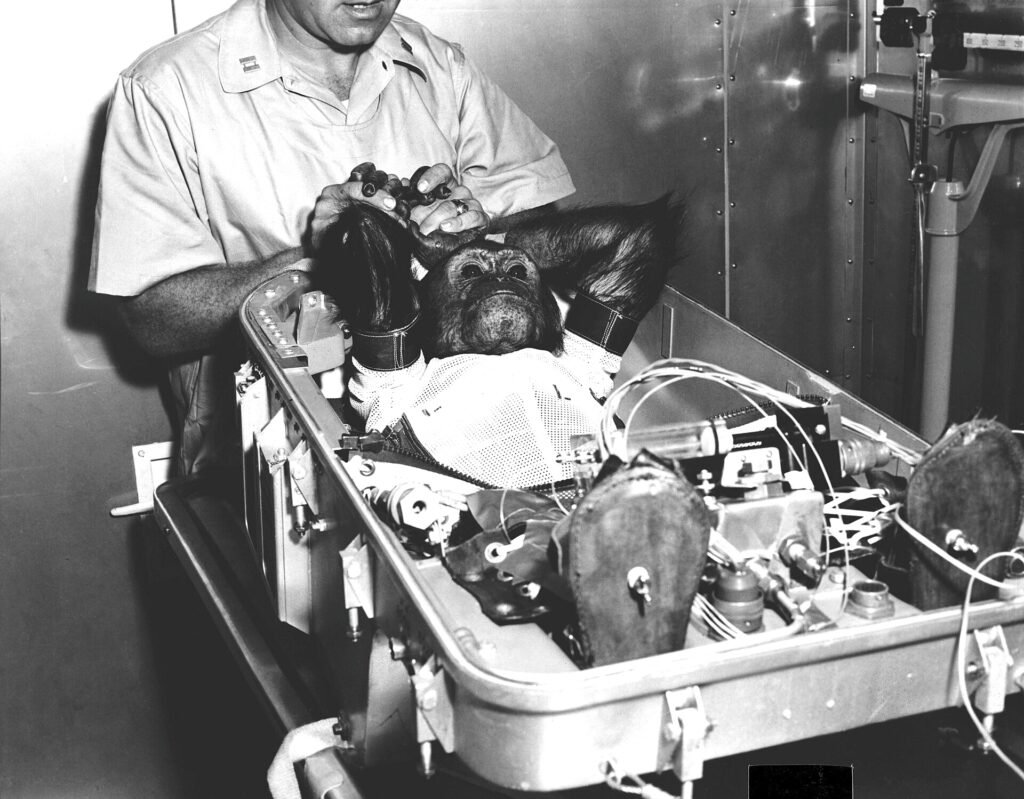
Before John Glenn circled the globe, an American spacecraft successfully orbited Earth with a living hominid inside. The occupant was not a human pilot, but a five-year-old chimpanzee named Enos.
Launched into the thermosphere on November 29, 1961, he endured extreme physical forces, severe heat, and a malfunctioning capsule that repeatedly administered electric shocks. This is the factual sequence of events that defined the Mercury-Atlas 5 mission.
1,250 Hours of High-G Space Training
Enos, whose name translates to “man” in Hebrew, arrived from the Miami Rare Bird Farm in April 1960. He joined Project Mercury, a NASA initiative focused on putting humans in space. The Soviet Union had already sent cosmonauts Yuri Gagarin and Gherman Titov into orbit. Enos completed over 1,250 hours of intensive preparation at the University of Kentucky and Holloman Air Force Base.
Because he was scheduled to experience prolonged weightlessness and high gravitational forces, his regimen was highly intense. He practiced psychomotor tasks, including oddity problems where he had to identify the mismatched shape among three options. Incorrect answers resulted in an electric shock to his feet.
A Malfunction and 76 Electrical Shocks
NASA chose him for the mission just three days before liftoff. As he launched aboard the Mercury-Atlas 5, he completed his first orbit in exactly 1 hour and 28.5 minutes. The original flight plan called for three full orbits. Things went wrong rapidly. The capsule began overheating.
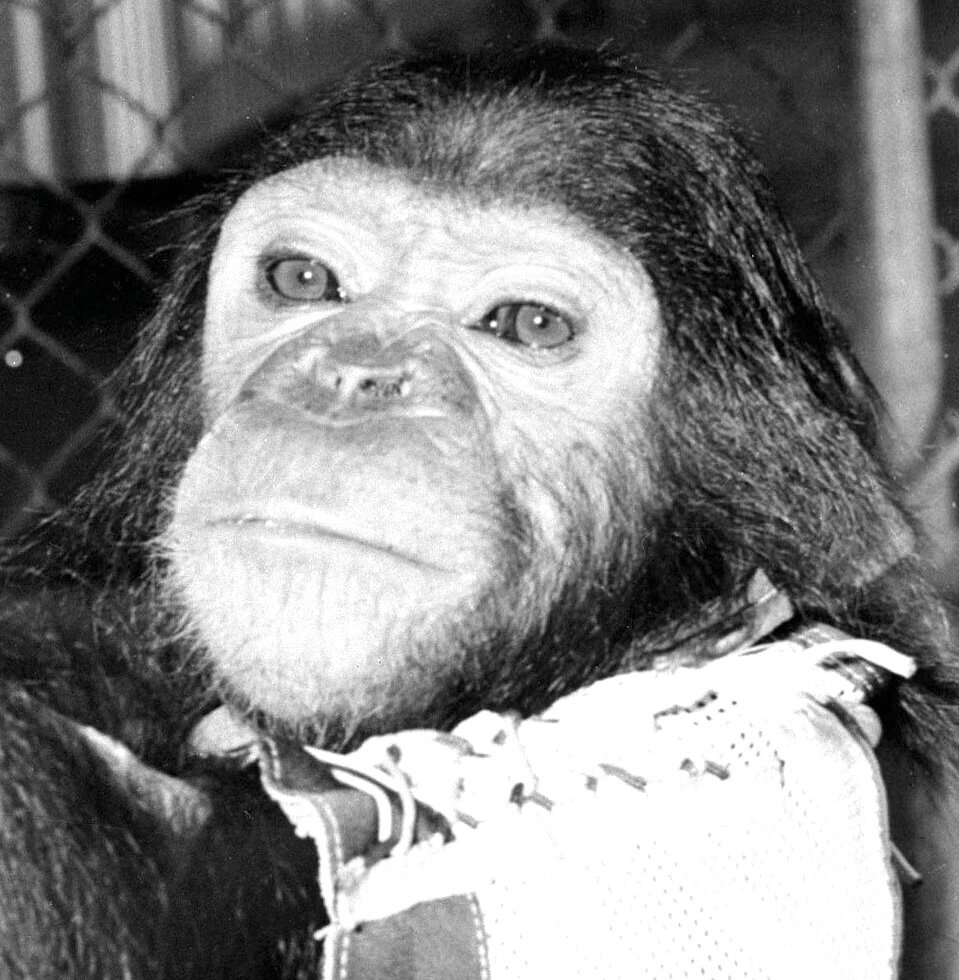
During his required psychomotor tests, a mechanical failure disabled the correct answers. Even though he performed the tasks precisely as trained, the malfunctioning hardware shocked his feet 76 times. Mission control aborted the flight after the second orbit due to the extreme heat and equipment failures.
The Ocean Rescue Aboard the USS Stormes
The Mercury capsule splashed down into the Atlantic Ocean near Bermuda. He waited inside the cramped quarters for three hours before United States Navy seamen finally retrieved him. Handlers noted that he was angry and frustrated by the delay. The USS Stormes brought the capsule aboard in the late afternoon.
Air Force personnel immediately took him below deck for medical evaluation. They transported him to the Kindley Air Force Base hospital, where doctors declared him in good physical condition.
The Final Year of an Astronaut Chimp
Three months later, the flight data directly enabled John Glenn to successfully orbit the planet. Enos returned to Holloman Air Force Base. Author Mary Roach later documented that handlers gave him a vulgar nickname due to his highly uncooperative behavior.
On November 4, 1962, he contracted a strain of shigellosis-related dysentery that resisted known antibiotics. He died after two months of constant medical observation. Pathologists confirmed the illness had no connection to his orbital flight. Researchers concluded that the military simply discarded his remains.