
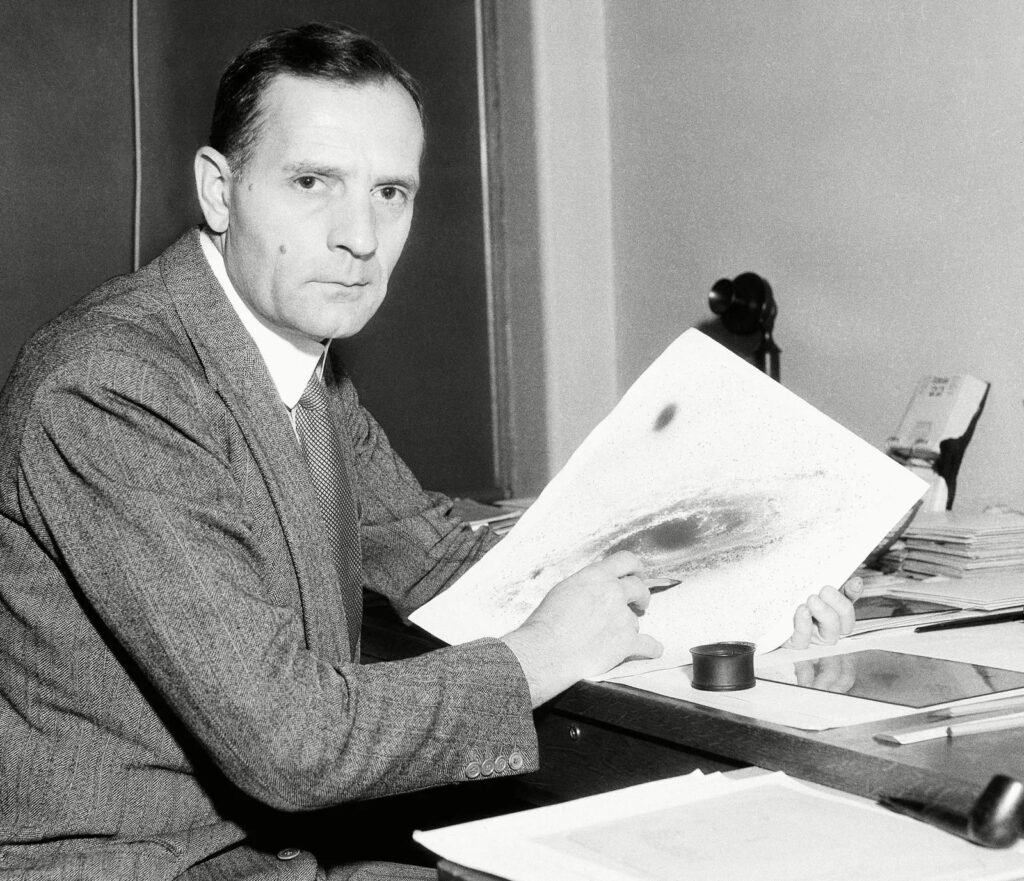
Before his name was bolted to a space telescope, he was an Illinois high jump record holder, an Oxford law student, a combat-injured military major, and a boxer who once knocked out a German heavyweight champion. He also fundamentally changed astrophysics.
In the 1920s, the scientific establishment firmly believed the Milky Way was the entirety of the universe. One man looked through a 100-inch telescope in California and proved them all wrong, discovering entirely new galaxies and demonstrating that the universe itself is expanding. This is the factual history of Edwin Hubble.
Science Fiction to the Trenches
Born in Missouri in 1889, Edwin Hubble grew up reading Jules Verne and breaking athletic records. He entered the University of Chicago at age 16, studying mathematics and astronomy. Honoring his dying father’s wish to explore other fields, he later studied jurisprudence and Spanish at the University of Oxford on a Rhodes scholarship.
He taught high school in Indiana before returning to science and earning his astronomy Ph.D. in 1917. He then enlisted in the Army, rising to the rank of major before a combat injury forced his discharge following the First World War.
Debunking the Single-Galaxy Universe
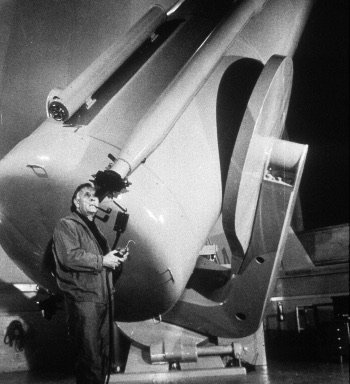
In 1919, Hubble arrived at the Mount Wilson Observatory in California still wearing his military uniform. Using the massive 100-inch Hooker telescope, he focused on fuzzy spiral shapes in the night sky. Prominent astronomers, including his contemporary rival Harlow Shapley, argued these were simply gas clouds located within the Milky Way.
By tracking the luminosity of Cepheid stars, Hubble calculated that the Andromeda Nebula was 900,000 light-years away. This massive distance proved Andromeda was an entirely separate galaxy. The scientific community initially resisted the claim, but the physical data proved accurate.
Solving the Redshift Problem
In 1929, Hubble and his colleague Milton Humason tackled the redshift problem. Scientists had previously noticed that light from spiral galaxies consistently leaned toward the red end of the electromagnetic spectrum. The two astronomers analyzed the data and published a groundbreaking conclusion: galaxies move away from each other at high velocities.
Because they recede so quickly, their emitted light shifts toward the red spectrum due to the Doppler effect. They established that the farther a galaxy is from Earth, the faster it moves away, proving definitively that the universe is expanding.
The Nobel Institute Campaign
Despite his discoveries, the Nobel Institute did not classify astronomy as a physics discipline, making Hubble completely ineligible for the prize.
Hubble hired a publicity agent and actively lobbied the committee to change their strict guidelines. He died in 1953, the exact same year the Nobel Institute finally reclassified astronomy as a branch of physics, making all future astronomers eligible for the award.