
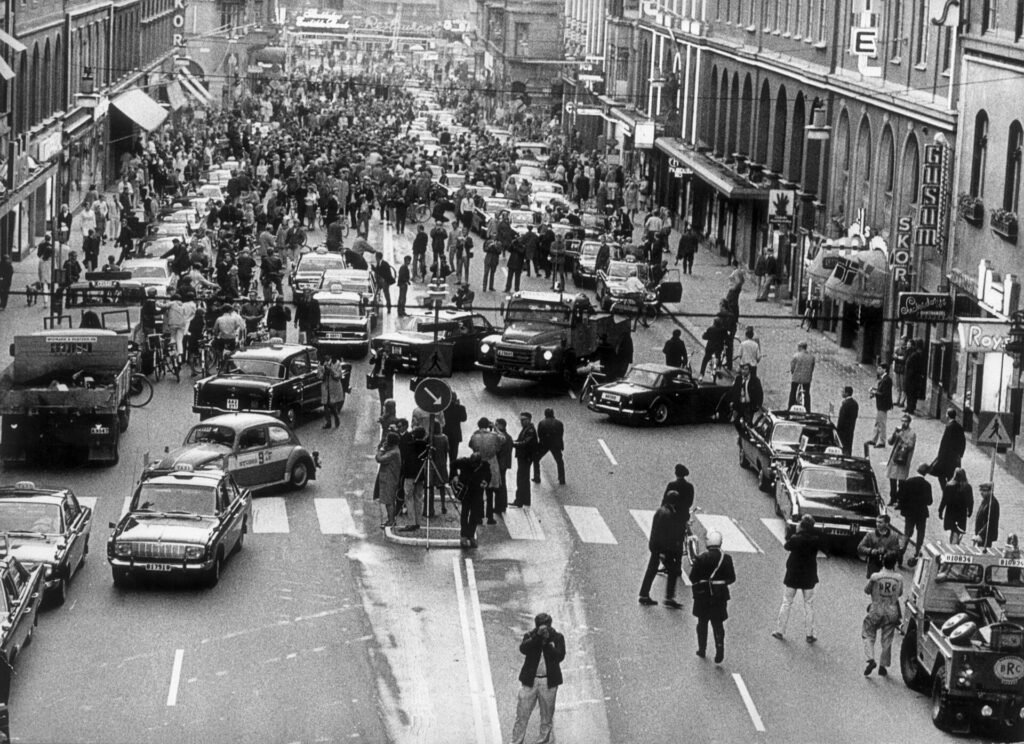
Imagine waking up on a Sunday morning to find that the entire country has been ordered to drive on the opposite side of the street. On September 3, 1967, Sweden executed exactly that maneuver in what remains the largest logistical event in the nation’s history.
Millions of vehicles shifted lanes simultaneously, backed by a massive PR campaign featuring branded underwear and a chart-topping pop song.
A Nation Defies the Voters
Before 1967, Swedes drove on the left but mostly owned left-hand-drive cars. This mismatch caused frequent head-on collisions on narrow two-lane highways. Furthermore, neighboring countries like Norway and Finland already drove on the right, complicating the five million annual border crossings.
Despite the accident rates, 83 percent of the Swedish population voted to keep driving on the left in a 1955 referendum. The government eventually mandated the switch in 1963, setting off a four-year logistical operation.
The Ultimate Public Relations Blitz
To prepare the population, authorities launched an intensive $120 million information campaign, a cost roughly equal to $930 million today. The Dagen H logo appeared everywhere, plastered across milk cartons, billboards, and even men’s shorts. Swedish television hosted a song contest, crowning the catchy tune “Keep to the right, Svensson” by The Telstars.
On the streets, workers installed 350,000 new traffic signs and erected parallel sets of white road lines, temporarily hiding them under black tape to replace the old yellow markings. Drivers were also required to replace their standard round headlamps with right-traffic units.
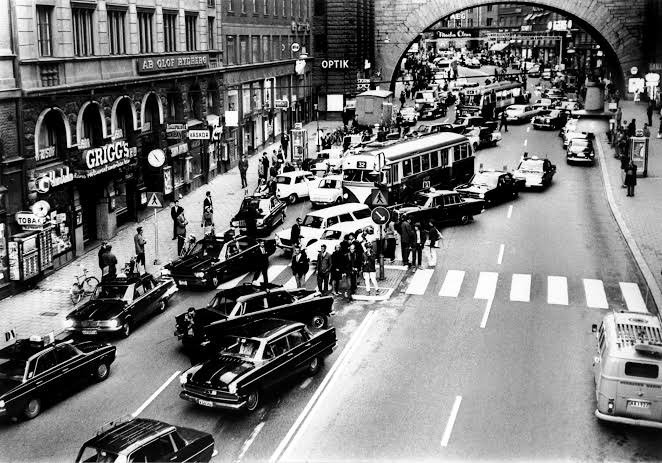
The 4:50 AM Halt
When Sunday, September 3 finally arrived, a strict ban kept non-essential traffic off the roads between 1:00 AM and 6:00 AM. Cities like Stockholm and Malmö enacted even longer bans, keeping cars off the streets for over 24 hours to reconfigure complex intersections.
For the few allowed to drive, the critical moment struck at exactly 4:50 AM. Every vehicle had to come to a complete stop, carefully roll over to the right-hand lane, and halt again. At exactly 5:00 AM, the nation resumed driving.
The Immediate Aftermath
To accommodate the new traffic flow, Stockholm and other major cities scrapped most of their tram lines. Transport authorities purchased over a thousand new buses with doors on the right side and retrofitted thousands more, exporting the obsolete buses to Pakistan and Kenya.
On the day of the switch, only 157 minor accidents occurred, resulting in 32 minor injuries and zero fatalities. Because drivers were terrified of the unfamiliar rules, they drove with extreme caution. British traffic expert Alec Dunic called this highly cautious period a honeymoon. Exactly as Dunic predicted, the initial drop in crashes was brief. Six weeks later, accident rates crept right back up to normal levels.