
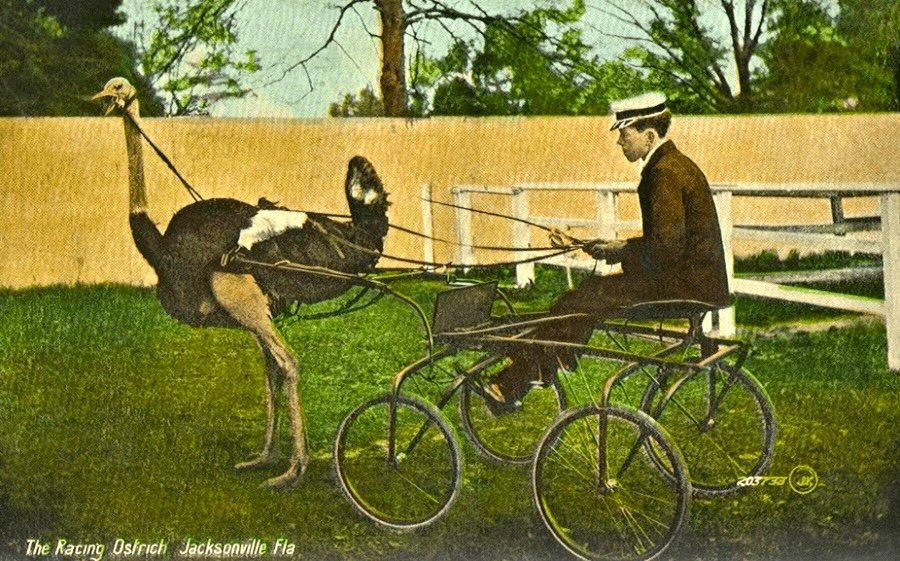
In the late 1800s, tourists flocked to Florida for a brand new spectator sport that featured towering birds sprinting down dirt tracks at 45 mph (72 km/h). Jockeys clung to the backs of these flightless animals, desperately trying to steer them to the finish line without getting thrown into the dust.
This was the birth of American ostrich racing, a highly unpredictable spectacle that quickly spread across the country and remains a competitive event today. The fastest birds on land proved to be far more difficult to control than horses, creating a chaotic and thrilling contest of speed and balance. The competitions drew massive crowds who placed bets on which rider could stay mounted the longest.
From Florida Tourist Attractions to Professional Racetracks
While an 1850 exhibition at a Paris hippodrome featured four ostriches, the sport gained massive traction in the United States decades later. In 1892, an ostrich farm opened in Jacksonville, Florida, introducing the public to the sheer power of the African birds. Visitors paid 50 cents to ride the animals, provided they weighed under 150 pounds (68 kg). Soon, organized competitions emerged in St. Augustine and St. Petersburg.
Competitors mounted the birds directly or sat in small carriages pulled behind them. If mounting the animal directly seemed too dangerous, participants could opt for the carriage races, which mirrored traditional harness racing. Today, the sport continues at venues like Canterbury Park in Minnesota, the Fair Grounds in New Orleans, and the Karoo region of South Africa.
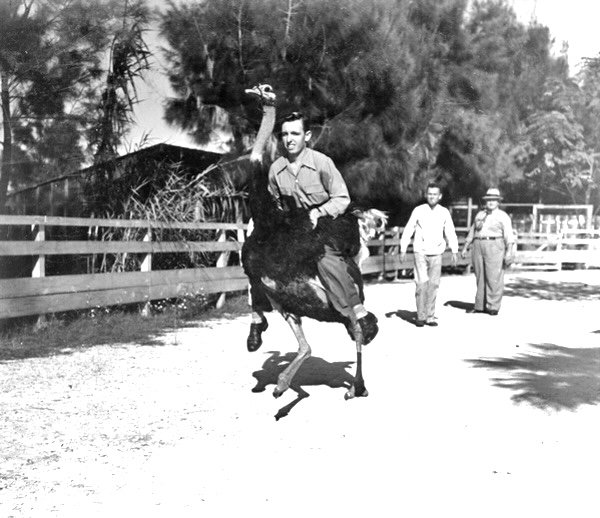
The Physical Demands of a 9-Foot (2.7 Meter) Sprinter
Weighing between 220 and 350 pounds (100 and 159 kg), ostriches stand up to 9 feet (2.7 meters) tall and possess extraordinary physical capabilities. During a race, a single stride covers up to 16 feet (4.9 meters). Their specialized feet feature a 2-inch (5.1 cm) claw that digs into the track for maximum traction.
The animals reach top speeds of 45 mph (72 km/h), making them the fastest birds on earth. Jockeys use minimal gear, typically relying only on reins, bits, and a mandatory helmet. Steering a running ostrich requires extreme physical coordination, as the birds are prone to sudden directional shifts and have highly unpredictable temperaments.
Regulations and Chaotic Racetrack Realities
The rules governing these events are straightforward. Riders must complete the circuit as fast as possible without leaving the track boundaries. A veterinary inspection happens before every event to ensure the birds are healthy and fit to compete. During the race, jockeys must hold tightly to the feathers and wings to maintain their balance.
Because ostriches lack the predictable running patterns of horses, riders frequently fall to the ground. If a bird becomes uncomfortable, it will simply wiggle out of the jockey’s grip and run completely off course. The first bird to cross the finish line with its rider still attached wins the heat.