
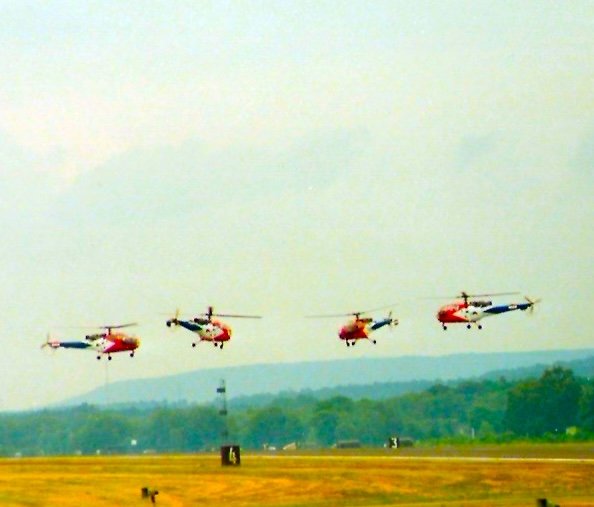
Four military helicopters fire up their engines, lifting off with a classical musician strapped inside each cockpit. As the aircraft circle six kilometers away from the venue, the musicians aggressively play their string instruments, their notes blending with the heavy, rhythmic thwack of the rotor blades.
The live audience sits safely inside an auditorium, watching the airborne concert on four columns of televisions. This is not a stunt for an action film. It is the precise execution of Karlheinz Stockhausen’s Helikopter-Streichquartett, one of the most logistically demanding musical compositions ever performed.
A Dream of Flying Musicians
The unusual concept began in early 1991 when Hans Landesmann of the Salzburger Festspiele commissioned Stockhausen to write a string quartet. The composer initially rejected the idea, stating he had no interest in writing one. That changed after he experienced a vivid dream where he flew above four transparent helicopters, observing a musician playing inside each aircraft. Later dreams involving a swarm of bees and a violinist further shaped his vision. He spent 1992 and 1993 drafting the complex serial score to match his nocturnal visions.
Protests and the Cancelled Premiere
Turning the score into a physical reality required intense negotiations. Stockhausen planned the premiere for 1994, working with the Salzburger Festspiele, the Austrian army for the aircraft, and various television networks. However, the Austrian Green Party launched severe protests against the project. They argued it was completely unacceptable for Austrian air to be polluted simply to perform a musical piece. The political backlash succeeded, forcing organizers to cancel the 1994 debut entirely.
The 1995 Amsterdam Liftoff
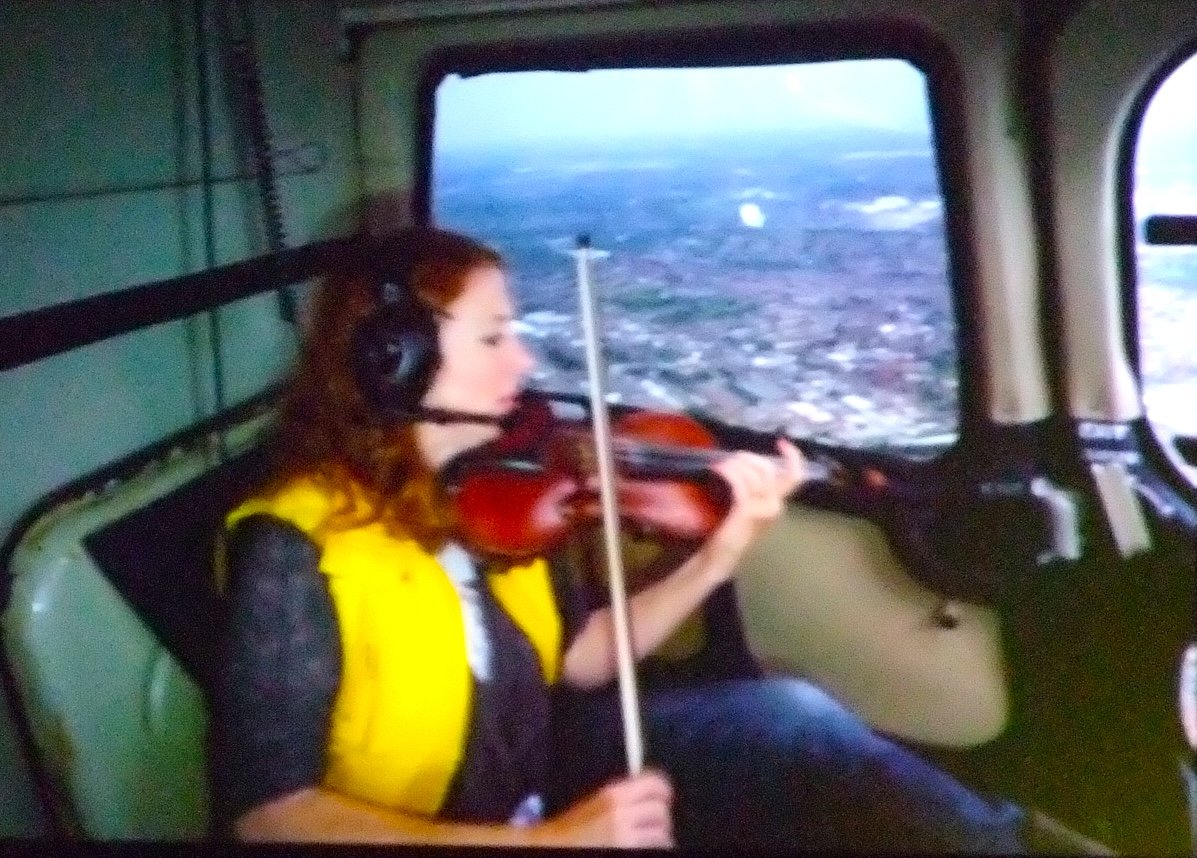
The piece finally reached the public on June 26, 1995, during the Holland Festival in Amsterdam. The Royal Dutch Air Force supplied Alouette helicopters and pilots from their Grasshoppers display team. The Arditti Quartet took on the formidable musical duties. Wearing headsets and seated next to the pilots, first violinist Irvine Arditti, second violinist Graeme Jennings, violist Garth Knox, and cellist Rohan de Saram took to the skies. They played rapid tremolos specifically designed to merge with the mechanical sounds of the aircraft.
Mixing Audio in the Sky
During the performance, technicians mixed the twelve incoming audio feeds so the stringed instruments sounded slightly louder than the engine noise. The helicopters constantly changed altitude to create a bouncing acoustic effect. As the aircraft circled the area, the earth remained visible through the glass cockpits behind the players on the auditorium screens. Following the successful Amsterdam flights, Stockhausen added three minutes of material to the score just before the five-minute descent phase, bringing the total airborne performance time to exactly 32 minutes.