
In the late nineteenth century, the loud engines of early automobiles terrified animals on city streets, prompting some carriage owners to threaten to shoot drivers on sight. To solve this dangerous traffic crisis, a preacher from Michigan patented an incredibly unusual vehicle modifier.
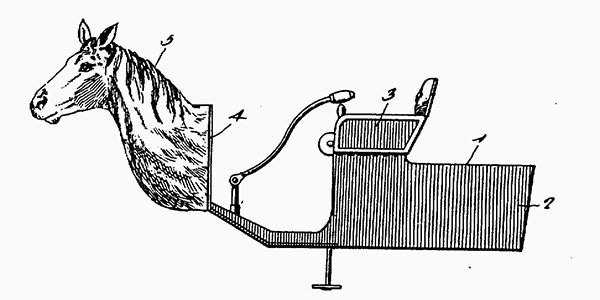
His design involved attaching a large wooden horse head to the front of a motorized buggy. This concept, known as the Horsey Horseless, was an attempt to trick actual horses into thinking the approaching machine was just another animal.
The Traffic Problem of Early Automobiles
During the late 1890s, the transition to engine-powered transportation caused significant disruptions in the United States and Europe. These wondrous machines, often called horseless carriages or “infernal machines,” shared the roads with traditional horse-drawn transport.
The high speed and loud mechanical noises of early cars frequently caused working horses to bolt in panic. Car manufacturers tried to persuade the public to make the switch, advertising that if you can afford to stable a horse, you can afford one of our cars. Still, frightened horses remained a massive problem for courageous early adopters seeking speed and status on the roads.
Uriah Smith and the Horsey Horseless
In 1899, Uriah Smith, a Seventh-day Adventist preacher living in Battle Creek, Michigan, proposed a unique solution to soothe skittish equine nerves. He submitted a patent for a vehicle called the Horsey Horseless. In his filing, Smith described a new and original design for a vehicle body that was intended to be both useful and ornamental.
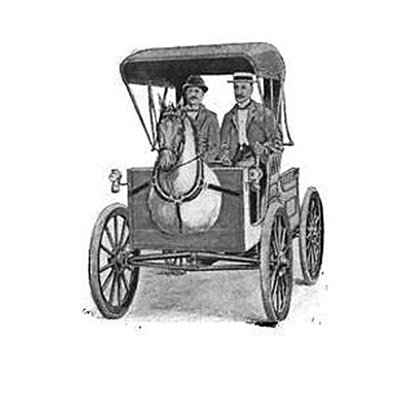
The blueprints called for a life-sized wooden horse head and neck to be firmly attached to the front of the chuffing buggy to resemble a typical horse and carriage. Smith reasoned that the wooden fake would prevent a panic response. He explained that the live horse would be thinking of another horse, and before he could discover his error and see that he had been fooled, the strange carriage would have passed, and it would then be too late to grow frantic and fractious.
A Hollow Head for Volatile Automobile Fuel
Beyond the visual trickery, the wooden horse head served a highly specific mechanical function. Smith recommended that the wooden appendage be completely hollow so it could act as the automobile’s fuel tank, holding the vehicle’s volatile fuel right at the front of the carriage.
Modern equine experts have since pointed out a major flaw in Smith’s overall logic: horses rely heavily on their sense of smell to identify each other, meaning they would not mistake a fuel-filled wooden block for a living animal.
The 1899 Concept Car Mystery
It remains completely unknown whether the Horsey Horseless was ever actually built, or if it only existed as a theoretical patent. Despite its uncertain production status, the unusual automobile concept was later documented in modern print media. In 2007, Time Magazine officially included the Horsey Horseless on its published list of “The 50 Worst Cars of All Time.”