
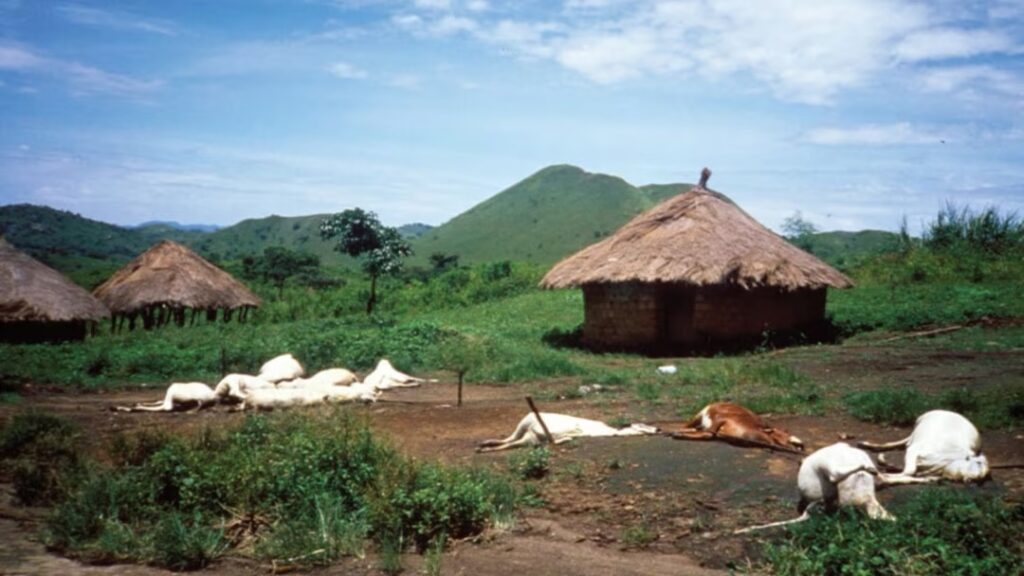
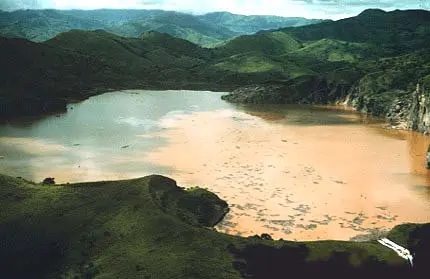
On August 21, 1986, the calm waters of a crater lake in northwestern Cameroon unexpectedly unleashed an invisible, suffocating cloud. Within minutes, this dense gas spread across 15.5 miles, quietly ending the lives of 1,746 people and more than 3,500 animals in their tracks.
There were no raging fires and no structural collapses. The victims simply fell unconscious where they stood or died in their sleep. This catastrophic phenomenon is known as a limnic eruption, and it transformed Lake Nyos into a sudden instrument of death.
A Limnic Eruption Hidden In Deep Waters
Lake Nyos sits above a volcanic region where magma chambers deep underground constantly emit carbon dioxide. Because of the lake’s extreme depth, the gas slowly accumulated at the bottom over many years, trapped by the immense pressure of the water above.
A sudden disturbance disrupted this delicate balance. Scientists determined through seismometers that a fresh volcanic eruption was not the cause. Instead, they believe a small earthquake, a landslide, or simply an over-accumulation of carbon dioxide caused the highly concentrated gas layer to shoot to the surface.
The Night The Carbon Dioxide Burst Forth
When the 1.6 million tons of magmatic gas reached the lower-pressure surface, it exploded violently. Because carbon dioxide is denser than air, the invisible cloud hugged the ground, sinking into the surrounding valleys and displacing all the oxygen in its path.
As it enveloped the villages of Nyos, Kam, Cha, and Subum, it acted as a rapid asphyxiant. Most of the victims showed no signs of struggle, instantly losing consciousness and passing away without a sound.
Waking Up To Absolute Devastation
Survivor Joseph Nkwain was in Subum when he noticed a terrible smell and heard his daughter breathing abnormally. Before he could reach her bed, he collapsed. When he regained consciousness the next morning, he found his arms wounded and his clothes stained red with a starchy mess.
Tragically, he discovered that his daughter and all his neighbors had perished. Riding his motorcycle through the area, Nkwain found no signs of life, noting that every human, cow, bird, and insect had died.
The Aftermath Of The Lake Nyos Disaster
The Cameroonian government evacuated the surviving locals and set up relief camps. To prevent future eruptions, engineers installed a degassing system starting in 2001, using pipes to safely vent the carbon dioxide from the lake bed. Similar pipes were later placed in Lake Monoun and Lake Kivu.
Despite these measures, the government kept the area restricted due to ongoing toxicity risks. Thirty years later, displaced villagers remained in temporary camps without adequate food, electricity, sanitation, or healthcare, waiting for promised compensation and the chance to return home.