
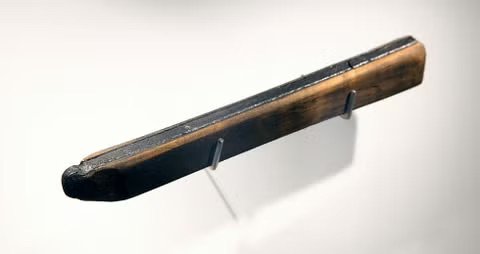
During the 1960s, a construction crew restoring the roof timbers of a 17th-century farmhouse in southern Germany pulled a small wooden stick from the rafters. Covered in dust after sitting untouched in the dark attic for more than three centuries, the object turned out to be the oldest known surviving wood-cased pencil in the world.
Left behind by a tradesman around 1630, this single piece of linden wood and graphite predates the earliest recorded pencil factories in Europe and now sits under glass in a German castle archive.
A Hidden Discovery in a 1630 Swabian Farmhouse
The discovery took place during renovation work on a historical half-timbered farmhouse in the German region of Swabia. While working on the upper roof beams, workers found a handmade marking tool resting inside the timber framework.
Because the farmhouse was built in 1630, historians dated the tool to that period and concluded that a carpenter working on the original roof structure left the pencil in the rafters by mistake. Sheltered from rain and weather beneath the roof, the wood and glue remained intact for over 330 years.
Inside the Design of the 17th-Century Linden Wood Pencil
Unlike round or hexagonal pencils produced today, the 17th-century Swabian artifact has a flat, angular body. Carpenters still use this flattened shape because it stops the pencil from rolling off sloped rafters and wooden planks. To build the tool, a craftsman carved a groove into a strip of linden wood, inserted a cut stick of pure graphite, and glued a second strip of linden wood on top. The wooden casing was left unpainted, and the tip shows visible wear marks from use prior to being lost.
From English Graphite to the Nuremberg Pencil Trade
When the Swabian carpenter lost his pencil around 1630, wood-cased writing tools were a recent invention. After locals discovered a large deposit of pure graphite in Borrowdale, England, during the 16th century, Europeans initially mistook the dark mineral for lead ore.
Because raw graphite rods snapped easily and dirtied the hands, early users wrapped them in string, paper, or leather. Gluing graphite inside carved wooden halves gave birth to the dedicated trade of pencil making. The 1630 Swabian pencil predates the earliest official record of commercial pencil production in Nuremberg, Germany, where city council annals first mentioned craftsman Friedrich Staedtler on February 28, 1662.
Where to See the World’s Oldest Pencil Today
Following its discovery in the 1960s, the Swabian carpenter’s pencil was purchased for the corporate archive of Faber-Castell, a German pencil manufacturer founded in 1761. The 17th-century artifact is preserved as the centerpiece of the permanent historical exhibition at the Faber-Castell Castle in Stein, near Nuremberg, Germany.