
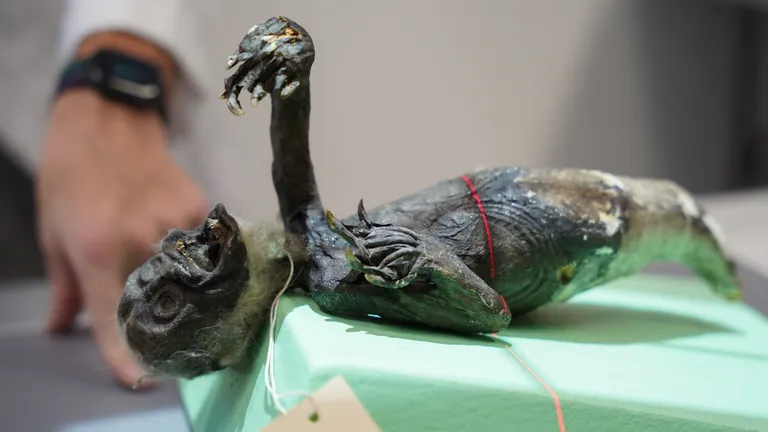
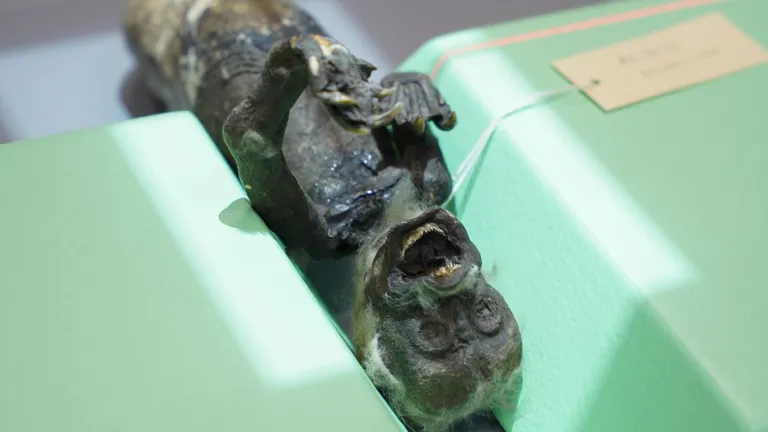
For decades, an eerie 12-inch, or 30.5-centimeter, figure lay inside a wooden box at the Enjuin temple in Japan. The current head priest discovered the artifact inside a temple safe roughly 40 years ago. With a primate-like face, mammalian hair, and a scaly fish tail, the object appeared to be a mermaid caught in the ocean.
A handwritten note stored alongside the specimen claimed it was captured in a fishing net between 1736 and 1741. The dried figure prompted a team of modern scientists to investigate its biological origins. The findings from the scientific investigation completely contradicted the historical claims made by the accompanying note.
Looking Inside the Creature
In 2022, researchers from the Kurashiki University of Science and the Arts secured permission from the temple to examine the artifact. The scientific team subjected the mummy to a battery of modern tests, including X-rays, CT scans, radiocarbon dating, and electron microscopy.
Initial visual inspections suggested it might be an elaborate taxidermy creation made by seamlessly sewing a monkey torso to a fish. The advanced imaging equipment quickly proved this theory wrong. The X-rays and CT scans clearly revealed that the upper body contained absolutely no skeletal structure.
A Carefully Constructed Object
The detailed internal scans showed exactly how the 12-inch, or 30.5-centimeter, figure was constructed. The interior core of the upper body consisted entirely of tightly packed cloth, paper, and cotton held together with metal pins. The creator coated this artificial torso in a paste made from a mixture of sand and charcoal powder.
To give the creature a realistic exterior texture, the arms, shoulders, neck, and cheeks were covered in the skin of a pufferfish. The hair attached to the head belonged to an unidentified mammal, and the sharp claws on the hands were carved from animal keratin.
Genuine Bones and Radiocarbon Dating
While the upper body was manufactured from inanimate materials and skin, the creator used actual animal parts to construct the rest of the object. The lower half of the mummy consists of the real tail and fins of a croaker fish. The only actual bone found in the entire specimen is a jawbone complete with tiny, sharp teeth. Biological analysis determined that this jawbone belonged to a carnivorous fish.
The researchers also extracted scales from the lower half of the creature for radiocarbon dating to verify the handwritten note. The scientific dating process determined that the scales did not date back to the 1700s. The results revealed that the object was manufactured much later, placing its creation firmly in the late 1800s. The temple continues to safely store the artifact, and the complete findings of the scientific investigation were published in February 2023.