
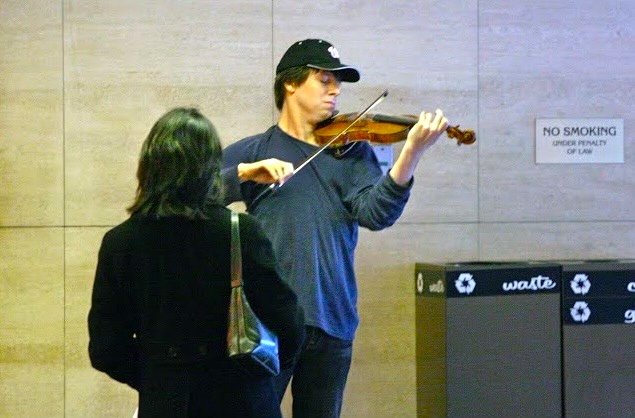
On a cold Friday morning in January 2007, one of the most famous classical musicians on the planet stood next to a trash can inside a busy Washington, D.C. subway station. Wearing a baseball cap and a long-sleeved T-shirt, Joshua Bell pulled a $3.5 million antique violin from its case and performed an unannounced concert for the morning rush-hour crowd.
Over the next 43 minutes, more than a thousand commuters walked straight past a master musician who usually packed prestigious concert halls around the globe, setting off a hidden-camera experiment that tracked every glance, pause, and dollar.
The Washington Post Sets Up the L’Enfant Plaza Experiment
Three days before stepping into the subway, Joshua Bell had performed to a full house at Symphony Hall in Boston, where standard seats cost $100. Journalist Gene Weingarten of The Washington Post arranged for the acclaimed violinist to play incognito as a street busker at L’Enfant Plaza station on January 12, 2007.
At 7:51 a.m., Bell positioned himself at the top of the escalators, opened his case for tips, and tossed in a few starter dollars. In his hands was the 1713 Gibson ex-Huberman Stradivarius, a rare handcrafted instrument made in Cremona, Italy. A hidden camera recorded every commuter who walked through the concourse.
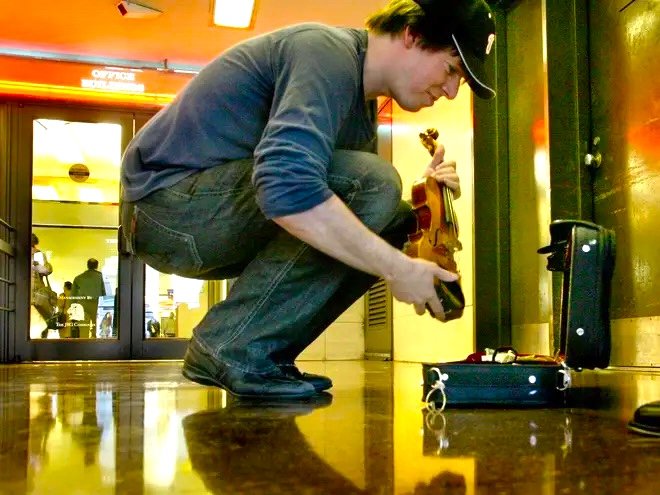
Forty-Three Minutes of Bach During the Morning Rush Hour
Bell opened his set with the “Chaconne” from Johann Sebastian Bach’s Partita No. 2 in D Minor, one of the most technically demanding violin compositions ever written. Across 43 minutes, he played six classical pieces, including Franz Schubert’s “Ave Maria.”
During the performance, 1,097 people walked past him, with many passing within 3 feet (0.9 meters) of his bow. For the first three minutes, 63 commuters walked by without looking. Then, a middle-aged man briefly slowed his pace and turned his head. Thirty seconds later, a woman dropped a single dollar into the open case without breaking her stride. It took six minutes before the first person stopped and leaned against a wall to listen.
Seven Listeners, Thirty-Two Dollars, and One Familiar Face
Throughout the session, no crowd formed, and nobody clapped when a piece ended. Out of the 1,097 commuters, only seven people stopped to listen for at least a minute. Every child who walked past tried to stop and watch, and every parent hurried their child away.
Twenty-seven passersby contributed money, mostly tossing coins and bills on the move, totaling $32.17. Near the end of the performance, Stacy Furukawa, a Commerce Department employee who had attended a free Joshua Bell concert at the Library of Congress three weeks earlier, recognized him. She stood 10 feet (3 meters) away until he finished, introduced herself, and handed him a $20 bill. Weingarten published the article on April 8, 2007, winning the 2008 Pulitzer Prize for Feature Writing.