
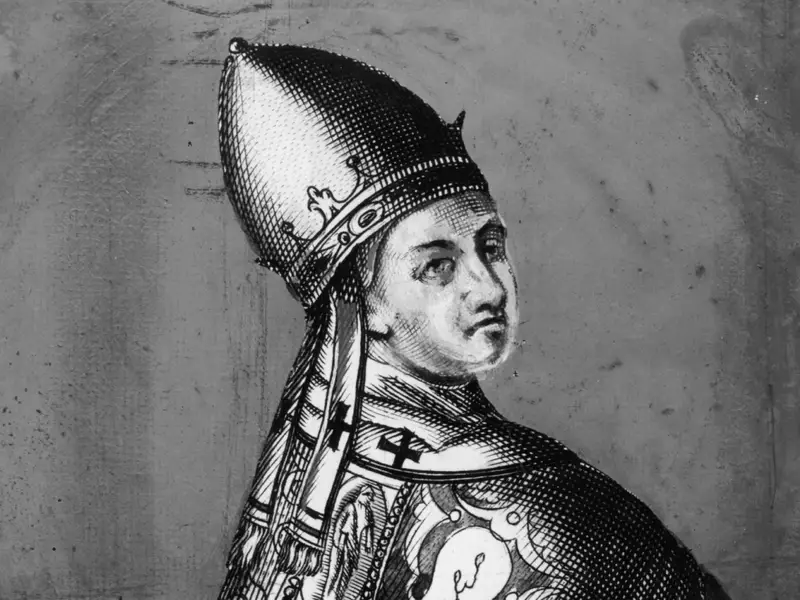
In October 1032, a young man named Theophylact of Tusculum ascended to the highest position in the Catholic Church through financial bribery arranged by his father. Historians record that he was approximately twenty years old, making him one of the youngest popes to ever rule the Papal States.
Over the next sixteen years, his actions triggered massive civil revolts, led to the simultaneous rule of three rival popes, and resulted in an unprecedented series of events. He became the only individual in history to serve as pope across three separate terms, and the only person ever documented to have put the papacy up for sale.
Bribery, Revolts, and the First Ouster
Benedict IX began his first pontificate amidst heavy political hostility in Rome. His family, the powerful counts of Tusculum, secured his position through direct financial payouts to the Roman citizens. However, his actions quickly alienated the local population and political factions.
By September 1044, an uprising forced Benedict out of Rome. The citizens elected a rival, Sylvester III, to take his place. This displacement did not last long. In April 1045, Benedict marshaled his military forces, returned to the city, and successfully expelled Sylvester to reclaim the papal throne for his second term.
Selling the Sacred Throne for Marriage
Shortly after regaining power, Benedict faced severe doubts about his ability to maintain control, and he wished to marry his cousin. To resolve this situation, he approached his godfather, a priest named John Gratian.
Benedict offered to resign the papacy on one condition: Gratian had to fully reimburse him for his original election expenses. Gratian agreed to the financial transaction, paid the required sum, and assumed power under the name Gregory VI. This transaction stands as the only recorded instance of a pope selling the office.
The Battle of the Three Popes
Benedict quickly regretted his decision to resign. He returned to Rome with his loyal supporters, seized control, and attempted to depose his godfather. This created a crisis where three different men—Benedict IX, Sylvester III, and Gregory VI—all claimed to be the legitimate bishop of Rome.
The situation forced influential clergymen to appeal to King Henry III of Germany for intervention. Henry marched his army across the Alps and convened the Council of Sutri in December 1046. The council deposed both Benedict and Sylvester, while forcing Gregory to resign due to the financial arrangement.
The Final Term and Excommunication
Henry III installed Clement II as the new pope, but the conflicts did not end there. When Clement died in October 1047, Benedict utilized the power vacuum to seize the Lateran Palace, commencing his third distinct term. German troops finally forced him out permanently in July 1048.
Damasus II was elected to replace him, and Benedict was excommunicated in 1049 after refusing to face formal charges of simony. He eventually abandoned his claims and died around 1056.