
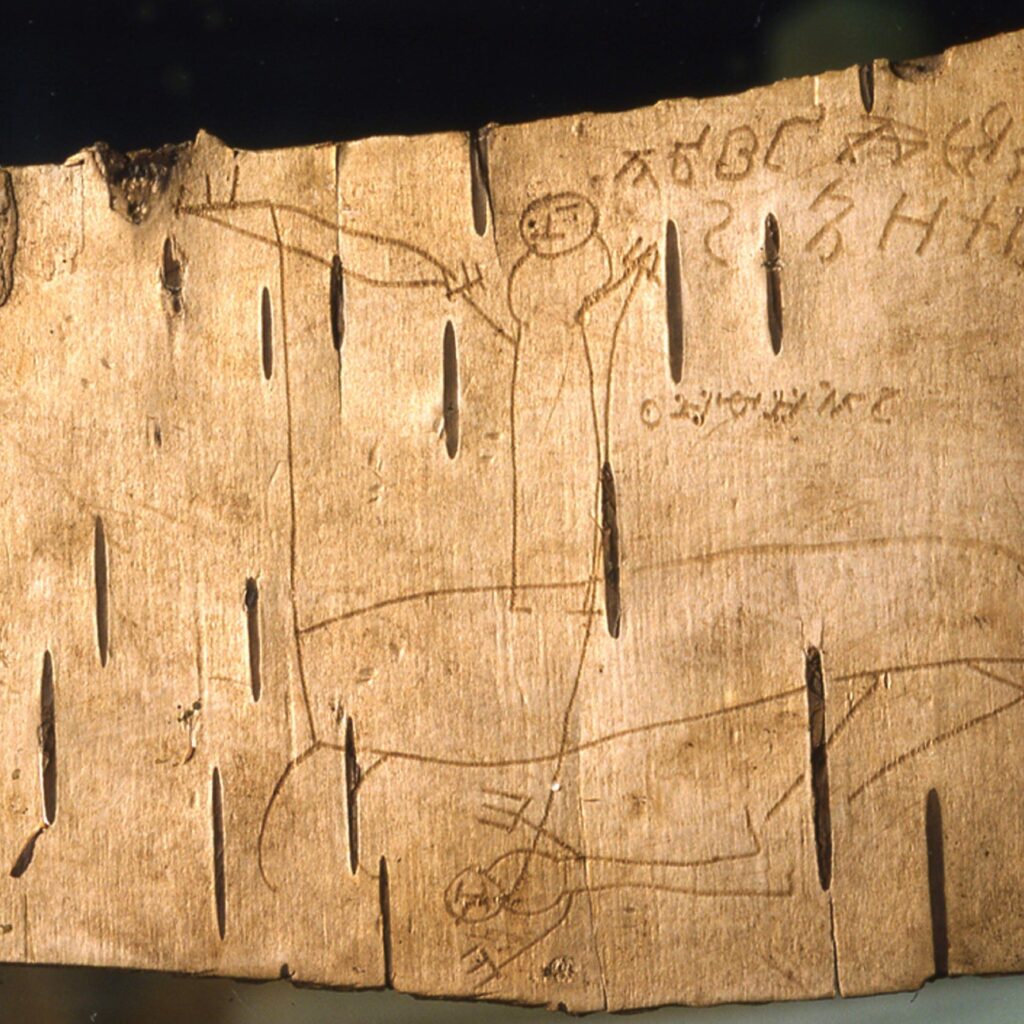
In 1951, archaeologists excavating the wet clay soil of Novgorod discovered a collection of extraordinary documents detailing knights, wild beasts, and spelling exercises. These artifacts do not belong to a military general, but to a six- or seven-year-old boy named Onfim.
Living in medieval Russia during the 13th century, Onfim left behind a vivid and factual record of his schoolwork and daydreams. Discovering these ancient notes offers a direct look into the daily education of a child from centuries past, revealing a world of alphabets, monsters, and messages sent to classmates.
Scraping Letters Into Soft Bark
Onfim lived sometime around 1220 or 1260 in the capital of the Novgorod Republic, an area located approximately 200 kilometers south of Saint Petersburg. During this historical period, the local population frequently used the bark of the surrounding birch forests as a writing surface because it was soft and easily scratched using specialized styluses. The dense clay soil of the region perfectly preserved these items until their modern discovery.
Researchers refer to these birch bark manuscripts as beresta, and the specific academic field dedicated to studying them is called berestology. Since the initial discoveries, experts have unearthed more than 1,100 pieces of written birch bark in Novgorod, indicating a widely literate society where both sexes and different classes could read.
A Roster of Knights and Monsters
Archaeologists have recovered exactly seventeen known birch bark items attributed directly to Onfim. Twelve of these historical fragments feature illustrations, while the remaining five contain only text. One drawing depicts a knight riding a horse and stabbing a fallen person with a lance, with the boy’s name written directly next to the figure.
Another piece, identified as item 199, was originally crafted as the bottom of a birch bark basket. This piece shows a four-legged creature with a curly tail, pointy ears, and a long neck. This beast appears to have a feathered arrow in its mouth or is spewing fire, accompanied by the carved text stating “I am a wild beast”.
The Struggle of Thirteenth-Century Education
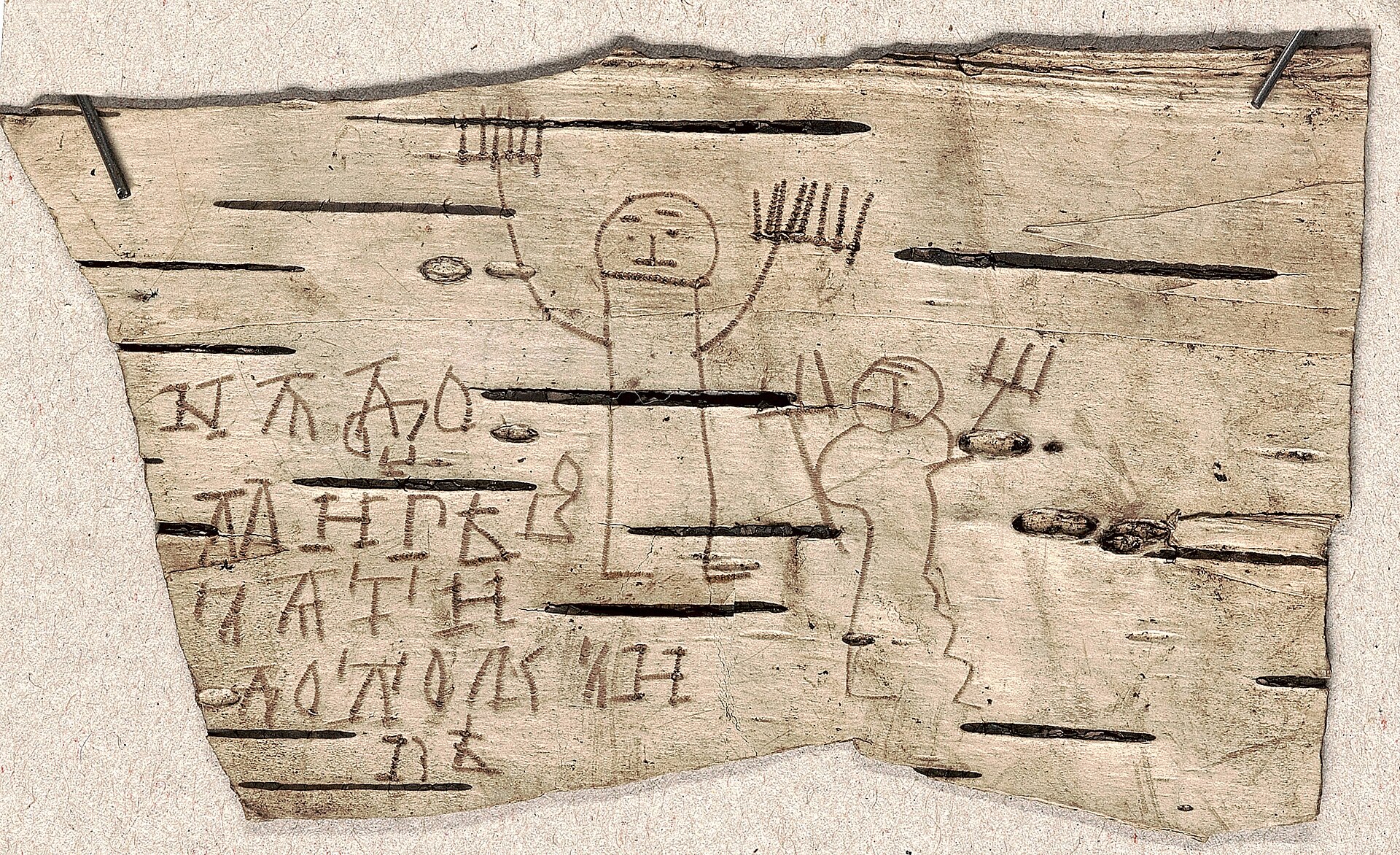
Beyond his artistic drawings, Onfim’s birch bark pieces contain his actual school assignments. He wrote in the Old Novgorod dialect, practicing the Cyrillic alphabet, repeating syllables, and copying out known religious texts. His writings include the phrase “Lord, help your servant Onfim” and specific fragments from Psalms 6:2 and 27:3.
Onfim also wrote a message reading “Greetings from Onfim to Danilo,” who researchers believe was a friend or classmate. He even drew a boat with oars on item 205 and portraits of himself and his friends on item 206. His drawings of people feature hands with anywhere from three to eight fingers, showing that while he was practicing his letters, he had not yet learned how to count.