
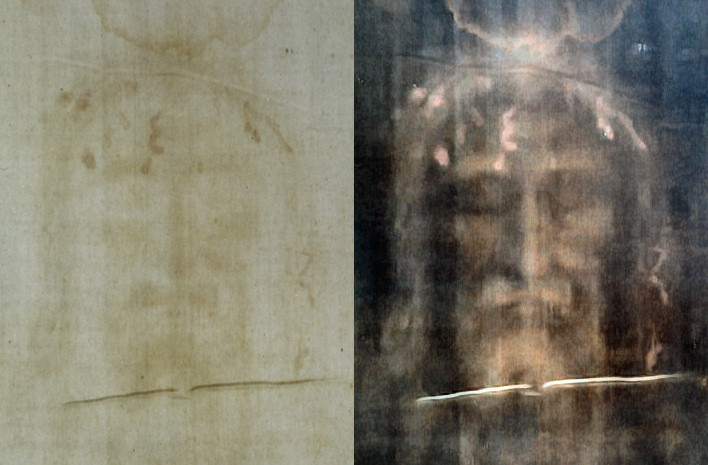
A faintly stained 14-foot, 3-inch (4.34-meter) linen cloth kept in Italy bears the image of a crucified man. For centuries, many have believed this fabric, known as the Shroud of Turin, is the actual burial garment of Jesus Christ. It features marks matching the biblical wounds of Jesus of Nazareth, including a crown of thorns.
Modern scientific technology has stepped in to find the truth, but the resulting data has sparked a fierce debate. Some cutting-edge X-ray studies suggest the cloth is 2,000 years old, while recent virtual simulations claim it is medieval art.
The Physical Imprint of Jesus
Since 1578, the Shroud has remained in Turin, Italy. The linen measures 14 feet, 3 inches (4.34 meters) long and 3 feet, 7 inches (1.09 meters) wide. It displays the front and back of a bearded man with shoulder-length hair standing roughly 5 feet, 7 inches (1.70 meters) tall.
Stains on the fabric align directly with the physical trauma Jesus Christ endured at Golgotha. The documented history of this item officially began in 1355 in France, before the royal House of Savoy acquired it in 1453.
Carbon Dating Versus Trauma Chemistry
In 1988, scientists tested the fabric using radiocarbon dating. The results dated the linen to between 1260 and 1390 C.E., pointing to a medieval origin. Other researchers quickly questioned these findings, arguing that historical repairs or contamination skewed the radiocarbon measurements.
Forensic experts later discovered high levels of creatinine and ferritin on the cloth. Human bodies typically release these chemical substances during severe physical trauma, which directly aligns with the physiological state of Jesus Christ during a crucifixion.
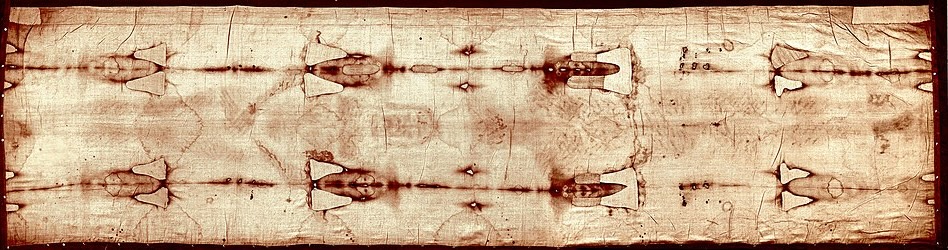
X-Ray Analysis of Cellulose Aging
A 2022 study published in the journal Heritage utilized X-ray technology to inspect the linen fibers. The researchers analyzed the natural degradation of the cellulose and found the decay compatible with a 2,000-year-old fabric. This specific aging timeline required strict environmental conditions.
The cloth would have needed continuous storage at an average temperature of 68 to 72 degrees Fahrenheit (20 to 22.2 degrees Celsius) and a humidity level of 55 to 75 percent for 13 centuries before it officially emerged in the historical record.
Virtual Simulations Challenge the Relic
In 2024, Brazilian graphics expert Cicero Moraes conducted a new examination using three-dimensional virtual simulations. Moraes draped a digital fabric over a 3D human body to observe how blood stains would transfer.
The simulation demonstrated that wrapping a real 3D object creates a heavily distorted, swollen image when the fabric lies flat. The Shroud features a flat, perfectly proportioned figure completely lacking prints on the torso and neck. Moraes concluded that the image on the cloth is Christian art rather than a physical imprint left by Jesus Christ.