
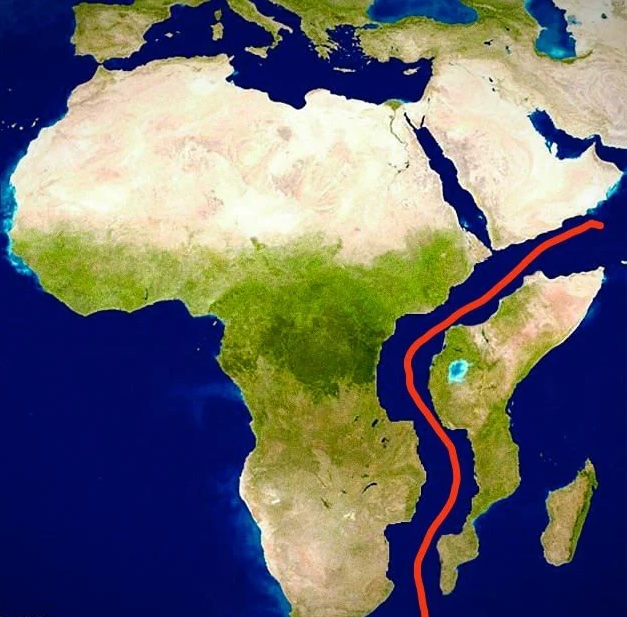
Earth has seven continents, but massive tectonic forces are actively tearing one apart. Africa is slowly splitting in two, a geological event that will eventually birth a new ocean. Geologists have tracked this continental divide for two decades, noting severe surface fractures, volcanic eruptions, and earthquakes. The map of our world is changing beneath our feet.
The First Fissure Tears Through Ethiopia
The scientific community witnessed the surface impact of this divide in 2005. An earthquake swarm struck Ethiopia’s Afar region, triggered by an eruption at the Dabbahu volcano. Over a few days, a massive crack ripped open the ground. This fissure stretched 35 miles (56.3 kilometers) long and opened 20 feet (6.1 meters) wide. Magma from the Earth’s mantle rose to fill the gaps. Cindy Ebinger, a professor at the University of Rochester, noted this mirrors how seafloor ridges are created. The African and Arabian tectonic plates have been drifting apart for 30 million years, but this event brought the expansion to the crust.
The East African Rift System
The Ethiopian fracture connects to the East African Rift System. This geological feature is 22 million years old and stretches 4,000 miles (6,437 kilometers) from Jordan to Mozambique. The rift marks where the Arabian plate and two parts of the African plate, the Nubian and Somali plates, are pulling away from each other. Heat from the asthenosphere forces the crust to expand and fracture. The plates separate at a rate of half an inch (1.27 centimeters) per year.
A Sudden Crack Appears in Kenya
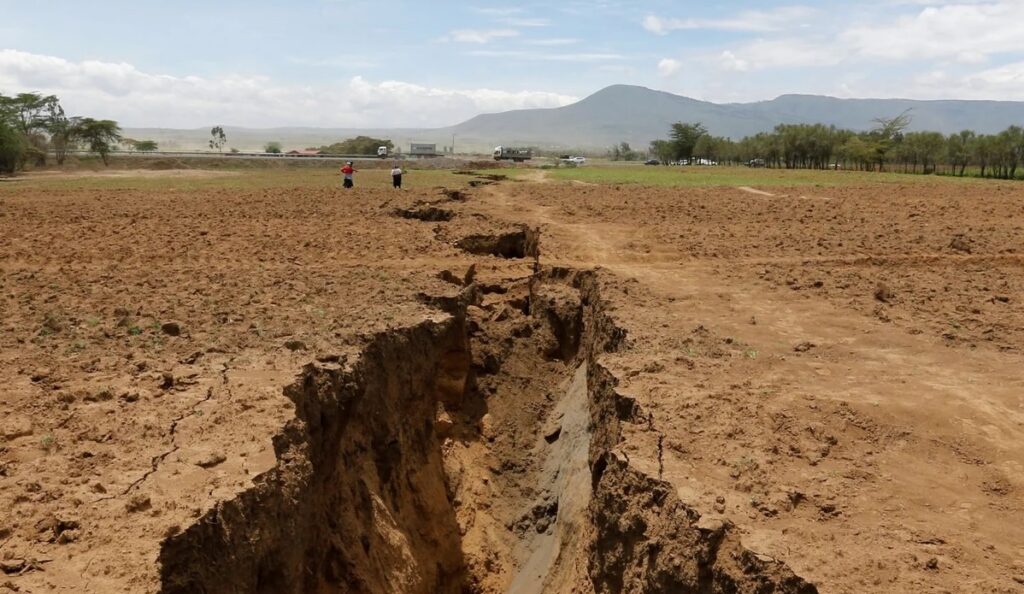
In March 2018, another ground fracture appeared in Kenya near Mai Mahiu. The chasm measured 50 feet (15.2 meters) deep and 65 feet (19.8 meters) wide. It damaged the Narok-Nairobi highway and forced evacuations in the Suswa area. Initially attributed to tectonic activity, geologists later determined this specific crack was an erosional gully. Heavy rainfall weakened the volcanic soils, causing the ground to collapse. However, this collapse still occurred directly along the active East African Rift.
The Birth of a Sixth Ocean
As the Nubian and Somali plates diverge, the rift will widen. Eventually, oceanic waters will flood the valley, separating eastern Africa from the continent and creating a sixth ocean. A 2024 study published in Frontiers in Earth Science explored this trajectory. According to researcher Ken Macdonald of the University of California, Santa Barbara, the ocean could intrude in just one to five million years. While humans will not see the final geographic split, the ongoing process will continue to cause significant earthquakes and volcanic eruptions.